



 Chat with AI
Exam 25: Production and Growth

Exam 1: Ten Principles of Economics220 Questions
Exam 2: Thinking Like an Economist284 Questions
Exam 3: Interdependence and the Gains From Trade192 Questions
Exam 4: The Market Forces of Supply and Demand277 Questions
Exam 5: Elasticity and Its Application222 Questions
Exam 6: Supply, Demand, and Government Policies321 Questions
Exam 7: Consumers, Producers, and the Efficiency of Markets218 Questions
Exam 8: Applications: The Costs of Taxation203 Questions
Exam 9: Application: International Trade214 Questions
Exam 10: Externalities204 Questions
Exam 11: Public Goods and Common Resources182 Questions
Exam 12: The Design of the Tax System225 Questions
Exam 13: The Costs of Production261 Questions
Exam 14: Firms in Competitive Markets243 Questions
Exam 15: Monopoly231 Questions
Exam 16: Monopolistic Competition246 Questions
Exam 17: Oligopoly204 Questions
Exam 18: The Markets for the Factors of Production232 Questions
Exam 19: Earnings and Discrimination230 Questions
Exam 20: Income Inequality and Poverty194 Questions
Exam 21: The Theory of Consumer Choice209 Questions
Exam 22: Frontiers in Microeconomics185 Questions
Exam 23: Measuring a Nations Income231 Questions
Exam 24: Measuring the Cost of Living214 Questions
Exam 25: Production and Growth187 Questions
Exam 26: Saving, Investment, and the Financial System225 Questions
Exam 27: Tools of Finance198 Questions
Exam 28: Unemployment and Its Natural Rate361 Questions
Exam 29: The Monetary System210 Questions
Exam 30: Money Growth and Inflation201 Questions
Exam 31: Open-Economy Macroeconomics: Basic Concepts194 Questions
Exam 32: A Macroeconomic Theory of the Open Economy188 Questions
Exam 33: Aggregate Demand and Aggregate Supply189 Questions
Exam 34: The Influence of Monetary and Fiscal Policy on Aggregate Demand207 Questions
Exam 35: The Short-Run Tradeoff Between Inflation and Unemployment223 Questions
Exam 36: Six Debates Over Macroeconomic Policy154 Questions
Select questions type


Petroleum is an example of a nonrenewable resource.

Free
(True/False)
4.9/5  (74)
(74) Correct Answer: Verified
True
If a production function has the property called __________, then doubling all inputs causes the amount of output to double as well.
Free
(Short Answer)
4.9/5 (71)
(71) Correct Answer:Verified
Verifiedconstant returns to scale
International data on the history of real GDP growth rates shows that over the last 120 years or so, rich countries got richer and poor countries got poorer.
Free
(True/False)
4.7/5 (96)
(96) Correct Answer:Verified
VerifiedFalse
In countries where women are discriminated against, policies that increase the likelihood of career success and educational opportunities for women are likely to decrease the birth rate.
(True/False)
4.8/5 (90)
(90) In order to assess the level of prosperity in a nation in a given year, should we examine the level of that nation's real GDP per person, or should we examine the growth rate of that nation's real GDP per person?
(Essay)
4.9/5 (75)
(75) Human capital is the term economists use to refer to the knowledge and skills that workers acquire through education, training, and experience.
(True/False)
4.9/5 (86)
(86) Figure 25-2
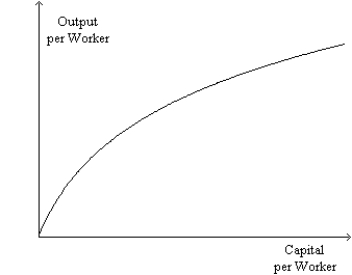
-Refer to Figure 25-2. In what way is the figure relevant to the catch-up effect?
-Refer to Figure 25-2. In what way is the figure relevant to the catch-up effect? (Essay)
4.9/5 (68)
(68) Consider the nations of India, Indonesia, and Japan. Over the past century, which of these three nations has experienced, by far, more rapid economic growth than the other two nations?
(Essay)
4.8/5 (95)
(95) A country with a relatively low level of real GDP per person is considering adopting two policies to promote economic growth. The first is to decrease barriers to trade. The second is to restrict foreign portfolio investment. Which of these policies do most economists say promote growth?
(Multiple Choice)
4.8/5 (78)
(78) Constant returns to scale is the point on a production function where increasing inputs will no longer increase output.
(True/False)
4.8/5 (81)
(81) In 2014 income per person in the United States was about 10 times that in India.
(True/False)
4.9/5 (68)
(68) The dictator of Turan has recently begun to arbitrarily seize farms belonging to his political opponents, and he has given the farms to his friends. His friends don't know much about farming. The courts in Turan have ruled that the seizures are illegal, but the dictator has ignored the rulings. Other things equal, we would expect that the growth rate in Turan will
(Multiple Choice)
4.9/5 (80)
(80) The catch-up effect refers to the idea that poor countries, despite their best efforts, are not likely ever to experience the economic growth rates of wealthier countries.
(True/False)
4.9/5 (65)
(65) Why do we refer to physical capital as a produced factor of production?
(Essay)
4.7/5 (70)
(70) Which of the following countries benefited significantly from the catch-up effect in the last half of the twentieth century?
(Multiple Choice)
4.8/5 (71)
(71) Like physical capital, human capital is a produced factor of production.
(True/False)
4.7/5 (84)
(84) In recent decades, economic growth has been much more rapid in South Korea than in the United States. What is the likely explanation for this fact?
(Essay)
4.8/5 (78)
(78) 
Filters
- Essay(0)
- Multiple Choice(0)
- Short Answer(0)
- True False(0)
- Matching(0)