



 Chat with AI
Exam 25: Production and Growth

Exam 1: Ten Principles of Economics220 Questions
Exam 2: Thinking Like an Economist284 Questions
Exam 3: Interdependence and the Gains From Trade192 Questions
Exam 4: The Market Forces of Supply and Demand277 Questions
Exam 5: Elasticity and Its Application222 Questions
Exam 6: Supply, Demand, and Government Policies321 Questions
Exam 7: Consumers, Producers, and the Efficiency of Markets218 Questions
Exam 8: Applications: The Costs of Taxation203 Questions
Exam 9: Application: International Trade214 Questions
Exam 10: Externalities204 Questions
Exam 11: Public Goods and Common Resources182 Questions
Exam 12: The Design of the Tax System225 Questions
Exam 13: The Costs of Production261 Questions
Exam 14: Firms in Competitive Markets243 Questions
Exam 15: Monopoly231 Questions
Exam 16: Monopolistic Competition246 Questions
Exam 17: Oligopoly204 Questions
Exam 18: The Markets for the Factors of Production232 Questions
Exam 19: Earnings and Discrimination230 Questions
Exam 20: Income Inequality and Poverty194 Questions
Exam 21: The Theory of Consumer Choice209 Questions
Exam 22: Frontiers in Microeconomics185 Questions
Exam 23: Measuring a Nations Income231 Questions
Exam 24: Measuring the Cost of Living214 Questions
Exam 25: Production and Growth187 Questions
Exam 26: Saving, Investment, and the Financial System225 Questions
Exam 27: Tools of Finance198 Questions
Exam 28: Unemployment and Its Natural Rate361 Questions
Exam 29: The Monetary System210 Questions
Exam 30: Money Growth and Inflation201 Questions
Exam 31: Open-Economy Macroeconomics: Basic Concepts194 Questions
Exam 32: A Macroeconomic Theory of the Open Economy188 Questions
Exam 33: Aggregate Demand and Aggregate Supply189 Questions
Exam 34: The Influence of Monetary and Fiscal Policy on Aggregate Demand207 Questions
Exam 35: The Short-Run Tradeoff Between Inflation and Unemployment223 Questions
Exam 36: Six Debates Over Macroeconomic Policy154 Questions
Select questions type


Journey Motorcycles produced 100 motorcycles using 50 workers who each worked 8 hours a day. Journey's productivity was 1/4.
(True/False)
4.9/5  (73)
(73) The majority of economists believe that future innovations will not be transformational enough to sustain high economic growth rates in the U.S. and western Europe.
(True/False)
4.9/5 (74)
(74) Over the period 1900-2014, Brazil's rate of economic growth exceeded that of China.
(True/False)
4.9/5 (81)
(81) All else equal, if there are diminishing returns, then which of the following is true if a country increases its capital by one unit?
(Multiple Choice)
4.8/5 (89)
(89) When a country eliminates tariffs and other trade restrictions, intending to promote economic growth, it is pursuing _______-oriented policies.
(Short Answer)
4.7/5 (92)
(92) A country that made its courts less corrupt and its government more stable would likely see its standard of living rise.
(True/False)
4.8/5 (76)
(76) According to some estimates, over the last two decades China has had an annual average growth rate of about 12 percent.
(True/False)
4.8/5 (66)
(66) If over a short time there is an increase in the number of people retired and a decrease in the number of people working, then productivity
(Multiple Choice)
4.9/5 (75)
(75) If a country has a higher level of productivity than another, then it also has a higher level of real GDP.
(True/False)
4.8/5 (60)
(60) As capital per worker rises, output per worker rises. However, this increase in output per worker is smaller at smaller levels of existing capital per worker.
(True/False)
4.8/5 (81)
(81) Figure 25-2
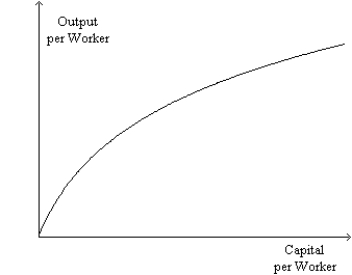
-Refer to Figure 25-2. Does the figure represent the idea that the amount of capital per worker influences the amount of output per worker, or does the figure represent the idea that the amount of output per worker influences the amount of capital per worker?
-Refer to Figure 25-2. Does the figure represent the idea that the amount of capital per worker influences the amount of output per worker, or does the figure represent the idea that the amount of output per worker influences the amount of capital per worker? (Essay)
4.8/5 (84)
(84) Keira is a farmer. Which of the following are included in her human capital?
(Multiple Choice)
4.8/5 (83)
(83) The same size decrease in the amount of capital stock per worker will cause output per worker to fall by more in a country with a relatively high level of capital per worker than in a country with a relatively low level of capital per worker.
(True/False)
4.8/5 (76)
(76) Assuming constant returns to scale, if two countries are otherwise the same, the one that is poorer grows faster.
(True/False)
4.7/5 (85)
(85) Figure 25-2
-Refer to Figure 25-2. In order for the figure to make sense, do we have to assume that capital is the only determinant of output? Briefly explain.
-Refer to Figure 25-2. In order for the figure to make sense, do we have to assume that capital is the only determinant of output? Briefly explain. (Essay)
4.8/5 (95)
(95) The equipment and structures available to produce goods and services are called
(Multiple Choice)
4.9/5 (71)
(71) A country's standard of living depends on its ability to produce goods and services.
(True/False)
4.8/5 (88)
(88) 
Filters
- Essay(0)
- Multiple Choice(0)
- Short Answer(0)
- True False(0)
- Matching(0)