



 Chat with AI
Exam 25: Production and Growth

Exam 1: Ten Principles of Economics220 Questions
Exam 2: Thinking Like an Economist284 Questions
Exam 3: Interdependence and the Gains From Trade192 Questions
Exam 4: The Market Forces of Supply and Demand277 Questions
Exam 5: Elasticity and Its Application222 Questions
Exam 6: Supply, Demand, and Government Policies321 Questions
Exam 7: Consumers, Producers, and the Efficiency of Markets218 Questions
Exam 8: Applications: The Costs of Taxation203 Questions
Exam 9: Application: International Trade214 Questions
Exam 10: Externalities204 Questions
Exam 11: Public Goods and Common Resources182 Questions
Exam 12: The Design of the Tax System225 Questions
Exam 13: The Costs of Production261 Questions
Exam 14: Firms in Competitive Markets243 Questions
Exam 15: Monopoly231 Questions
Exam 16: Monopolistic Competition246 Questions
Exam 17: Oligopoly204 Questions
Exam 18: The Markets for the Factors of Production232 Questions
Exam 19: Earnings and Discrimination230 Questions
Exam 20: Income Inequality and Poverty194 Questions
Exam 21: The Theory of Consumer Choice209 Questions
Exam 22: Frontiers in Microeconomics185 Questions
Exam 23: Measuring a Nations Income231 Questions
Exam 24: Measuring the Cost of Living214 Questions
Exam 25: Production and Growth187 Questions
Exam 26: Saving, Investment, and the Financial System225 Questions
Exam 27: Tools of Finance198 Questions
Exam 28: Unemployment and Its Natural Rate361 Questions
Exam 29: The Monetary System210 Questions
Exam 30: Money Growth and Inflation201 Questions
Exam 31: Open-Economy Macroeconomics: Basic Concepts194 Questions
Exam 32: A Macroeconomic Theory of the Open Economy188 Questions
Exam 33: Aggregate Demand and Aggregate Supply189 Questions
Exam 34: The Influence of Monetary and Fiscal Policy on Aggregate Demand207 Questions
Exam 35: The Short-Run Tradeoff Between Inflation and Unemployment223 Questions
Exam 36: Six Debates Over Macroeconomic Policy154 Questions
Select questions type


The catch-up effect says that countries with low income can grow faster than countries with higher income. However, in statistical studies that include many diverse countries we do not observe the catch-up-effect unless we control for other variables that affect productivity. Considering the determinants of productivity, list and explain some things that would tend to prohibit or limit a poor country's ability to catch up with the rich ones.
(Essay)
4.8/5  (74)
(74) What do we mean when we say that some technological knowledge is not proprietary?
(Essay)
4.7/5 (78)
(78) Studies have found that there is a relationship between height and productivity. Briefly explain.
(Essay)
4.9/5 (89)
(89) Which one of the factors of production originates as an output from the production process, and is subsequently used as an input into the production process?
(Short Answer)
4.8/5 (63)
(63) Real GDP per person in rich countries, such as Germany, is sometimes more than 10 times that of poor countries like India.
(True/False)
4.9/5 (95)
(95) Consider the nations of China, Japan, and the United States. Over the past century, which of these nations has progressed, in an economic sense, more rapidly than the other two nations?
(Essay)
4.8/5 (94)
(94) The behavior of market prices over time indicates that natural resources are
(Multiple Choice)
4.7/5 (87)
(87) Over the last 140 years or so, on average Canada's real GDP per-person grew faster than that of the U.K.
(True/False)
4.9/5 (76)
(76) If Country A produces 7,000 units of goods and services using 700 hours of labor, and if Country B produces 5,500 units of goods and services using 500 units of labor, then productivity is lower in Country A than in Country B.
(True/False)
4.9/5 (80)
(80) John and Miguel are fishermen. When they go fishing, John consistently catches 2 or 3 fish per hour, while Miguel consistently catches 5 or 6 fish per hour. Miguel's __________ exceeds that of John.
(Short Answer)
4.7/5 (79)
(79) Increases in both human capital per worker and physical capital per worker increase productivity.
(True/False)
4.8/5 (78)
(78) Suppose Japanese-based Toshiba Corporation builds and operates a new computer factory in the United States. Future production from such an investment will
(Multiple Choice)
5.0/5 (89)
(89) An organization that tries to encourage the flow of investment from advanced countries to poor countries is the
(Multiple Choice)
4.7/5 (88)
(88) Consider the production function Y=2F(L,K,H,N). Suppose F(12, 10, 9, 7) = 100 and F(24, 20, 18, 14) = 180. Does the production function have the property of constant returns to scale? Why or why not?
(Essay)
4.9/5 (64)
(64) Out of the following economic statistics, which is the best measure of economic prosperity?
(Multiple Choice)
4.9/5 (80)
(80) Foreign direct investment and domestic investment have the same effect on all measures of economic prosperity.
(True/False)
4.8/5 (72)
(72) Figure 25-2
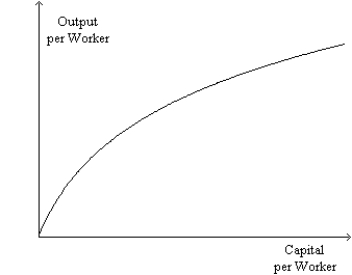
-Refer to Figure 25-2. "When the amount of capital per worker increases by one unit, a poor country experiences a greater benefit than does a rich country." Does the figure illustrate this notion? Briefly explain.
-Refer to Figure 25-2. "When the amount of capital per worker increases by one unit, a poor country experiences a greater benefit than does a rich country." Does the figure illustrate this notion? Briefly explain. (Essay)
4.9/5 (86)
(86) 
Filters
- Essay(0)
- Multiple Choice(0)
- Short Answer(0)
- True False(0)
- Matching(0)