



 Chat with AI
Exam 3: Interdependence and the Gains From Trade

Exam 1: Ten Principles of Economics220 Questions
Exam 2: Thinking Like an Economist284 Questions
Exam 3: Interdependence and the Gains From Trade192 Questions
Exam 4: The Market Forces of Supply and Demand277 Questions
Exam 5: Elasticity and Its Application222 Questions
Exam 6: Supply, Demand, and Government Policies321 Questions
Exam 7: Consumers, Producers, and the Efficiency of Markets218 Questions
Exam 8: Applications: The Costs of Taxation203 Questions
Exam 9: Application: International Trade214 Questions
Exam 10: Externalities204 Questions
Exam 11: Public Goods and Common Resources182 Questions
Exam 12: The Design of the Tax System225 Questions
Exam 13: The Costs of Production261 Questions
Exam 14: Firms in Competitive Markets243 Questions
Exam 15: Monopoly231 Questions
Exam 16: Monopolistic Competition246 Questions
Exam 17: Oligopoly204 Questions
Exam 18: The Markets for the Factors of Production232 Questions
Exam 19: Earnings and Discrimination230 Questions
Exam 20: Income Inequality and Poverty194 Questions
Exam 21: The Theory of Consumer Choice209 Questions
Exam 22: Frontiers in Microeconomics185 Questions
Exam 23: Measuring a Nations Income231 Questions
Exam 24: Measuring the Cost of Living214 Questions
Exam 25: Production and Growth187 Questions
Exam 26: Saving, Investment, and the Financial System225 Questions
Exam 27: Tools of Finance198 Questions
Exam 28: Unemployment and Its Natural Rate361 Questions
Exam 29: The Monetary System210 Questions
Exam 30: Money Growth and Inflation201 Questions
Exam 31: Open-Economy Macroeconomics: Basic Concepts194 Questions
Exam 32: A Macroeconomic Theory of the Open Economy188 Questions
Exam 33: Aggregate Demand and Aggregate Supply189 Questions
Exam 34: The Influence of Monetary and Fiscal Policy on Aggregate Demand207 Questions
Exam 35: The Short-Run Tradeoff Between Inflation and Unemployment223 Questions
Exam 36: Six Debates Over Macroeconomic Policy154 Questions
Select questions type


Adam Smith was the author of the 1776 book An Inquiry into the Nature and Causes of the Wealth of Nations.
(True/False)
5.0/5  (66)
(66) Table 3-7
Barb and Ren run a business that sets up and tests computers. Assume that Barb and Ren can switch between setting up and testing computers at a constant rate. The following table applies.
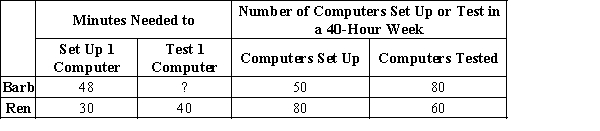 -Refer to Table 3-7. The number of minutes needed by Barb to test a computer is
 (Multiple Choice)
4.8/5 (84)
(84) Suppose that in one hour Dewey can produce either 10 bushels of corn or 20 yards of cloth. Dewey's opportunity cost of producing one bushel of corn is 1/2 yard of cloth.
(True/False)
4.9/5 (82)
(82) With eight hours of work Elmer can produce 20 pounds of carrots or 15 pounds of peas. With eight hours Bugs can produce 10 pounds of carrots or 7.5 pounds of peas. Can Elmer and Bugs gain from trade? Defend your answer.
(Essay)
4.8/5 (85)
(85) Figure 3-4
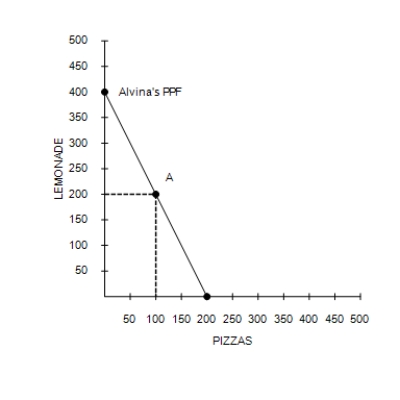
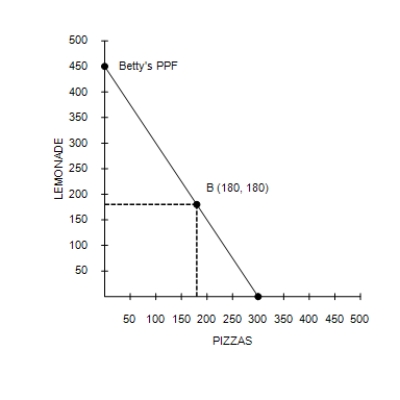 -Refer to Figure 3-4. If Betty produces only pizzas, she can produce
 (Multiple Choice)
4.8/5 (85)
(85) For both parties to gain from trade, the price at which they trade must lie between the two opportunity costs.
(True/False)
4.7/5 (76)
(76) Figure 3-3
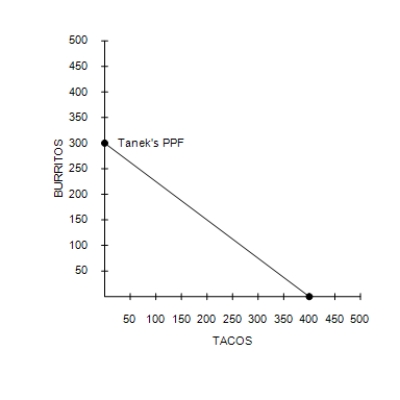
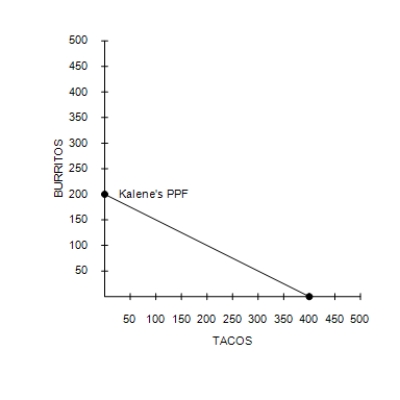 -Refer to Figure 3-3. If Tanek and Kalene both spend all of their time producing burritos, then total production is
 (Multiple Choice)
4.9/5 (86)
(86) Economists use the term ______ to refer to the ability to produce a good using fewer inputs than another producer.
(Short Answer)
4.8/5 (76)
(76) If Iowa's opportunity cost of corn is lower than Oklahoma's opportunity cost of corn, then
(Multiple Choice)
4.9/5 (83)
(83) Two countries can achieve gains from trade even if one country has an absolute advantage in the production of both goods.
(True/False)
4.8/5 (95)
(95) Zora can produce 4 quilts in a week and she can produce 1 corporate website in a week. Lou can produce 9 quilts in a week and he can produce 2 corporate websites in a week. Zora has the comparative advantage in quilts and the absolute advantage in neither good, while Lou has the comparative advantage in corporate websites and the absolute advantage in both goods.
(True/False)
4.9/5 (82)
(82) Scenario 3-1
In country A a worker who works 40 hours can produce 200 pounds of rice or 100 pounds of broccoli. In country B a worker who works 40 hours can produce 160 pounds of rice or 120 pounds of broccoli.
-Refer to Scenario 3-1. Which country, if either, has a comparative advantage producing rice? Defend your answer using the numbers given.
(Essay)
4.8/5 (69)
(69) If one producer has the absolute advantage in the production of all goods, then that same producer will have the comparative advantage in the production of all goods as well.
(True/False)
4.9/5 (87)
(87) Frank can make 20 hot dogs an hour or 10 pints of potato salad an hour. Earnest can make 30 hot dogs an hour or 20 pints of potato salad an hour. Who has the comparative advantage making hot dogs and who has the comparative advantage making potato salad?
(Essay)
5.0/5 (71)
(71) If one producer is able to produce a good at a lower opportunity cost than some other producer, then the producer with the lower opportunity cost is said to have an absolute advantage in the production of that good.
(True/False)
4.7/5 (76)
(76) Figure 3-7
Mary's Production Possibilities Frontier Kate's Production Possibilities Frontier 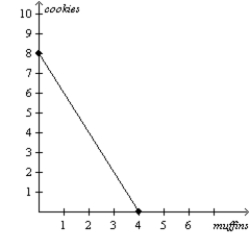
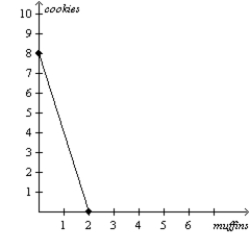
-Refer to Figure 3-7. What is Kate's opportunity cost of one muffin?
-Refer to Figure 3-7. What is Kate's opportunity cost of one muffin? (Short Answer)
4.8/5 (79)
(79) Figure 3-2
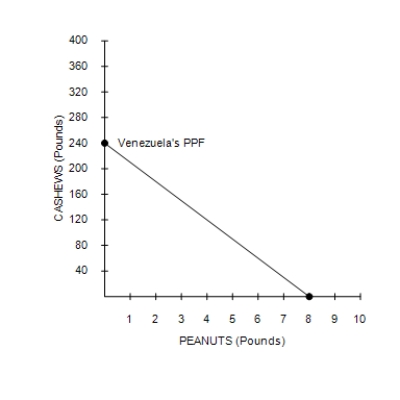 -Refer to Figure 3-2. If the production possibilities frontier shown is for 48 hours of production, then how long does it take Venezuela to make one pound of cashews?
 (Multiple Choice)
5.0/5 (72)
(72) Suppose the United States has a comparative advantage over Mexico in producing pork. The principle of comparative advantage asserts that
(Multiple Choice)
4.9/5 (77)
(77) Figure 3-7
Mary's Production Possibilities Frontier Kate's Production Possibilities Frontier
-Refer to Figure 3-7. Who has a comparative advantage in making cookies?
-Refer to Figure 3-7. Who has a comparative advantage in making cookies? (Short Answer)
4.8/5 (78)
(78) Both Jarek and Kalene produce hair scarves and necklaces. However, Kalene is better at producing both goods. In this case, trade could
(Multiple Choice)
4.9/5 (77)
(77) 
Filters
- Essay(0)
- Multiple Choice(0)
- Short Answer(0)
- True False(0)
- Matching(0)