



 Chat with AI
Exam 10: Externalities

Exam 1: Ten Principles of Economics220 Questions
Exam 2: Thinking Like an Economist284 Questions
Exam 3: Interdependence and the Gains From Trade192 Questions
Exam 4: The Market Forces of Supply and Demand277 Questions
Exam 5: Elasticity and Its Application222 Questions
Exam 6: Supply, Demand, and Government Policies321 Questions
Exam 7: Consumers, Producers, and the Efficiency of Markets218 Questions
Exam 8: Applications: The Costs of Taxation203 Questions
Exam 9: Application: International Trade214 Questions
Exam 10: Externalities204 Questions
Exam 11: Public Goods and Common Resources182 Questions
Exam 12: The Design of the Tax System225 Questions
Exam 13: The Costs of Production261 Questions
Exam 14: Firms in Competitive Markets243 Questions
Exam 15: Monopoly231 Questions
Exam 16: Monopolistic Competition246 Questions
Exam 17: Oligopoly204 Questions
Exam 18: The Markets for the Factors of Production232 Questions
Exam 19: Earnings and Discrimination230 Questions
Exam 20: Income Inequality and Poverty194 Questions
Exam 21: The Theory of Consumer Choice209 Questions
Exam 22: Frontiers in Microeconomics185 Questions
Exam 23: Measuring a Nations Income231 Questions
Exam 24: Measuring the Cost of Living214 Questions
Exam 25: Production and Growth187 Questions
Exam 26: Saving, Investment, and the Financial System225 Questions
Exam 27: Tools of Finance198 Questions
Exam 28: Unemployment and Its Natural Rate361 Questions
Exam 29: The Monetary System210 Questions
Exam 30: Money Growth and Inflation201 Questions
Exam 31: Open-Economy Macroeconomics: Basic Concepts194 Questions
Exam 32: A Macroeconomic Theory of the Open Economy188 Questions
Exam 33: Aggregate Demand and Aggregate Supply189 Questions
Exam 34: The Influence of Monetary and Fiscal Policy on Aggregate Demand207 Questions
Exam 35: The Short-Run Tradeoff Between Inflation and Unemployment223 Questions
Exam 36: Six Debates Over Macroeconomic Policy154 Questions
Select questions type


Scenario 10-4
The demand curve for fire extinguishers slopes downward and the supply curve for fire extinguishers slopes upward. The production of the 500th fire extinguisher entails the following:
• a private cost of $10;
• an external cost of $0;
• a private value of $9;
• an external benefit of $3.
-Refer to Scenario 10-4. Is the market-equilibrium quantity of fire extinguishers less than, equal to, or greater than 500? Explain.
(Essay)
5.0/5  (85)
(85) Figure 10-5 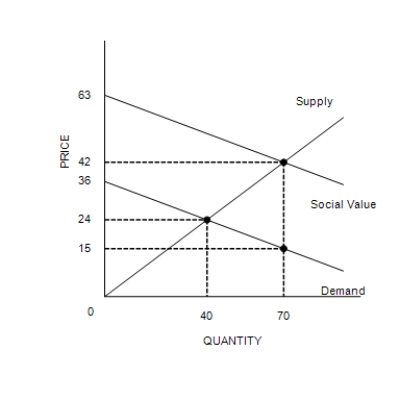 -Refer to Figure 10-5. Taking into account private value and external benefits, the maximum total surplus that can be achieved in this market is
 (Multiple Choice)
4.8/5 (72)
(72) Figure 10-5
-Refer to Figure 10-5. The graph represents a market in which
-Refer to Figure 10-5. The graph represents a market in which (Multiple Choice)
4.9/5 (64)
(64) Some government policies provide incentives for private decision makers to choose to solve the problem of externalities on their own. What term do we use to describe such policies?
(Essay)
4.8/5 (96)
(96) Figure 10-6
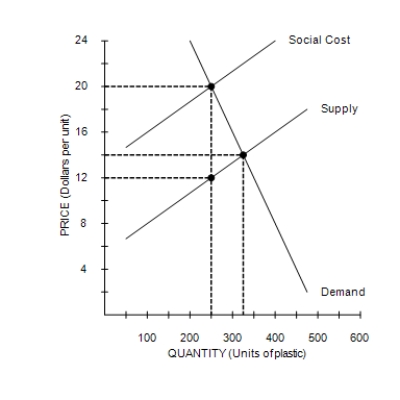 -Refer to Figure 10-6. Each unit of plastics that is produced results in an external
 (Multiple Choice)
4.9/5 (88)
(88) Table 10-1
Quantity (Units) Private Value (Dollars) Private Cost (Dollars) External Cost (Dollars) 1 28 12 4 2 26 14 4 3 24 16 4 4 22 18 4 5 20 20 4 6 18 22 4 7 16 24 4
-Refer to Table 10-1. Which of the following statements is correct?
(Multiple Choice)
4.7/5 (89)
(89) Government intervention in the economy with the goal of promoting technology-producing industries is known as patent policy.
(True/False)
5.0/5 (79)
(79) Table 10-3
Quantity (Units) Private Value (Dollars) Private Cost (Dollars) External Benefit (Dollars) 1 22 12 10 2 20 15 10 3 18 18 10 4 16 21 10 5 14 24 10 6 12 27 10
-Refer to Table 10-3. The social value of the 4th unit of output that is produced is
(Multiple Choice)
4.9/5 (76)
(76) In some cases, tradable pollution permits may be better than a corrective tax because
(Multiple Choice)
4.9/5 (85)
(85) Suppose that candy producers create a positive externality equal to $1 per pound of candy. Further suppose that the government offers a $1-per-pound subsidy to the producers. What is the relationship between the equilibrium quantity and the socially optimal quantity of candy?
(Multiple Choice)
4.9/5 (85)
(85) Suppose the socially-optimal quantity of good x is larger than the market-equilibrium quantity of good x. Does the production of good x convey a positive externality or does it convey a negative externality?
(Essay)
4.8/5 (88)
(88) Scenario 10-1
The demand curve for gasoline slopes downward and the supply curve for gasoline slopes upward. The production of the 400th gallon of gasoline entails the following:
a private cost of $2.83;
a social cost of $3.12;
a value to consumers of $3.23.
-Refer to Scenario 10-1. From the given information, it is apparent that
(Multiple Choice)
4.7/5 (92)
(92) Bruce engages in an activity that diminishes the well-being of Shawna. Bruce pays no compensation to Shawna for her loss in well-being. What specific term do economists use to describe this situation?
(Short Answer)
4.7/5 (67)
(67) Why are Pigovian taxes preferred to regulatory policies as methods to remedy negative externalities?
(Essay)
4.8/5 (69)
(69) Figure 10-8 
-Refer to Figure 10-8. This market would benefit from a tax equal to $50 per unit.
-Refer to Figure 10-8. This market would benefit from a tax equal to $50 per unit. (True/False)
4.9/5 (79)
(79) Patent protection is one way to deal with technology spillovers.
(True/False)
4.7/5 (78)
(78) Figure 10-8
-Refer to Figure 10-8. The socially optimal price and quantity are $250 and 250 units, respectively.
-Refer to Figure 10-8. The socially optimal price and quantity are $250 and 250 units, respectively. (True/False)
4.9/5 (78)
(78) 
Filters
- Essay(0)
- Multiple Choice(0)
- Short Answer(0)
- True False(0)
- Matching(0)