



 Chat with AI
Exam 10: Externalities

Exam 1: Ten Principles of Economics220 Questions
Exam 2: Thinking Like an Economist284 Questions
Exam 3: Interdependence and the Gains From Trade192 Questions
Exam 4: The Market Forces of Supply and Demand277 Questions
Exam 5: Elasticity and Its Application222 Questions
Exam 6: Supply, Demand, and Government Policies321 Questions
Exam 7: Consumers, Producers, and the Efficiency of Markets218 Questions
Exam 8: Applications: The Costs of Taxation203 Questions
Exam 9: Application: International Trade214 Questions
Exam 10: Externalities204 Questions
Exam 11: Public Goods and Common Resources182 Questions
Exam 12: The Design of the Tax System225 Questions
Exam 13: The Costs of Production261 Questions
Exam 14: Firms in Competitive Markets243 Questions
Exam 15: Monopoly231 Questions
Exam 16: Monopolistic Competition246 Questions
Exam 17: Oligopoly204 Questions
Exam 18: The Markets for the Factors of Production232 Questions
Exam 19: Earnings and Discrimination230 Questions
Exam 20: Income Inequality and Poverty194 Questions
Exam 21: The Theory of Consumer Choice209 Questions
Exam 22: Frontiers in Microeconomics185 Questions
Exam 23: Measuring a Nations Income231 Questions
Exam 24: Measuring the Cost of Living214 Questions
Exam 25: Production and Growth187 Questions
Exam 26: Saving, Investment, and the Financial System225 Questions
Exam 27: Tools of Finance198 Questions
Exam 28: Unemployment and Its Natural Rate361 Questions
Exam 29: The Monetary System210 Questions
Exam 30: Money Growth and Inflation201 Questions
Exam 31: Open-Economy Macroeconomics: Basic Concepts194 Questions
Exam 32: A Macroeconomic Theory of the Open Economy188 Questions
Exam 33: Aggregate Demand and Aggregate Supply189 Questions
Exam 34: The Influence of Monetary and Fiscal Policy on Aggregate Demand207 Questions
Exam 35: The Short-Run Tradeoff Between Inflation and Unemployment223 Questions
Exam 36: Six Debates Over Macroeconomic Policy154 Questions
Select questions type


Suppose the Environmental Protection Agency uses a corrective tax to set a price for pollution. Under this policy, is the supply curve for pollution rights vertical or is it horizontal?
(Short Answer)
5.0/5  (80)
(80) A benevolent social planner would prefer that the output of good x be decreased from its current level if, at the current level of output of good x,
(Multiple Choice)
4.8/5 (85)
(85) The Coase theorem suggests that efficient solutions to externalities can be determined through bargaining. Under what circumstances will private bargaining fail to produce a solution?
(Essay)
4.9/5 (80)
(80) Table 10-1
Quantity (Units) Private Value (Dollars) Private Cost (Dollars) External Cost (Dollars) 1 28 12 4 2 26 14 4 3 24 16 4 4 22 18 4 5 20 20 4 6 18 22 4 7 16 24 4
-Refer to Table 10-1. How large would a corrective tax need to be to move this market from the equilibrium outcome to the socially optimal outcome?
(Multiple Choice)
4.8/5 (81)
(81) Figure 10-7 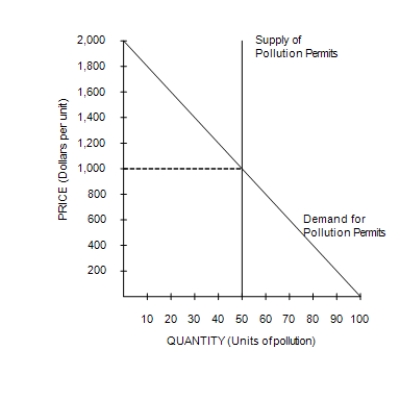 -Refer to Figure 10-7. This graph shows the market for pollution when permits are issued to firms and traded in the marketplace. The equilibrium price of pollution is
 (Multiple Choice)
5.0/5 (67)
(67) Figure 10-6
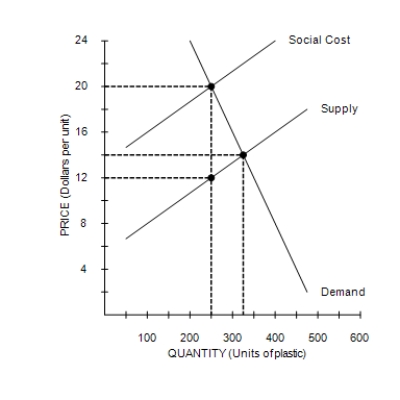 -Refer to Figure 10-6. In order to reach the social optimum, the government could
 (Multiple Choice)
4.9/5 (86)
(86) A market for pollution permits can efficiently allocate the right to pollute by using the forces of supply and demand.
(True/False)
4.7/5 (86)
(86) Which theorem asserts that private economic actors can often solve the problem of externalities among themselves?
(Short Answer)
5.0/5 (83)
(83) Figure 10-4
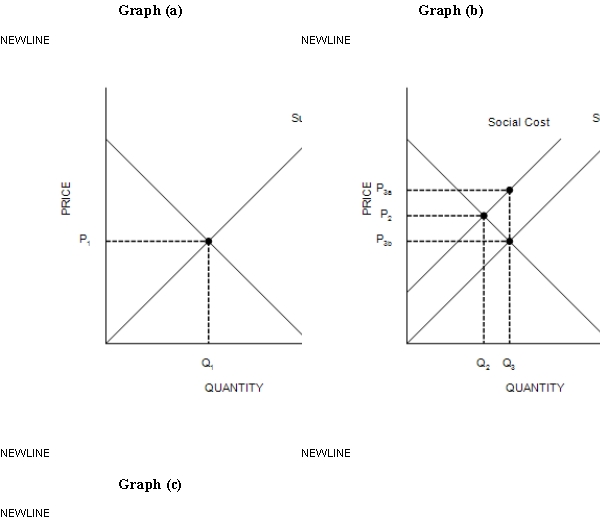 -Refer to Figure 10-4, Graph (b) and Graph (c). The installation of a scrubber in a smokestack reduces the emission of harmful chemicals from the smokestack. Therefore, a government policy that internalized the externality would move the quantity of smokestack scrubbers installed from point
 (Multiple Choice)
5.0/5 (73)
(73) Assume each gallon of gasoline that is produced gives rise to an external cost of $1.25. On any given day, the production of the 10,000th gallon of gasoline entails a private value of $4.00 and a social cost of $3.50. What is the private cost of the 10,000th gallon?
(Essay)
4.9/5 (93)
(93) What are the three externalities that are associated with driving cars and trucks?
(Essay)
4.8/5 (69)
(69) Table 10-3
Quantity (Units) Private Value (Dollars) Private Cost (Dollars) External Benefit (Dollars) 1 22 12 10 2 20 15 10 3 18 18 10 4 16 21 10 5 14 24 10 6 12 27 10
-Refer to Table 10-3. Taking into account private and external benefits, the total surplus to society at the socially efficient quantity is
(Multiple Choice)
4.8/5 (101)
(101) Corrective taxes enhance efficiency, but the cost to administer them exceeds the revenue they raise for the government.
(True/False)
4.7/5 (72)
(72) Which of the following is NOT a way of internalizing technology spillovers?
(Multiple Choice)
4.8/5 (84)
(84) Figure 10-4
-Refer to Figure 10-4, Graph (b) and Graph (c). The overuse of antibiotics leads to the development of antibiotic-resistant diseases. Therefore, the socially optimal quantity of antibiotics is represented by point
-Refer to Figure 10-4, Graph (b) and Graph (c). The overuse of antibiotics leads to the development of antibiotic-resistant diseases. Therefore, the socially optimal quantity of antibiotics is represented by point (Multiple Choice)
4.8/5 (83)
(83) Figure 10-2  -Refer to Figure 10-2. If all external costs were internalized, then the market's output would be
 (Multiple Choice)
4.8/5 (82)
(82) At any given quantity, the willingness to pay of the marginal buyer is the height of the __________.
(Short Answer)
4.8/5 (94)
(94) 
Filters
- Essay(0)
- Multiple Choice(0)
- Short Answer(0)
- True False(0)
- Matching(0)