



 Chat with AI
Exam 10: Externalities

Exam 1: Ten Principles of Economics220 Questions
Exam 2: Thinking Like an Economist284 Questions
Exam 3: Interdependence and the Gains From Trade192 Questions
Exam 4: The Market Forces of Supply and Demand277 Questions
Exam 5: Elasticity and Its Application222 Questions
Exam 6: Supply, Demand, and Government Policies321 Questions
Exam 7: Consumers, Producers, and the Efficiency of Markets218 Questions
Exam 8: Applications: The Costs of Taxation203 Questions
Exam 9: Application: International Trade214 Questions
Exam 10: Externalities204 Questions
Exam 11: Public Goods and Common Resources182 Questions
Exam 12: The Design of the Tax System225 Questions
Exam 13: The Costs of Production261 Questions
Exam 14: Firms in Competitive Markets243 Questions
Exam 15: Monopoly231 Questions
Exam 16: Monopolistic Competition246 Questions
Exam 17: Oligopoly204 Questions
Exam 18: The Markets for the Factors of Production232 Questions
Exam 19: Earnings and Discrimination230 Questions
Exam 20: Income Inequality and Poverty194 Questions
Exam 21: The Theory of Consumer Choice209 Questions
Exam 22: Frontiers in Microeconomics185 Questions
Exam 23: Measuring a Nations Income231 Questions
Exam 24: Measuring the Cost of Living214 Questions
Exam 25: Production and Growth187 Questions
Exam 26: Saving, Investment, and the Financial System225 Questions
Exam 27: Tools of Finance198 Questions
Exam 28: Unemployment and Its Natural Rate361 Questions
Exam 29: The Monetary System210 Questions
Exam 30: Money Growth and Inflation201 Questions
Exam 31: Open-Economy Macroeconomics: Basic Concepts194 Questions
Exam 32: A Macroeconomic Theory of the Open Economy188 Questions
Exam 33: Aggregate Demand and Aggregate Supply189 Questions
Exam 34: The Influence of Monetary and Fiscal Policy on Aggregate Demand207 Questions
Exam 35: The Short-Run Tradeoff Between Inflation and Unemployment223 Questions
Exam 36: Six Debates Over Macroeconomic Policy154 Questions
Select questions type


The Environmental Protection Agency (EPA) cannot reach a target level of pollution through the use of pollution permits.
(True/False)
4.9/5  (88)
(88) Table 10-3
Quantity (Units) Private Value (Dollars) Private Cost (Dollars) External Benefit (Dollars) 1 22 12 10 2 20 15 10 3 18 18 10 4 16 21 10 5 14 24 10 6 12 27 10
-Refer to Table 10-3. The market equilibrium quantity of output is
(Multiple Choice)
4.9/5 (92)
(92) Scenario 10-3
Suppose the equation for the demand curve in a market is P = 120 - (1/5) QD , where QD is the quantity demanded and is the price. Also, suppose the equation for the supply curve in the same market is P = (1/10) QS , where QS is the quantity supplied.
-Refer to Scenario 10-3. What are the market equilibrium quantity and price?
(Essay)
4.9/5 (74)
(74) Figure 10-6
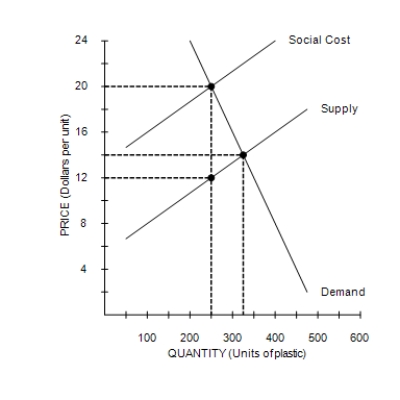 -Refer to Figure 10-6. If 325 units of plastics are produced and consumed, then the
 (Multiple Choice)
4.7/5 (83)
(83) The least expensive way to clean up the environment is for all firms to reduce pollution by an equal percentage.
(True/False)
4.8/5 (75)
(75) Using a supply and demand diagram, demonstrate how a negative externality leads to market inefficiency. How might the government help to eliminate this inefficiency?
(Short Answer)
4.8/5 (85)
(85) Figure 10-4
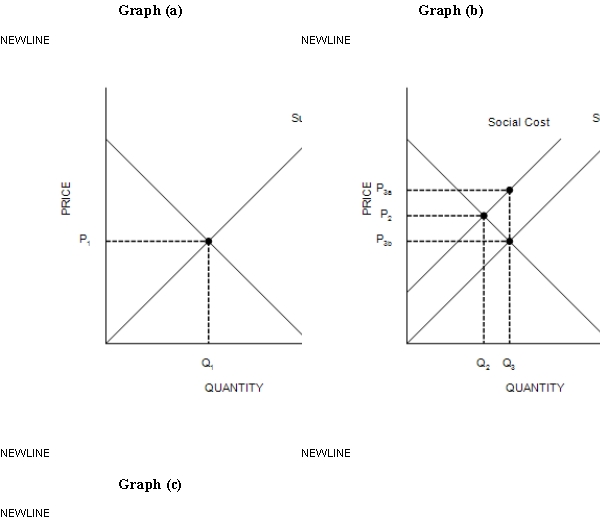 -Refer to Figure 10-4. The installation of a scrubber in a smokestack reduces the emission of harmful chemicals from the smokestack. Therefore, the market for smokestack scrubbers is shown in
 (Multiple Choice)
4.9/5 (82)
(82) Tyler owns a dog and receives a $300 benefit from owning it. Tyler's neighbor, Liz, incurs a cost of $450 from the dog's barking. Suggest a deal between Tyler and Liz that would result in both individuals becoming better off.
(Essay)
4.8/5 (75)
(75) Which of the following statements about a well-maintained yard best conveys the general nature of the externality?
(Multiple Choice)
4.9/5 (67)
(67) The Coase theorem suggests that taxes should be enacted to alleviate the effects of negative externalities.
(True/False)
4.9/5 (64)
(64) Scenario 10-4
The demand curve for fire extinguishers slopes downward and the supply curve for fire extinguishers slopes upward. The production of the 500th fire extinguisher entails the following:
• a private cost of $10;
• an external cost of $0;
• a private value of $9;
• an external benefit of $3.
-Refer to Scenario 10-4. In order to maximize the total benefit of fire extinguishers to society as a whole, should the number of fire extinguishers produced be less than, equal to, or greater than 500? Explain.
(Essay)
4.9/5 (77)
(77) Scenario 10-3
Suppose the equation for the demand curve in a market is P = 120 - (1/5) QD , where QD is the quantity demanded and is the price. Also, suppose the equation for the supply curve in the same market is P = (1/10) QS , where QS is the quantity supplied.
-Refer to Scenario 10-3. Suppose there is an external cost of $12 associated with the production of each unit of the good. What is the social cost of producing 30 units of the good?
(Essay)
4.9/5 (76)
(76) Government subsidized scholarships are an example of a government policy aimed at correcting negative externalities associated with education.
(True/False)
4.8/5 (97)
(97) Corrective taxes cause deadweight losses, reducing economic efficiency.
(True/False)
4.7/5 (73)
(73) Table 10-1
Quantity (Units) Private Value (Dollars) Private Cost (Dollars) External Cost (Dollars) 1 28 12 4 2 26 14 4 3 24 16 4 4 22 18 4 5 20 20 4 6 18 22 4 7 16 24 4
-Refer to Table 10-1. What is the socially optimal quantity of output in this market?
(Multiple Choice)
4.8/5 (77)
(77) Does the phenomenon of externalities strengthen the argument that we should rely upon the "invisible hand" of the marketplace, or does it weaken that argument?
(Essay)
4.8/5 (74)
(74) Table 10-1
Quantity (Units) Private Value (Dollars) Private Cost (Dollars) External Cost (Dollars) 1 28 12 4 2 26 14 4 3 24 16 4 4 22 18 4 5 20 20 4 6 18 22 4 7 16 24 4
-Refer to Table 10-1. What is the equilibrium quantity of output in the market?
(Multiple Choice)
4.9/5 (87)
(87) 
Filters
- Essay(0)
- Multiple Choice(0)
- Short Answer(0)
- True False(0)
- Matching(0)