



 Chat with AI
Exam 7: The Control of Microbial Growth

Exam 1: The Microbial World and You56 Questions
Exam 2: Chemical Principles52 Questions
Exam 3: Observing Microorganisms Through a Microscope58 Questions
Exam 4: Functional Anatomy of Prokaryotic and Eukaryotic Cells59 Questions
Exam 5: Microbial Metabolism64 Questions
Exam 6: Microbial Growth52 Questions
Exam 7: The Control of Microbial Growth63 Questions
Exam 8: Microbial Genetics58 Questions
Exam 9: Biotechnology and Dna Technology59 Questions
Exam 10: Classification of Microorganisms58 Questions
Exam 11: The Prokaryotes: Domains Bacteria and Archaea59 Questions
Exam 12: The Eukaryotes: Fungi, Algae, Protozoa, and Helminths58 Questions
Exam 13: Viruses, Viroids, and Prions62 Questions
Exam 14: Principles of Disease and Epidemiology60 Questions
Exam 15: Microbial Mechanisms of Pathogenicity58 Questions
Exam 16: Innate Immunity: Nonspecific Defenses of the Host59 Questions
Exam 17: Adaptive Immunity: Specific Defenses of the Host60 Questions
Exam 18: Practical Applications of Immunology58 Questions
Exam 19: Disorders Associated With the Immune System62 Questions
Exam 20: Antimicrobial Drugs60 Questions
Exam 21: Microbial Diseases of the Skin and Eyes59 Questions
Exam 22: Microbial Diseases of the Nervous System58 Questions
Exam 23: Microbial Diseases of the Cardiovascular and Lymphatic Systems59 Questions
Exam 24: Microbial Diseases of the Respiratory System58 Questions
Exam 25: Microbial Diseases of the Digestive System61 Questions
Exam 26: Microbial Disease of the Urinary and Reproductive Systems59 Questions
Exam 27: Environmental Microbiology58 Questions
Exam 28: Applied and Industrial Microbiology59 Questions
Select questions type


Why must most milk sold in the U.S. be refrigerated at all times while evaporated canned milk and milk in cardboard containers sold in Europe do not need to be refrigerated until they are opened?
(Short Answer)
4.9/5  (71)
(71) Table 7.2 The fate of E. coli O157:H7 in apple cider held at 8°C for 2 weeks, with and without preservatives, is shown below: Bacteria
Cider only 2.2 Cider with potassium sorbate 2.0 Sodium benzoate 0 Potassium sorbate + sodium benzoate 0 In Table 7.2, which preservative is most effective?
(Multiple Choice)
4.9/5 (87)
(87) All of the following are effective for destroying prions EXCEPT
(Multiple Choice)
4.9/5 (78)
(78) Application of heat to living cells can result in all of the following EXCEPT
(Multiple Choice)
4.9/5 (77)
(77) Ultraviolet light (UV) causes irreversible breaks in DNA strands.
(True/False)
4.9/5 (82)
(82) Figure 7.1
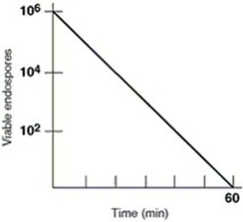 A suspension of 106 Bacillus cereus endospores was put in a hot-air oven at 170°C. Plate counts were used to determine the number of endospores surviving at the time intervals shown.
-Which of the following pairs is mismatched?
A suspension of 106 Bacillus cereus endospores was put in a hot-air oven at 170°C. Plate counts were used to determine the number of endospores surviving at the time intervals shown.
-Which of the following pairs is mismatched? (Multiple Choice)
4.8/5 (81)
(81) All of the following are methods of food preservation EXCEPT
(Multiple Choice)
4.8/5 (72)
(72) Which of the following could be used to sterilize plastic Petri plates in a plastic wrapper?
(Multiple Choice)
4.8/5 (75)
(75) What are the advantages of gluteraldehyde compared to formaldehyde?
(Short Answer)
5.0/5 (81)
(81) If you were preparing nutrient agar at home and did not have an autoclave, what could you use to sterilize the nutrient agar?
(Multiple Choice)
4.7/5 (90)
(90) Figure 7.2
Assume 109 E. coli cells/ml are in a flask.
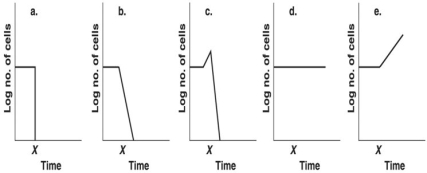 -Which graph in Figure 7.2 best depicts the effect of placing the culture in an autoclave for 15 minutes at time x?
 (Multiple Choice)
4.8/5 (77)
(77) Which of the following substances is used for surgical hand scrubs?
(Multiple Choice)
4.7/5 (85)
(85) Any process that destroys the non-spore forming contaminants on inanimate objects is sterilization.
(True/False)
4.9/5 (69)
(69) The antimicrobial activity of chlorine is due to which of the following?
(Multiple Choice)
4.8/5 (73)
(73) 
Filters
- Essay(0)
- Multiple Choice(0)
- Short Answer(0)
- True False(0)
- Matching(0)