



 Chat with AI
Exam 14: Firms in Competitive Markets

Exam 1: Ten Principles of Economics455 Questions
Exam 2: Thinking Like an Economist643 Questions
Exam 3: Interdependence and the Gains From Trade547 Questions
Exam 4: The Market Forces of Supply and Demand693 Questions
Exam 5: Elasticity and Its Application626 Questions
Exam 6: Supply, Demand, and Government Policies668 Questions
Exam 7: Consumers, Producers, and the Efficiency of Markets547 Questions
Exam 8: Applications: the Costs of Taxation509 Questions
Exam 9: Application: International Trade521 Questions
Exam 10: Externalities543 Questions
Exam 11: Public Goods and Common Resources452 Questions
Exam 12: The Design of the Tax System664 Questions
Exam 13: The Costs of Production649 Questions
Exam 14: Firms in Competitive Markets604 Questions
Exam 15: Monopoly662 Questions
Exam 16: Monopolistic Competition649 Questions
Exam 17: Oligopoly522 Questions
Exam 18: The Markets for the Factors of Production592 Questions
Exam 19: Earnings and Discrimination511 Questions
Exam 20: Income Inequality and Poverty478 Questions
Exam 21: The Theory of Consumer Choice570 Questions
Exam 22: Frontiers in Microeconomics461 Questions
Exam 23: Measuring a Nation S Income547 Questions
Exam 24: Measuring the Cost of Living565 Questions
Exam 25: Production and Growth527 Questions
Exam 26: Saving, Investment, and the Financial System637 Questions
Exam 27: Tools of Finance534 Questions
Exam 28: Unemployment and Its Natural Rate701 Questions
Exam 29: The Monetary System540 Questions
Exam 30: Money Growth and Inflation504 Questions
Exam 31: Open-Economy Macroeconomics: Basic Concepts540 Questions
Exam 32: A Macroeconomic Theory of the Open Economy511 Questions
Exam 33: Aggregate Demand and Aggregate Supply572 Questions
Exam 34: The Influence of Monetary and Fiscal Policy on Aggregate Demand523 Questions
Exam 35: The Short-Run Tradeoff Between Inflation and Unemployment536 Questions
Exam 36: Six Debates Over Macroeconomic Policy354 Questions
Select questions type


Comparing marginal revenue to marginal cost
(i)reveals the contribution of the last unit of production to total profit.
(ii)is helpful in making profit-maximizing production decisions.
(iii)tells a firm whether its fixed costs are too high.
(Multiple Choice)
4.9/5  (90)
(90) For a particular competitive firm, the minimum value of average variable cost (AVC) is $12 and is reached when 200 units of output are produced. For the same firm, the minimum value of average total cost (ATC) is $15 and is reached when 230 units of output are produced. Which of the following statements is correct?
(Multiple Choice)
4.7/5 (73)
(73) Scenario 14-2
Assume a certain firm is producing Q = 1,000 units of output. At Q = 1,000, the firm's marginal cost equals $20 and its average total cost equals $25. The firm sells its output for $30 per unit.
-Refer to Scenario 14-2. To maximize its profit, the firm should
(Multiple Choice)
4.7/5 (88)
(88) When a competitive firm doubles the quantity of output it sells, its
(Multiple Choice)
4.9/5 (73)
(73) Table 14-10
Suppose that a firm in a competitive market faces the following revenues and costs: 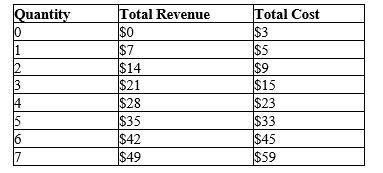 -Refer to Table 14-10. If the firm produces the profit-maximizing level of production, how much profit will the firm earn?
 (Multiple Choice)
4.9/5 (76)
(76) Figure 14-10
In the figure below, panel (a) depicts the linear marginal cost of a firm in a competitive market, and panel (b) depicts the linear market supply curve for a market with a fixed number of identical firms. 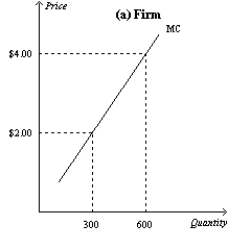
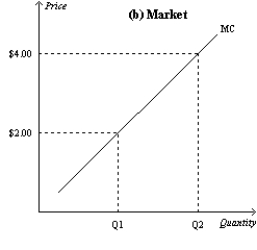 -Refer to Figure 14-10. If there are 700 identical firms in this market, what is the value of Q1?
 (Multiple Choice)
4.8/5 (83)
(83) Kate is a professional opera singer who gives voice lessons. The vocal-music industry is competitive. Kate hires a business consultant to analyze her financial records. The consultant recommends that Kate give fewer voice lessons. The consultant must have concluded that Kate's
(Multiple Choice)
4.9/5 (87)
(87) A firm is currently producing 100 units of output per day. The manager reports to the owner that producing the 100th unit costs the firm $5. The firm can sell the unit for $6. The firm should produce more than 100 units in order to maximize its profits (or minimize its losses).
(True/False)
4.7/5 (85)
(85) In order to maximize profits in the short run, a firm should produce where
(Multiple Choice)
4.9/5 (81)
(81) In a certain market there are many buyers and many sellers. It is easy to distinguish the product sold by one firm from the products sold by other firms. Is the market competitive?
(Essay)
4.9/5 (66)
(66) A firm will shut down in the short run if, for all positive levels of output,
(Multiple Choice)
4.7/5 (61)
(61) Figure 14-2
Suppose a firm operating in a competitive market has the following cost curves: 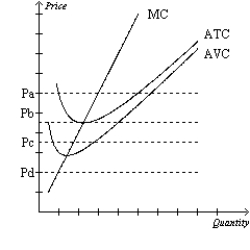 -Refer to Figure 14-2. If the market price is Pc, in the short run the firm will earn
 (Multiple Choice)
4.8/5 (69)
(69) A firm operating in a perfectly competitive industry will continue to operate in the short run but earn losses if the market price is less than that firm's average total cost but greater than the firm's average variable cost.
(True/False)
4.8/5 (76)
(76) A market is competitive if
(i)firms have the flexibility to price their own product.
(ii)each buyer is small compared to the market.
(iii)each seller is small compared to the market.
(Multiple Choice)
4.9/5 (76)
(76) Table 14-12 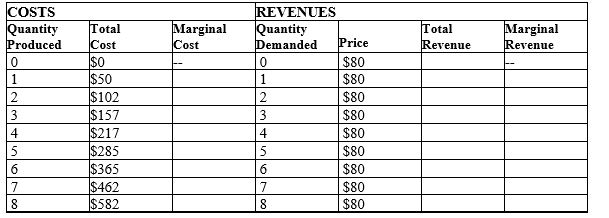 -Refer to Table 14-12. What is the total revenue from selling 7 units?
 (Multiple Choice)
5.0/5 (85)
(85) Figure 14-9
In the figure below, panel (a) depicts the linear marginal cost of a firm in a competitive market, and panel (b) depicts the linear market supply curve for a market with a fixed number of identical firms. 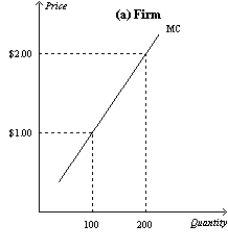
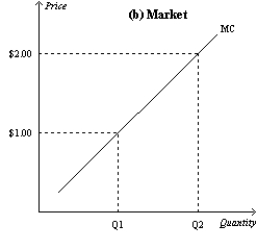 -Refer to Figure 14-9. When 100 identical firms participate in this market, at what price will 15,000 units be supplied to this market?
 (Multiple Choice)
4.9/5 (85)
(85) When economists refer to a production cost that has already been committed and cannot be recovered, they use the term
(Multiple Choice)
4.8/5 (82)
(82) A long-run supply curve is flatter than a short-run supply curve because
(Multiple Choice)
4.9/5 (74)
(74) Suppose that some firms in a competitive industry are earning zero economic profits, while others are experiencing losses. All else equal, in the long run, we would expect the number of firms in the industry to
(Multiple Choice)
4.8/5 (80)
(80) Which of the following industries is most likely to exhibit the characteristic of free entry?
(Multiple Choice)
4.9/5 (81)
(81) 
Filters
- Essay(0)
- Multiple Choice(0)
- Short Answer(0)
- True False(0)
- Matching(0)