



 Chat with AI
Exam 14: Firms in Competitive Markets

Exam 1: Ten Principles of Economics455 Questions
Exam 2: Thinking Like an Economist643 Questions
Exam 3: Interdependence and the Gains From Trade547 Questions
Exam 4: The Market Forces of Supply and Demand693 Questions
Exam 5: Elasticity and Its Application626 Questions
Exam 6: Supply, Demand, and Government Policies668 Questions
Exam 7: Consumers, Producers, and the Efficiency of Markets547 Questions
Exam 8: Applications: the Costs of Taxation509 Questions
Exam 9: Application: International Trade521 Questions
Exam 10: Externalities543 Questions
Exam 11: Public Goods and Common Resources452 Questions
Exam 12: The Design of the Tax System664 Questions
Exam 13: The Costs of Production649 Questions
Exam 14: Firms in Competitive Markets604 Questions
Exam 15: Monopoly662 Questions
Exam 16: Monopolistic Competition649 Questions
Exam 17: Oligopoly522 Questions
Exam 18: The Markets for the Factors of Production592 Questions
Exam 19: Earnings and Discrimination511 Questions
Exam 20: Income Inequality and Poverty478 Questions
Exam 21: The Theory of Consumer Choice570 Questions
Exam 22: Frontiers in Microeconomics461 Questions
Exam 23: Measuring a Nation S Income547 Questions
Exam 24: Measuring the Cost of Living565 Questions
Exam 25: Production and Growth527 Questions
Exam 26: Saving, Investment, and the Financial System637 Questions
Exam 27: Tools of Finance534 Questions
Exam 28: Unemployment and Its Natural Rate701 Questions
Exam 29: The Monetary System540 Questions
Exam 30: Money Growth and Inflation504 Questions
Exam 31: Open-Economy Macroeconomics: Basic Concepts540 Questions
Exam 32: A Macroeconomic Theory of the Open Economy511 Questions
Exam 33: Aggregate Demand and Aggregate Supply572 Questions
Exam 34: The Influence of Monetary and Fiscal Policy on Aggregate Demand523 Questions
Exam 35: The Short-Run Tradeoff Between Inflation and Unemployment536 Questions
Exam 36: Six Debates Over Macroeconomic Policy354 Questions
Select questions type


When entry and exit behavior of firms in an industry does not affect a firm's cost structure,
(Multiple Choice)
4.7/5  (85)
(85) For any competitive market, the supply curve is closely related to the
(Multiple Choice)
4.8/5 (79)
(79) Firms that operate in perfectly competitive markets try to
(Multiple Choice)
4.8/5 (67)
(67) A firm in a competitive market has the following cost structure:
Output
Total Cost
0
$5
1
$10
2
$12
3
$15
4
$24
5
$40
If the market price is $16, this firm will
(Multiple Choice)
4.9/5 (90)
(90) Table 14-2
The table represents a demand curve faced by a firm in a competitive market. 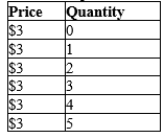 -Refer to Table 14-2. This firm maximizes total revenue by producing
 (Multiple Choice)
4.7/5 (54)
(54) Bill operates a boat rental business in a competitive industry. He owns 10 boats and pays $1,000 per month on the loan that he took out to buy them. He rents each boat for $200 per month. The variable cost for each boat rental is $50. In the off season, Bill should
(Multiple Choice)
4.9/5 (73)
(73) Figure 14-14 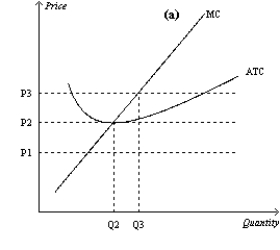
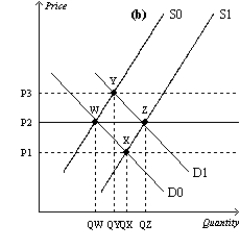 -Refer to Figure 14-14. Assume that the market starts in equilibrium at point W in panel (b) and that panel (a) illustrates the cost curves facing individual firms. Suppose that demand increases from D0 to D1. Which of the following statements is not correct?
 (Multiple Choice)
4.9/5 (71)
(71) One of the defining characteristics of a perfectly competitive market is
(Multiple Choice)
4.8/5 (80)
(80) Changes in the output of a perfectly competitive firm, without any change in the price of the product, will change the firm's
(Multiple Choice)
4.9/5 (80)
(80) Table 14-15 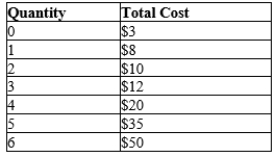 -Refer to Table 14-15. What is the lowest price at which this firm would operate in the short run?
 (Multiple Choice)
4.8/5 (68)
(68) Consider a competitive market with a large number of identical firms. The firms in this market do not use any resources that are available only in limited quantities. In long-run equilibrium, market price is determined by
(Multiple Choice)
4.7/5 (69)
(69) Which of the following statements best expresses a firm's profit-maximizing decision rule?
(Multiple Choice)
4.9/5 (89)
(89) In a perfectly competitive market, the process of entry and exit will end when
(i)accounting profits are zero.
(ii)economic profits are zero.
(iii)price equals minimum marginal cost.
(iv)price equals minimum average total cost.
(Multiple Choice)
4.9/5 (76)
(76) Table 14-14
The following table presents cost and revenue information for Bob's bakery production and sales. 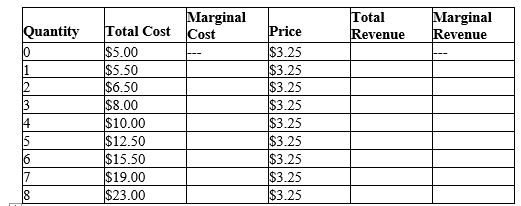 -Refer to Table 14-14. At what quantity will Bob maximize his profit?
 (Multiple Choice)
4.8/5 (79)
(79) Table 14-9
Suppose that a firm in a competitive market faces the following revenues and costs: 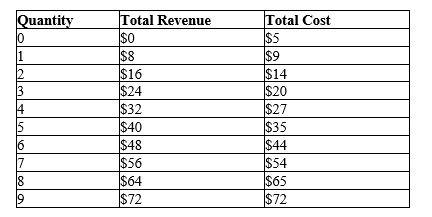 -Refer to Table 14-9. If the firm produces 3 units of output,
 (Multiple Choice)
4.9/5 (77)
(77) Consider a firm operating in a competitive market. The firm is producing 40 units of output, has an average total cost of production equal to $5, and is earning $240 economic profit in the short run. What is the current market price?
(Multiple Choice)
4.7/5 (84)
(84) A competitive firm is maximizing its profit by selling 150 units of output. The firm's marginal cost is $8 and its average total cost is $6. The firm's profit amounts to __________.
(Short Answer)
4.8/5 (68)
(68) Firms operating in competitive markets produce output levels where marginal revenue equals
(Multiple Choice)
4.9/5 (85)
(85) In the long run, each firm in a competitive industry earns
(Multiple Choice)
4.8/5 (74)
(74) 
Filters
- Essay(0)
- Multiple Choice(0)
- Short Answer(0)
- True False(0)
- Matching(0)