



 Chat with AI
Exam 14: Firms in Competitive Markets

Exam 1: Ten Principles of Economics455 Questions
Exam 2: Thinking Like an Economist643 Questions
Exam 3: Interdependence and the Gains From Trade547 Questions
Exam 4: The Market Forces of Supply and Demand693 Questions
Exam 5: Elasticity and Its Application626 Questions
Exam 6: Supply, Demand, and Government Policies668 Questions
Exam 7: Consumers, Producers, and the Efficiency of Markets547 Questions
Exam 8: Applications: the Costs of Taxation509 Questions
Exam 9: Application: International Trade521 Questions
Exam 10: Externalities543 Questions
Exam 11: Public Goods and Common Resources452 Questions
Exam 12: The Design of the Tax System664 Questions
Exam 13: The Costs of Production649 Questions
Exam 14: Firms in Competitive Markets604 Questions
Exam 15: Monopoly662 Questions
Exam 16: Monopolistic Competition649 Questions
Exam 17: Oligopoly522 Questions
Exam 18: The Markets for the Factors of Production592 Questions
Exam 19: Earnings and Discrimination511 Questions
Exam 20: Income Inequality and Poverty478 Questions
Exam 21: The Theory of Consumer Choice570 Questions
Exam 22: Frontiers in Microeconomics461 Questions
Exam 23: Measuring a Nation S Income547 Questions
Exam 24: Measuring the Cost of Living565 Questions
Exam 25: Production and Growth527 Questions
Exam 26: Saving, Investment, and the Financial System637 Questions
Exam 27: Tools of Finance534 Questions
Exam 28: Unemployment and Its Natural Rate701 Questions
Exam 29: The Monetary System540 Questions
Exam 30: Money Growth and Inflation504 Questions
Exam 31: Open-Economy Macroeconomics: Basic Concepts540 Questions
Exam 32: A Macroeconomic Theory of the Open Economy511 Questions
Exam 33: Aggregate Demand and Aggregate Supply572 Questions
Exam 34: The Influence of Monetary and Fiscal Policy on Aggregate Demand523 Questions
Exam 35: The Short-Run Tradeoff Between Inflation and Unemployment536 Questions
Exam 36: Six Debates Over Macroeconomic Policy354 Questions
Select questions type


Figure 14-2
Suppose a firm operating in a competitive market has the following cost curves: 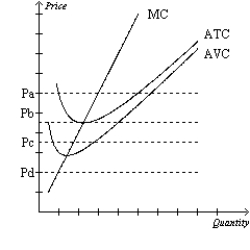 -Refer to Figure 14-2. If the market price is Pd, in the short run the firm will earn
 (Multiple Choice)
5.0/5  (87)
(87) Figure 14-14 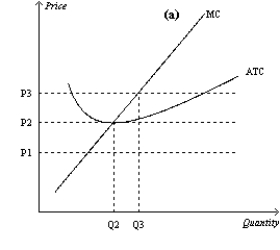
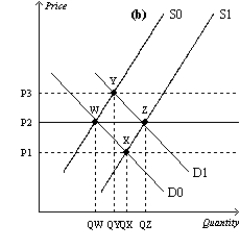 -Refer to Figure 14-14. Suppose a firm in a competitive market, like the one depicted in panel (a), observes market price rising from P1 to P2. Which of the following could explain this observation?
 (Multiple Choice)
4.8/5 (84)
(84) A firm will shut down in the short run if revenue is not sufficient to cover all of its fixed costs of production.
(True/False)
4.9/5 (89)
(89) When economic profits are zero in equilibrium, the firm's revenue must be sufficient to cover all opportunity costs.
(True/False)
4.8/5 (61)
(61) The textile industry is composed of a large number of small firms. In recent years, these firms have suffered economic losses, and many sellers have left the industry. Economic theory suggests that these conditions will
(Multiple Choice)
4.9/5 (83)
(83) If a firm operating in a competitive industry shuts down in the short run, it can avoid paying
(Multiple Choice)
4.8/5 (81)
(81) A competitive firm sells 500 units of output and its marginal revenue at 500 units of output is $35. The firm's total revenue amounts to __________.
(Short Answer)
4.8/5 (76)
(76) If there is an increase in market demand in a perfectly competitive market, then in the short run
(Multiple Choice)
4.8/5 (80)
(80) Table 14-9
Suppose that a firm in a competitive market faces the following revenues and costs: 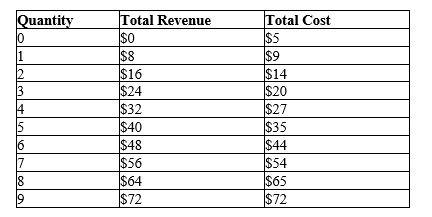 -Refer to Table 14-9. In order to maximize profit, the firm will produce a level of output where marginal cost is equal to
 (Multiple Choice)
4.8/5 (93)
(93) For an individual firm operating in a competitive market, marginal revenue equals
(Multiple Choice)
4.8/5 (71)
(71) In the short run, a firm operating in a competitive industry will shut down if price is
(Multiple Choice)
4.9/5 (74)
(74) Table 14-11
Suppose that a firm in a competitive market faces the following prices and costs: 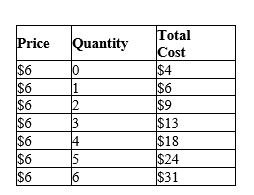 -Refer to Table 14-11. If the firm is producing 3 units of output, it should produce
 (Multiple Choice)
4.8/5 (65)
(65) Table 14-6
The following table presents cost and revenue information for a firm operating in a competitive industry. 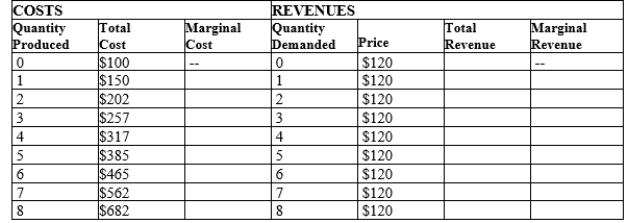 -Refer to Table 14-6. What is the total revenue from selling 7 units?
 (Multiple Choice)
4.7/5 (59)
(59) Land of Many Lakes (LML) sells butter to a broker in Albert Lea, Minnesota. Because the market for butter is generally considered to be competitive, LML does not
(Multiple Choice)
4.9/5 (71)
(71) What is the relationship between price and marginal revenue for a competitive firm?
(Essay)
4.9/5 (84)
(84) When a competitive firm produces and sells 600 units of output, its total revenue is $35,970. What is the firm's total revenue when it produces and sells 620 units of output?
(Essay)
4.8/5 (72)
(72) Table 14-13 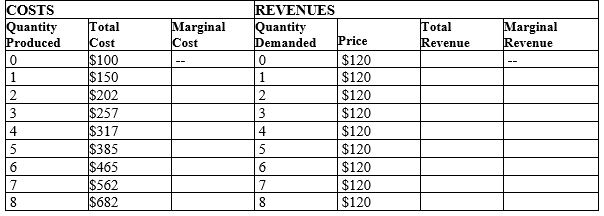 -Refer to Table 14-13. What is Diana's economic profit at the profit maximizing point?
 (Multiple Choice)
4.9/5 (82)
(82) 
Filters
- Essay(0)
- Multiple Choice(0)
- Short Answer(0)
- True False(0)
- Matching(0)