



 Chat with AI
Exam 14: Firms in Competitive Markets

Exam 1: Ten Principles of Economics455 Questions
Exam 2: Thinking Like an Economist643 Questions
Exam 3: Interdependence and the Gains From Trade547 Questions
Exam 4: The Market Forces of Supply and Demand693 Questions
Exam 5: Elasticity and Its Application626 Questions
Exam 6: Supply, Demand, and Government Policies668 Questions
Exam 7: Consumers, Producers, and the Efficiency of Markets547 Questions
Exam 8: Applications: the Costs of Taxation509 Questions
Exam 9: Application: International Trade521 Questions
Exam 10: Externalities543 Questions
Exam 11: Public Goods and Common Resources452 Questions
Exam 12: The Design of the Tax System664 Questions
Exam 13: The Costs of Production649 Questions
Exam 14: Firms in Competitive Markets604 Questions
Exam 15: Monopoly662 Questions
Exam 16: Monopolistic Competition649 Questions
Exam 17: Oligopoly522 Questions
Exam 18: The Markets for the Factors of Production592 Questions
Exam 19: Earnings and Discrimination511 Questions
Exam 20: Income Inequality and Poverty478 Questions
Exam 21: The Theory of Consumer Choice570 Questions
Exam 22: Frontiers in Microeconomics461 Questions
Exam 23: Measuring a Nation S Income547 Questions
Exam 24: Measuring the Cost of Living565 Questions
Exam 25: Production and Growth527 Questions
Exam 26: Saving, Investment, and the Financial System637 Questions
Exam 27: Tools of Finance534 Questions
Exam 28: Unemployment and Its Natural Rate701 Questions
Exam 29: The Monetary System540 Questions
Exam 30: Money Growth and Inflation504 Questions
Exam 31: Open-Economy Macroeconomics: Basic Concepts540 Questions
Exam 32: A Macroeconomic Theory of the Open Economy511 Questions
Exam 33: Aggregate Demand and Aggregate Supply572 Questions
Exam 34: The Influence of Monetary and Fiscal Policy on Aggregate Demand523 Questions
Exam 35: The Short-Run Tradeoff Between Inflation and Unemployment536 Questions
Exam 36: Six Debates Over Macroeconomic Policy354 Questions
Select questions type


Which of the following statements best reflects a price-taking firm?
(Multiple Choice)
4.9/5  (74)
(74) Suppose that a firm operating in perfectly competitive market sells 400 units of output at a price of $4 each. Which of the following statements is correct?
(i)Marginal revenue equals $4.
(ii)Average revenue equals $100.
(iii)Total revenue equals $1,600.
(Multiple Choice)
4.7/5 (73)
(73) Give two reasons why the long-run industry supply curve may slope upward. Use an example to demonstrate your reasons.
(Essay)
4.7/5 (76)
(76) Explain how a firm in a competitive market identifies the profit-maximizing level of production. When should the firm raise production, and when should the firm lower production?
(Essay)
4.9/5 (83)
(83) Suppose a firm in a competitive market produces and sells 150 units of output and earns $1,800 in total revenue from the sales. If the firm increases its output to 200 units, the average revenue of the 200th unit will be
(Multiple Choice)
5.0/5 (66)
(66) In a competitive market the current price is $5. The typical firm in the market has ATC = $5.50 and AVC = $4.50.
(Multiple Choice)
4.9/5 (79)
(79) Table 14-3
The table represents a demand curve faced by a firm in a competitive market. 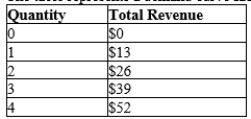 -Refer to Table 14-3. For this firm, the marginal revenue is
 (Multiple Choice)
4.8/5 (77)
(77) A profit-maximizing firm in a competitive market is currently producing 200 units of output. It has average revenue of $9 and average total cost of $7. It follows that the firm's
(Multiple Choice)
5.0/5 (91)
(91) Susan quit her job as a teacher, which paid her $36,000 per year, in order to start her own catering business. She spent $12,000 of her savings, which had been earning 10 percent interest per year, on equipment for her business. She also borrowed $12,000 from her bank at 10 percent interest, which she also spent on equipment. For the past several months she has spent $1,000 per month on ingredients and other variable costs. Also for the past several months she has taken in $3,500 in monthly revenue. In the short run, Susan should
(Multiple Choice)
4.8/5 (68)
(68) Consider a firm that operates in a perfectly competitive market. The firm is producing at its profit maximizing output level. If this is true, then
(Multiple Choice)
4.8/5 (84)
(84) A competitive market will typically experience entry and exit until accounting profits are zero.
(True/False)
4.9/5 (71)
(71) The long-run equilibrium in a competitive market characterized by firms with identical costs is generally characterized by firms operating at efficient scale.
(True/False)
4.9/5 (71)
(71) The long-run supply curve in a competitive market is more elastic than the short-run supply curve.
(True/False)
4.8/5 (81)
(81) Figure 14-4
Suppose a firm operating in a competitive market has the following cost curves: 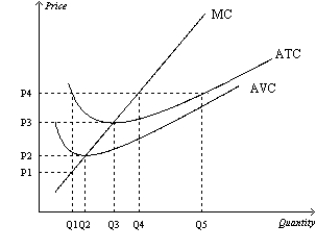 -Refer to Figure 14-4. The firm will earn positive economic profits if the price is
(i)P4.
(ii)P3.
(iii)P2.
(iv)P1.
-Refer to Figure 14-4. The firm will earn positive economic profits if the price is
(i)P4.
(ii)P3.
(iii)P2.
(iv)P1. (Multiple Choice)
4.8/5 (73)
(73) Table 14-10
Suppose that a firm in a competitive market faces the following revenues and costs: 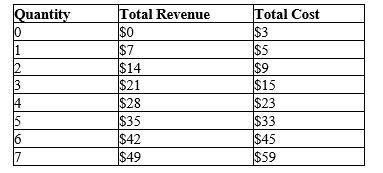 -Refer to Table 14-10. This firm should continue to produce and sell units as long as the marginal cost of production is less than or equal to
 (Multiple Choice)
4.8/5 (75)
(75) When the process of entry and exit has ended in a competitive market, are firms' profits positive, negative, or zero?
(Essay)
4.8/5 (77)
(77) In the long run, a profit-maximizing firm will choose to exit a market when
(Multiple Choice)
4.9/5 (66)
(66) Competitive firms that earn a loss in the short run should
(Multiple Choice)
4.9/5 (71)
(71) A profit-maximizing firm will shut down in the short run when
(Multiple Choice)
4.7/5 (81)
(81) Why does a firm in a competitive industry charge the market price?
(Multiple Choice)
4.8/5 (75)
(75) 
Filters
- Essay(0)
- Multiple Choice(0)
- Short Answer(0)
- True False(0)
- Matching(0)