



 Chat with AI
Exam 27: Tools of Finance

Exam 1: Ten Principles of Economics455 Questions
Exam 2: Thinking Like an Economist643 Questions
Exam 3: Interdependence and the Gains From Trade547 Questions
Exam 4: The Market Forces of Supply and Demand693 Questions
Exam 5: Elasticity and Its Application626 Questions
Exam 6: Supply, Demand, and Government Policies668 Questions
Exam 7: Consumers, Producers, and the Efficiency of Markets547 Questions
Exam 8: Applications: the Costs of Taxation509 Questions
Exam 9: Application: International Trade521 Questions
Exam 10: Externalities543 Questions
Exam 11: Public Goods and Common Resources452 Questions
Exam 12: The Design of the Tax System664 Questions
Exam 13: The Costs of Production649 Questions
Exam 14: Firms in Competitive Markets604 Questions
Exam 15: Monopoly662 Questions
Exam 16: Monopolistic Competition649 Questions
Exam 17: Oligopoly522 Questions
Exam 18: The Markets for the Factors of Production592 Questions
Exam 19: Earnings and Discrimination511 Questions
Exam 20: Income Inequality and Poverty478 Questions
Exam 21: The Theory of Consumer Choice570 Questions
Exam 22: Frontiers in Microeconomics461 Questions
Exam 23: Measuring a Nation S Income547 Questions
Exam 24: Measuring the Cost of Living565 Questions
Exam 25: Production and Growth527 Questions
Exam 26: Saving, Investment, and the Financial System637 Questions
Exam 27: Tools of Finance534 Questions
Exam 28: Unemployment and Its Natural Rate701 Questions
Exam 29: The Monetary System540 Questions
Exam 30: Money Growth and Inflation504 Questions
Exam 31: Open-Economy Macroeconomics: Basic Concepts540 Questions
Exam 32: A Macroeconomic Theory of the Open Economy511 Questions
Exam 33: Aggregate Demand and Aggregate Supply572 Questions
Exam 34: The Influence of Monetary and Fiscal Policy on Aggregate Demand523 Questions
Exam 35: The Short-Run Tradeoff Between Inflation and Unemployment536 Questions
Exam 36: Six Debates Over Macroeconomic Policy354 Questions
Select questions type


The rule of 70 can be stated as follows: A variable with a growth rate of X percent per year
(Multiple Choice)
4.9/5  (87)
(87) Which of the following pairs of portfolios exemplifies the risk-return tradeoff?
(Multiple Choice)
4.8/5 (72)
(72) Suppose you will receive $500 at some point in the future. If the annual interest rate is 7.5 percent, then the present value of the $500 is
(Multiple Choice)
4.9/5 (94)
(94) Suppose you win a small lottery and you are given the following choice: You can (1) receive an immediate payment of $10,000 or (2) three annual payments, each in the amount of $3,600, with the first payment coming one year from now, the second two years from now, and the third three years from now. You would choose to take the three annual payments if the interest rate is
(Multiple Choice)
4.9/5 (87)
(87) Daniel has $300 in a bank account. Some years ago he put $213.20 into this account, and it has earned 5 percent interest every year since then. How many years ago did Daniel open his account?
(Multiple Choice)
4.9/5 (85)
(85) David recently received an inheritance, and he is planning to invest the inheritance in one of four stock portfolios. Which of these portfolios would you expect to have the lowest risk?
(Multiple Choice)
4.9/5 (93)
(93) Which of the following approaches to investing does not rely on fundamental analysis to choose the stocks in your portfolio?
(Multiple Choice)
4.9/5 (84)
(84) List three different ways that a risk-averse person can reduce financial risk.
(Essay)
4.7/5 (84)
(84) You have been promised a payment of $400 in the future. In which of the following cases is the present value of this payment the lowest?
(Multiple Choice)
4.8/5 (87)
(87) A company that produces baseball gloves is considering buying some new equipment that it expects will increase future profits. If the interest rate rises, then the present value of these future profits
(Multiple Choice)
4.8/5 (77)
(77) At about what number of companies does the reduction in risk from adding stocks of more companies to a portfolio do little to reduce risk?
(Essay)
5.0/5 (89)
(89) Figure 27-6. On the graph, x represents risk and y represents return. 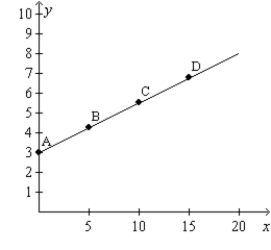 -Refer to Figure 27-6. Which of the following statements is correct?
 (Multiple Choice)
4.8/5 (74)
(74) What is the future value of $750 one year from today if the interest rate is 2.5 percent?
(Multiple Choice)
4.8/5 (80)
(80) Tonya put $250 into an account three years ago. The first year he earned 6 percent interest, the second year 7 percent, and the third year 8 percent. About how about much does Tonya have in her account now?
(Multiple Choice)
4.9/5 (84)
(84) At which interest rate is the present value of $196.85 three years from today equal to $175 today?
(Multiple Choice)
4.8/5 (82)
(82) Matt's Utility Function
Wealth
Utility
$50,000
7000
51,000
7250
52,000
7499
53,000
7746
If Matt's current wealth is $51,000, then
(Multiple Choice)
4.9/5 (84)
(84) Your accountant tells you that if you can continue to earn the current interest rate on your balance of $800 for the next two years you will have $898.88 in your account. If your accountant is correct, then what is the current interest rate?
(Multiple Choice)
4.9/5 (79)
(79) In answering which of the following questions would you find it necessary to calculate a future value?
(Multiple Choice)
4.9/5 (78)
(78) ZZL Corporation has the opportunity to undertake an investment project that will cost $20,000 today. If the interest rate is 20 percent and if the project will yield the company $30,000 in 3 years, then ZZL will undertake the project.
(True/False)
4.9/5 (68)
(68) 
Filters
- Essay(0)
- Multiple Choice(0)
- Short Answer(0)
- True False(0)
- Matching(0)