



 Chat with AI
Exam 27: Tools of Finance

Exam 1: Ten Principles of Economics455 Questions
Exam 2: Thinking Like an Economist643 Questions
Exam 3: Interdependence and the Gains From Trade547 Questions
Exam 4: The Market Forces of Supply and Demand693 Questions
Exam 5: Elasticity and Its Application626 Questions
Exam 6: Supply, Demand, and Government Policies668 Questions
Exam 7: Consumers, Producers, and the Efficiency of Markets547 Questions
Exam 8: Applications: the Costs of Taxation509 Questions
Exam 9: Application: International Trade521 Questions
Exam 10: Externalities543 Questions
Exam 11: Public Goods and Common Resources452 Questions
Exam 12: The Design of the Tax System664 Questions
Exam 13: The Costs of Production649 Questions
Exam 14: Firms in Competitive Markets604 Questions
Exam 15: Monopoly662 Questions
Exam 16: Monopolistic Competition649 Questions
Exam 17: Oligopoly522 Questions
Exam 18: The Markets for the Factors of Production592 Questions
Exam 19: Earnings and Discrimination511 Questions
Exam 20: Income Inequality and Poverty478 Questions
Exam 21: The Theory of Consumer Choice570 Questions
Exam 22: Frontiers in Microeconomics461 Questions
Exam 23: Measuring a Nation S Income547 Questions
Exam 24: Measuring the Cost of Living565 Questions
Exam 25: Production and Growth527 Questions
Exam 26: Saving, Investment, and the Financial System637 Questions
Exam 27: Tools of Finance534 Questions
Exam 28: Unemployment and Its Natural Rate701 Questions
Exam 29: The Monetary System540 Questions
Exam 30: Money Growth and Inflation504 Questions
Exam 31: Open-Economy Macroeconomics: Basic Concepts540 Questions
Exam 32: A Macroeconomic Theory of the Open Economy511 Questions
Exam 33: Aggregate Demand and Aggregate Supply572 Questions
Exam 34: The Influence of Monetary and Fiscal Policy on Aggregate Demand523 Questions
Exam 35: The Short-Run Tradeoff Between Inflation and Unemployment536 Questions
Exam 36: Six Debates Over Macroeconomic Policy354 Questions
Select questions type


Mary Beth is risk averse and has $1,000 with which to make a financial investment. She has three options. Option A is a risk-free government bond that pays 5 percent interest each year for two years. Option B is a low-risk stock that analysts expect to be worth about $1,102.50 in two years. Option C is a high-risk stock that is expected to be worth about $1,200 in four years. Mary Beth should choose
(Multiple Choice)
4.7/5  (80)
(80) Suppose you own a savings bond that will pay you $100 in 7 years. If the annual interest rate is 2%, what is the present value of the savings bond?
(Multiple Choice)
4.8/5 (74)
(74) The last $2,000 of Rolanda's wealth adds less to her utility than the previous $2,000. Based on this information, Rolanda has
(Multiple Choice)
4.9/5 (78)
(78) Increasing the number of corporations whose stocks are in your portfolio reduces market risk.
(True/False)
4.9/5 (80)
(80) The possibility of speculative bubbles in the stock market arises in part because
(Multiple Choice)
4.9/5 (81)
(81) At an annual interest rate of 20 percent, about how many years will it take $100 to triple in value?
(Multiple Choice)
5.0/5 (78)
(78) Susan is planning to invest in one of four stock portfolios, and her financial advisor has given her details regarding the risk associated with each portfolio. Which of the following portfolios would you expect to have the highest average annual rate of return?
(Multiple Choice)
4.9/5 (75)
(75) Which of the following statements best describes the economist's view of finance and the financial system?
(Multiple Choice)
4.8/5 (81)
(81) Svetlana is risk averse. Which of the following is correct about Svetlana?
(Multiple Choice)
4.9/5 (87)
(87) Anthony closes out his account in which he deposited $500 five years ago at an interest rate of 5%. Mark closes out his account in which he deposited $500 ten years ago at an interest rate of 5%. Who had more in their account? About how much more did he have?
(Essay)
4.8/5 (84)
(84) Risk aversion simply means that people dislike bad things to happen.
(True/False)
4.8/5 (87)
(87) After the 1982 recession, the U.S. and world economies entered into a long period
(Multiple Choice)
4.9/5 (95)
(95) Speculative bubbles may arise in part because the value of the stock to a stockholder depends on the final sale price.
(True/False)
4.8/5 (69)
(69) According to the efficient markets hypothesis, worse-than-expected news about a corporation will
(Multiple Choice)
4.7/5 (70)
(70) Assuming the interest rate is 6 percent, which of the following has the greatest present value?
(Multiple Choice)
4.8/5 (79)
(79) Zoey wants to have about $750,000 when she retires in 10 years. She has $300,000 to deposit now. At which of the following interest rates would Zoey's deposit come closest to $750,000 after 10 years?
(Multiple Choice)
4.8/5 (90)
(90) Figure 27-4. The figure shows a utility function for Alex. 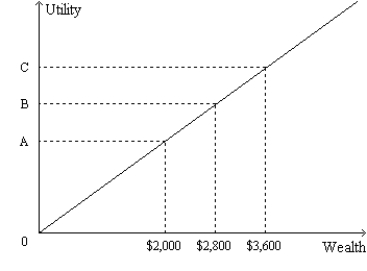 -Refer to Figure 27-4. From the appearance of Alex's utility function, we know that
 (Multiple Choice)
4.7/5 (85)
(85) Fourteen years ago William put money in his account at First National Bank. William decides to cash in his account and is told that his money has quadrupled. According to the rule of 70, what rate of interest did Alfred earn?
(Multiple Choice)
4.9/5 (73)
(73) 
Filters
- Essay(0)
- Multiple Choice(0)
- Short Answer(0)
- True False(0)
- Matching(0)