



 Chat with AI
Exam 27: Tools of Finance

Exam 1: Ten Principles of Economics455 Questions
Exam 2: Thinking Like an Economist643 Questions
Exam 3: Interdependence and the Gains From Trade547 Questions
Exam 4: The Market Forces of Supply and Demand693 Questions
Exam 5: Elasticity and Its Application626 Questions
Exam 6: Supply, Demand, and Government Policies668 Questions
Exam 7: Consumers, Producers, and the Efficiency of Markets547 Questions
Exam 8: Applications: the Costs of Taxation509 Questions
Exam 9: Application: International Trade521 Questions
Exam 10: Externalities543 Questions
Exam 11: Public Goods and Common Resources452 Questions
Exam 12: The Design of the Tax System664 Questions
Exam 13: The Costs of Production649 Questions
Exam 14: Firms in Competitive Markets604 Questions
Exam 15: Monopoly662 Questions
Exam 16: Monopolistic Competition649 Questions
Exam 17: Oligopoly522 Questions
Exam 18: The Markets for the Factors of Production592 Questions
Exam 19: Earnings and Discrimination511 Questions
Exam 20: Income Inequality and Poverty478 Questions
Exam 21: The Theory of Consumer Choice570 Questions
Exam 22: Frontiers in Microeconomics461 Questions
Exam 23: Measuring a Nation S Income547 Questions
Exam 24: Measuring the Cost of Living565 Questions
Exam 25: Production and Growth527 Questions
Exam 26: Saving, Investment, and the Financial System637 Questions
Exam 27: Tools of Finance534 Questions
Exam 28: Unemployment and Its Natural Rate701 Questions
Exam 29: The Monetary System540 Questions
Exam 30: Money Growth and Inflation504 Questions
Exam 31: Open-Economy Macroeconomics: Basic Concepts540 Questions
Exam 32: A Macroeconomic Theory of the Open Economy511 Questions
Exam 33: Aggregate Demand and Aggregate Supply572 Questions
Exam 34: The Influence of Monetary and Fiscal Policy on Aggregate Demand523 Questions
Exam 35: The Short-Run Tradeoff Between Inflation and Unemployment536 Questions
Exam 36: Six Debates Over Macroeconomic Policy354 Questions
Select questions type


Which of the following changes would increase the present value of a future payment?
(Multiple Choice)
4.9/5  (90)
(90) Mixster Concrete Company is considering buying a new cement truck. The owners and their accountants decide that this is the profitable thing to do. Before they can buy the truck, the interest rate and price of trucks change. In which case do these changes both make them less likely to buy the truck?
(Multiple Choice)
4.8/5 (73)
(73) What is the future value of $450 at an interest rate of 9 percent two years from today?
(Multiple Choice)
4.9/5 (84)
(84) On the Internet you find the following offers for opening an online account. Which of them is the best offer if you have $5,000 to save for two years?
(Multiple Choice)
4.8/5 (81)
(81) Write the formula for finding the future value of $1,000 today in 10 years if the interest rate is 4 percent.
(Short Answer)
4.8/5 (91)
(91) Figure 27-1. The figure shows a utility function. 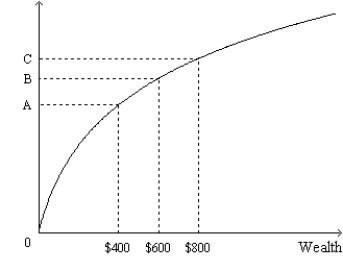 -Refer to Figure 27-1. The properties exhibited by this utility function help to explain various things we observe in the economy, including
 (Multiple Choice)
4.9/5 (76)
(76) Should a person who is risk averse hold a portfolio with no stock and only bonds?
Explain.
(Essay)
4.9/5 (84)
(84) Ellen deposited $500 into an account and two years later she had $561.80 in the account. What interest rate was paid on Ellen's deposit?
(Multiple Choice)
4.9/5 (76)
(76) At which interest rate is the present value of $168.54 two years from today equal to $150 today?
(Multiple Choice)
4.9/5 (84)
(84) Which, if any, of the present values below are computed correctly?
(Multiple Choice)
4.8/5 (79)
(79) As the interest rate increases, what happens to the present value of a future payment? Explain why changes in the interest rate will lead to changes in the quantity of loanable funds demanded and investment spending.
(Essay)
4.8/5 (86)
(86) Fundamental analysis shows that stock in Garske Software Corporation has a present value that is higher than its price.
(Multiple Choice)
4.8/5 (89)
(89) According to fundamental analysis, when choosing stocks for your portfolio, you should prefer undervalued stocks.
(True/False)
4.8/5 (71)
(71) Give an example of adverse selection and an example of moral hazard using homeowners insurance.
(Essay)
4.8/5 (95)
(95) Suppose Dave drives more recklessly when he has car insurance than when he does not have car insurance. This is an example of the moral hazard problem associated with insurance.
(True/False)
4.9/5 (77)
(77) Laura says that the present value of $700 to be received one year from today if the interest rate is 6 percent is less than the present value of $700 to be received two years from today if the interest rate is 3 percent. Cassie says that $700 saved for one year at 6 percent interest has a smaller future value than $700 saved for two years at 3 percent interest.
(Multiple Choice)
4.9/5 (93)
(93) 
Filters
- Essay(0)
- Multiple Choice(0)
- Short Answer(0)
- True False(0)
- Matching(0)