



 Chat with AI
Exam 27: Tools of Finance

Exam 1: Ten Principles of Economics455 Questions
Exam 2: Thinking Like an Economist643 Questions
Exam 3: Interdependence and the Gains From Trade547 Questions
Exam 4: The Market Forces of Supply and Demand693 Questions
Exam 5: Elasticity and Its Application626 Questions
Exam 6: Supply, Demand, and Government Policies668 Questions
Exam 7: Consumers, Producers, and the Efficiency of Markets547 Questions
Exam 8: Applications: the Costs of Taxation509 Questions
Exam 9: Application: International Trade521 Questions
Exam 10: Externalities543 Questions
Exam 11: Public Goods and Common Resources452 Questions
Exam 12: The Design of the Tax System664 Questions
Exam 13: The Costs of Production649 Questions
Exam 14: Firms in Competitive Markets604 Questions
Exam 15: Monopoly662 Questions
Exam 16: Monopolistic Competition649 Questions
Exam 17: Oligopoly522 Questions
Exam 18: The Markets for the Factors of Production592 Questions
Exam 19: Earnings and Discrimination511 Questions
Exam 20: Income Inequality and Poverty478 Questions
Exam 21: The Theory of Consumer Choice570 Questions
Exam 22: Frontiers in Microeconomics461 Questions
Exam 23: Measuring a Nation S Income547 Questions
Exam 24: Measuring the Cost of Living565 Questions
Exam 25: Production and Growth527 Questions
Exam 26: Saving, Investment, and the Financial System637 Questions
Exam 27: Tools of Finance534 Questions
Exam 28: Unemployment and Its Natural Rate701 Questions
Exam 29: The Monetary System540 Questions
Exam 30: Money Growth and Inflation504 Questions
Exam 31: Open-Economy Macroeconomics: Basic Concepts540 Questions
Exam 32: A Macroeconomic Theory of the Open Economy511 Questions
Exam 33: Aggregate Demand and Aggregate Supply572 Questions
Exam 34: The Influence of Monetary and Fiscal Policy on Aggregate Demand523 Questions
Exam 35: The Short-Run Tradeoff Between Inflation and Unemployment536 Questions
Exam 36: Six Debates Over Macroeconomic Policy354 Questions
Select questions type


Al, Ralph, and Stan are all intending to retire. Each currently has $1 million in assets. Al will earn 16% interest and retire in two years. Ralph will earn 8% interest and retire in four years. Stan will earn 4% interest and retire in eight years. Who will have the largest sum when he retires?
(Multiple Choice)
4.8/5  (81)
(81) Scenario 27-2
Suppose Dave has a utility function  where W is his wealth in millions of dollars and U is the utility he obtains.
-Refer to Scenario 27-2. Suppose Dave is faced with a choice between two options. With option A Dave receives a guaranteed $2 million. With option B Dave faces a lottery that pays $0 with probability 0.8 and pays $10 million with probability 0.2. Given Dave's utility function, will he prefer option A or option B? Provide evidence to support your answer.
where W is his wealth in millions of dollars and U is the utility he obtains.
-Refer to Scenario 27-2. Suppose Dave is faced with a choice between two options. With option A Dave receives a guaranteed $2 million. With option B Dave faces a lottery that pays $0 with probability 0.8 and pays $10 million with probability 0.2. Given Dave's utility function, will he prefer option A or option B? Provide evidence to support your answer. (Essay)
4.9/5 (93)
(93) Which of the following is correct concerning a risk-averse person?
(Multiple Choice)
5.0/5 (72)
(72) Risk-averse individuals like good things more than they dislike comparable bad things.
(True/False)
4.7/5 (89)
(89) Figure 27-4. The figure shows a utility function for Alex. 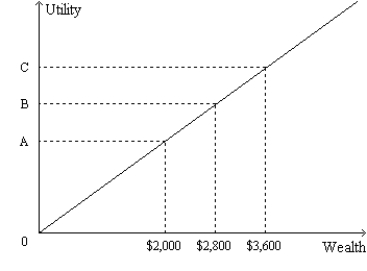 -Refer to Figure 27-4. From the appearance of Alex's utility function, we know that
 (Multiple Choice)
4.7/5 (82)
(82) The concept of present value helps explain why the quantity of loanable funds demanded decreases when the interest rate increases.
(True/False)
4.8/5 (86)
(86) A person with diminishing marginal utility of wealth is risk averse.
(True/False)
4.9/5 (75)
(75) Other things the same, as the stocks of a greater number of corporations are held in a portfolio,
(Multiple Choice)
4.9/5 (89)
(89) If you wish to rely on fundamental analysis to choose a portfolio of stocks, then you have no choice but to do all the necessary research yourself.
(True/False)
4.9/5 (88)
(88) As the number of stocks in a person's portfolio increases,
(Multiple Choice)
4.8/5 (81)
(81) La Rossa Pasta Company is considering expanding its factory. In which case would both the change in the cost and the change in the interest rate each make it less likely that La Rossa's would expand?
(Multiple Choice)
4.8/5 (70)
(70) Will is risk averse and has $1,000 with which to make a financial investment. He has three options. Option A is a risk-free government bond that pays 5 percent interest each year for two years. Option B is a low-risk stock that analysts expect to be worth about $1,102.50 in two years. Option C is a high-risk stock that is expected to be worth about $1,200 in four years. Will should choose
(Multiple Choice)
5.0/5 (85)
(85) The present value of a payment to be made in the future falls as
(Multiple Choice)
4.7/5 (84)
(84) Which of the following actions best illustrates moral hazard?
(Multiple Choice)
4.8/5 (72)
(72) Chloe talked to several stockbrokers and made the following conclusions. Which, if any, of Chloe's conclusions are correct?
(Multiple Choice)
4.8/5 (81)
(81) 
Filters
- Essay(0)
- Multiple Choice(0)
- Short Answer(0)
- True False(0)
- Matching(0)