



 Chat with AI
Exam 27: Tools of Finance

Exam 1: Ten Principles of Economics455 Questions
Exam 2: Thinking Like an Economist643 Questions
Exam 3: Interdependence and the Gains From Trade547 Questions
Exam 4: The Market Forces of Supply and Demand693 Questions
Exam 5: Elasticity and Its Application626 Questions
Exam 6: Supply, Demand, and Government Policies668 Questions
Exam 7: Consumers, Producers, and the Efficiency of Markets547 Questions
Exam 8: Applications: the Costs of Taxation509 Questions
Exam 9: Application: International Trade521 Questions
Exam 10: Externalities543 Questions
Exam 11: Public Goods and Common Resources452 Questions
Exam 12: The Design of the Tax System664 Questions
Exam 13: The Costs of Production649 Questions
Exam 14: Firms in Competitive Markets604 Questions
Exam 15: Monopoly662 Questions
Exam 16: Monopolistic Competition649 Questions
Exam 17: Oligopoly522 Questions
Exam 18: The Markets for the Factors of Production592 Questions
Exam 19: Earnings and Discrimination511 Questions
Exam 20: Income Inequality and Poverty478 Questions
Exam 21: The Theory of Consumer Choice570 Questions
Exam 22: Frontiers in Microeconomics461 Questions
Exam 23: Measuring a Nation S Income547 Questions
Exam 24: Measuring the Cost of Living565 Questions
Exam 25: Production and Growth527 Questions
Exam 26: Saving, Investment, and the Financial System637 Questions
Exam 27: Tools of Finance534 Questions
Exam 28: Unemployment and Its Natural Rate701 Questions
Exam 29: The Monetary System540 Questions
Exam 30: Money Growth and Inflation504 Questions
Exam 31: Open-Economy Macroeconomics: Basic Concepts540 Questions
Exam 32: A Macroeconomic Theory of the Open Economy511 Questions
Exam 33: Aggregate Demand and Aggregate Supply572 Questions
Exam 34: The Influence of Monetary and Fiscal Policy on Aggregate Demand523 Questions
Exam 35: The Short-Run Tradeoff Between Inflation and Unemployment536 Questions
Exam 36: Six Debates Over Macroeconomic Policy354 Questions
Select questions type


John has been a sky diver for many years. When the company John works for offers its employees the option to purchase a life insurance policy, John purchases a policy. This illustrates the problem of
(Multiple Choice)
4.8/5  (95)
(95) What is the present value of a payment of $150 one year from today if the interest rate is 6 percent?
(Multiple Choice)
4.8/5 (71)
(71) You are given three options. You may have the balance in an account that has been collecting 5 percent interest for 20 years, the balance in an account that has been collecting 10 percent interest for 10 years, or the balance in an account that has been collecting 20 percent interest for five years. Each account had the same original balance. Which account now has the lowest balance?
(Multiple Choice)
4.8/5 (80)
(80) Tami knows that people in her family die young, and so she buys life insurance. Preston knows he is a reckless driver and so he applies for automobile insurance.
(Multiple Choice)
4.8/5 (85)
(85) Figure 27-5. The figure shows a utility function for Dexter. 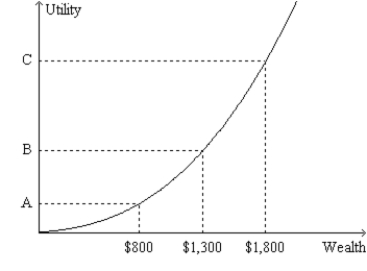 -Refer to Figure 27-5. From the appearance of the utility function, we know that
 (Multiple Choice)
4.8/5 (86)
(86) Suppose the interest rate is 10 percent. Which of the following payments has the largest present value?
(Multiple Choice)
4.8/5 (78)
(78) Suppose your bank account pays a 5% interest rate. You are considering purchasing a share of stock in DH Corporation for $250. The stock will pay you a $10 dividend at the end of years 1, 2, 3, 4, and 5. You expect to be able to sell the stock at the end of year 5 for $300. Is DH a good investment? Provide evidence to support your answer.
(Essay)
4.9/5 (80)
(80) At which interest rate is the present value of $145.80 two years from today equal to $125 today?
(Multiple Choice)
4.9/5 (81)
(81) Susan put $375 into an account and one year later had $405. What interest rate was paid on Susan's deposit?
(Multiple Choice)
4.7/5 (79)
(79) Vince says that the present value of $500 to be received one year from today if the interest rate is 8 percent is more than the present value of $500 to be received two years from today if the interest rate is 4 percent. Terri says that $500 saved for two years at an interest rate of 3 percent has a larger future value than $500 saved for one years at an interest rate of 6 percent.
(Multiple Choice)
4.9/5 (86)
(86) Suppose your grandfather put $10,000 in the bank in 1965 at an annual interest rate of 7%. Using the Rule of 70, approximately how large should the bank balance be in 2015?
(Multiple Choice)
4.9/5 (69)
(69) Suppose you place $1,000 into a savings account that will pay you 4% interest per year. What will be the future value of the savings account in 10 years?
(Short Answer)
4.8/5 (78)
(78) Imagine that someone offers you $100 today or $200 in 10 years. You would prefer to take the $100 today if the interest rate is
(Multiple Choice)
4.7/5 (79)
(79) Jarrod says that the future value of $250 saved for one year at 6 percent interest is less than the future value of $250 saved for two years at 3 percent interest. Simon says that the present value of a $250 payment to be received in one year when the interest rate is 6 percent is less than the value of a $250 payment to be received in two years when the interest rate is 3 percent.
(Multiple Choice)
4.9/5 (94)
(94) Sage decides to cash in all his savings to open a recording studio. He has three accounts to cash in. The first earned 9 percent for two years. The second earned 6 percent for three years. And the last earned 3 percent for six years. Supposing he started with $5,000 in each account, from which account will he get the most cash?
(Multiple Choice)
4.8/5 (88)
(88) What is the present value of a payment of $100 one year from today if the interest rate is 5 percent?
(Multiple Choice)
4.9/5 (73)
(73) Cash payments that companies make to shareholders are called
(Multiple Choice)
5.0/5 (75)
(75) According to the efficient markets hypothesis, stocks follow a random walk so that stocks that increase in price one year are more likely to increase than decrease in the next year.
(True/False)
4.7/5 (85)
(85) 
Filters
- Essay(0)
- Multiple Choice(0)
- Short Answer(0)
- True False(0)
- Matching(0)