



 Chat with AI
Exam 27: Tools of Finance

Exam 1: Ten Principles of Economics455 Questions
Exam 2: Thinking Like an Economist643 Questions
Exam 3: Interdependence and the Gains From Trade547 Questions
Exam 4: The Market Forces of Supply and Demand693 Questions
Exam 5: Elasticity and Its Application626 Questions
Exam 6: Supply, Demand, and Government Policies668 Questions
Exam 7: Consumers, Producers, and the Efficiency of Markets547 Questions
Exam 8: Applications: the Costs of Taxation509 Questions
Exam 9: Application: International Trade521 Questions
Exam 10: Externalities543 Questions
Exam 11: Public Goods and Common Resources452 Questions
Exam 12: The Design of the Tax System664 Questions
Exam 13: The Costs of Production649 Questions
Exam 14: Firms in Competitive Markets604 Questions
Exam 15: Monopoly662 Questions
Exam 16: Monopolistic Competition649 Questions
Exam 17: Oligopoly522 Questions
Exam 18: The Markets for the Factors of Production592 Questions
Exam 19: Earnings and Discrimination511 Questions
Exam 20: Income Inequality and Poverty478 Questions
Exam 21: The Theory of Consumer Choice570 Questions
Exam 22: Frontiers in Microeconomics461 Questions
Exam 23: Measuring a Nation S Income547 Questions
Exam 24: Measuring the Cost of Living565 Questions
Exam 25: Production and Growth527 Questions
Exam 26: Saving, Investment, and the Financial System637 Questions
Exam 27: Tools of Finance534 Questions
Exam 28: Unemployment and Its Natural Rate701 Questions
Exam 29: The Monetary System540 Questions
Exam 30: Money Growth and Inflation504 Questions
Exam 31: Open-Economy Macroeconomics: Basic Concepts540 Questions
Exam 32: A Macroeconomic Theory of the Open Economy511 Questions
Exam 33: Aggregate Demand and Aggregate Supply572 Questions
Exam 34: The Influence of Monetary and Fiscal Policy on Aggregate Demand523 Questions
Exam 35: The Short-Run Tradeoff Between Inflation and Unemployment536 Questions
Exam 36: Six Debates Over Macroeconomic Policy354 Questions
Select questions type


If you believe that stock prices follow a random walk, then probably you
(Multiple Choice)
4.9/5  (92)
(92) If the interest rate is 4 percent, then you would be equally happy if you received a gift of either $100 today or a gift of
(Multiple Choice)
5.0/5 (80)
(80) Imagine that someone offers you $X today or $1,500 in 5 years. If the interest rate is 4 percent, then you would prefer to take the $X today if and only if
(Multiple Choice)
4.8/5 (71)
(71) Which of the following is correct concerning stock market irrationality?
(Multiple Choice)
4.9/5 (72)
(72) Two years ago Darryl put $3,000 into an account paying 3 percent interest. How much does he have in the account today?
(Multiple Choice)
4.8/5 (79)
(79) You want to have $100,000 in five years. If the interest rate is 8 percent, about how much do you need to have today?
(Multiple Choice)
4.8/5 (66)
(66) The future value of $500 saved for two years at an interest rate of 5% is
(Multiple Choice)
4.9/5 (79)
(79) Figure 27-4. The figure shows a utility function for Alex. 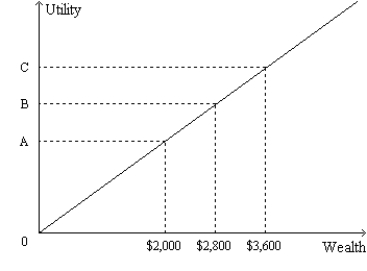 -Refer to Figure 27-4. If most people's utility functions look like Alex's utility function, then it is easy to explain why
 (Multiple Choice)
4.9/5 (72)
(72) You have been promised a payment of $250,000 in the future. In which case is the present value of this payment highest?
(Multiple Choice)
4.8/5 (80)
(80) Rory receives, from an insurance company, a payment of $5,000 each year, and he will continue to receive these payments until he dies. This series of payments is called a(n)
(Multiple Choice)
4.8/5 (69)
(69) The objective of diversification is to reduce risk. How does a person diversify a stock portfolio? How is risk measured?
(Essay)
4.8/5 (74)
(74) Recently, Lisa's wealth increased by $500. If her wealth were to increase by another $500 in the near future, then her utility would increase, but not by as much as it increased with the recent increase to her wealth. Based on this information, Lisa's utility function
(Multiple Choice)
4.9/5 (97)
(97) What is the present value of a payment of $100 to be made one year from today if the interest rate is 6 percent?
(Multiple Choice)
4.9/5 (75)
(75) Fundamental analysis shows that Quadrangle Company is fairly valued. Then Quadrangle Company unexpectedly improves its production techniques and unexpectedly hires a new CEO away from another very successful competitor. Suppose this has no effect on the price of the stock of Quadrangle Company.
(Multiple Choice)
4.8/5 (58)
(58) Allen Steel Company is considering whether to build a new mill. If the interest rate rises,
(Multiple Choice)
4.9/5 (89)
(89) The value of a stock depends on the ability of the company to generate dividends and the expected price of the stock when the stockholder sells her shares.
(True/False)
4.9/5 (85)
(85) Scenario 27-1
Lisa has a utility function  where W is Lisa's wealth in millions of dollars and U is the utility she obtains.
-Refer to Scenario 27-1. Is Lisa risk averse? Explain.
where W is Lisa's wealth in millions of dollars and U is the utility she obtains.
-Refer to Scenario 27-1. Is Lisa risk averse? Explain. (Essay)
4.9/5 (81)
(81) 
Filters
- Essay(0)
- Multiple Choice(0)
- Short Answer(0)
- True False(0)
- Matching(0)