



 Chat with AI
Exam 27: Tools of Finance

Exam 1: Ten Principles of Economics455 Questions
Exam 2: Thinking Like an Economist643 Questions
Exam 3: Interdependence and the Gains From Trade547 Questions
Exam 4: The Market Forces of Supply and Demand693 Questions
Exam 5: Elasticity and Its Application626 Questions
Exam 6: Supply, Demand, and Government Policies668 Questions
Exam 7: Consumers, Producers, and the Efficiency of Markets547 Questions
Exam 8: Applications: the Costs of Taxation509 Questions
Exam 9: Application: International Trade521 Questions
Exam 10: Externalities543 Questions
Exam 11: Public Goods and Common Resources452 Questions
Exam 12: The Design of the Tax System664 Questions
Exam 13: The Costs of Production649 Questions
Exam 14: Firms in Competitive Markets604 Questions
Exam 15: Monopoly662 Questions
Exam 16: Monopolistic Competition649 Questions
Exam 17: Oligopoly522 Questions
Exam 18: The Markets for the Factors of Production592 Questions
Exam 19: Earnings and Discrimination511 Questions
Exam 20: Income Inequality and Poverty478 Questions
Exam 21: The Theory of Consumer Choice570 Questions
Exam 22: Frontiers in Microeconomics461 Questions
Exam 23: Measuring a Nation S Income547 Questions
Exam 24: Measuring the Cost of Living565 Questions
Exam 25: Production and Growth527 Questions
Exam 26: Saving, Investment, and the Financial System637 Questions
Exam 27: Tools of Finance534 Questions
Exam 28: Unemployment and Its Natural Rate701 Questions
Exam 29: The Monetary System540 Questions
Exam 30: Money Growth and Inflation504 Questions
Exam 31: Open-Economy Macroeconomics: Basic Concepts540 Questions
Exam 32: A Macroeconomic Theory of the Open Economy511 Questions
Exam 33: Aggregate Demand and Aggregate Supply572 Questions
Exam 34: The Influence of Monetary and Fiscal Policy on Aggregate Demand523 Questions
Exam 35: The Short-Run Tradeoff Between Inflation and Unemployment536 Questions
Exam 36: Six Debates Over Macroeconomic Policy354 Questions
Select questions type


If a savings account pays 7% interest, then according to the rule of 70 how long will it take for the account balance to double?
(Short Answer)
4.9/5  (74)
(74) Yoyo's Frozen Yogurt, Inc. is thinking of building a new warehouse. They believe that this will give them $50,000 of additional revenue at the end of one year, $60,000 additional revenue at the end of two years, and $70,000 in additional revenue at the end of three years. If the interest rate is 5 percent, Yoyo would be willing to pay
(Multiple Choice)
4.8/5 (88)
(88) Which of the following methods of picking stocks is not consistent with fundamental analysis?
(Multiple Choice)
4.9/5 (81)
(81) To diversify, a homeowner with a variable-rate mortgage should choose investments that
(Multiple Choice)
4.9/5 (74)
(74) The future value of a deposit in a savings account will be smaller
(Multiple Choice)
4.9/5 (74)
(74) If the interest rate is 5 percent, then receiving $1,000 eight years from now is worth more than receiving $700 today.
(True/False)
4.8/5 (79)
(79) People who are risk averse dislike bad outcomes more than they like comparable good outcomes.
(True/False)
4.7/5 (91)
(91) Suppose your uncle offers you $100 today or $150 in 10 years. You would prefer to take the $100 today if the interest rate is
(Multiple Choice)
4.8/5 (75)
(75) Which of the following is the correct expression for finding the present value of a $500 payment two years from today if the interest rate is 6 percent?
(Multiple Choice)
4.8/5 (85)
(85) Suppose you have a choice between receiving a lump-sum payment of $10,000 today or four annual payments of $2,750 (with the first payment one year from today). Of the following, which is the highest annual interest rate at which you would prefer the four annual payments over the lump-sum payment?
(Multiple Choice)
4.9/5 (70)
(70) Suppose that Albert can buy a bond for $1,000 that matures in two years and pays Albert $1,102.5 with certainty. He is indifferent between this bond and one that has some risk but on which the interest rate is 3% higher. How much, to the nearest penny, does the riskier bond pay in two years?
(Multiple Choice)
4.8/5 (83)
(83) Which famous person referred to compounding as "the greatest mathematical discovery of all time?"
(Multiple Choice)
4.9/5 (88)
(88) Figure 27-2. The figure shows a utility function for Britney. 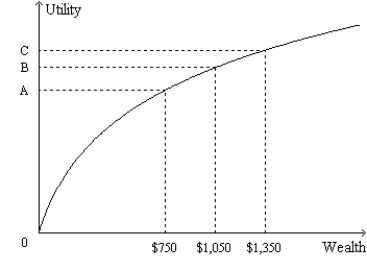 -Refer to Figure 27-2. From the appearance of the utility function, we know that
 (Multiple Choice)
4.8/5 (66)
(66) Suppose you are deciding whether to buy a particular bond. If you buy the bond and hold it for 4 years, then at that time you will receive a payment of $10,000. If the interest rate is 6 percent, you will buy the bond if its price today is no greater than
(Multiple Choice)
4.9/5 (86)
(86) Abby buys health insurance because she knows that she has health risks that wouldn't be obvious to an insurance company. Brad buys home owners insurance and then is less careful to make sure he's put out his cigarettes. The example with Abby
(Multiple Choice)
4.8/5 (80)
(80) Suppose you put $500 into a bank account today. Interest is paid annually and the annual interest rate is 8 percent. The future value of the $500 after 2 years is
(Multiple Choice)
4.8/5 (84)
(84) Figure 27-5. The figure shows a utility function for Dexter. 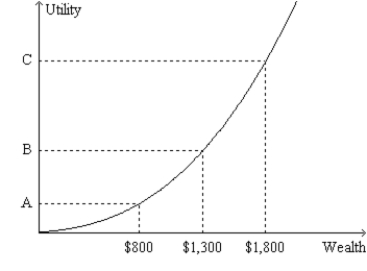 -Refer to Figure 27-5. From the appearance of the graph, we know that
 (Multiple Choice)
4.8/5 (86)
(86) Scenario 27-2
Suppose Dave has a utility function  where W is his wealth in millions of dollars and U is the utility he obtains.
-Refer to Scenario 27-2. Suppose Dave is faced with a choice between two options. With option A Dave receives a guaranteed $2 million. With option B Dave faces a lottery that pays $10 million with probability P and pays $0 with probability (1-P). Given Dave's utility function, how high does P need to be before he will prefer option B over option A?
where W is his wealth in millions of dollars and U is the utility he obtains.
-Refer to Scenario 27-2. Suppose Dave is faced with a choice between two options. With option A Dave receives a guaranteed $2 million. With option B Dave faces a lottery that pays $10 million with probability P and pays $0 with probability (1-P). Given Dave's utility function, how high does P need to be before he will prefer option B over option A? (Essay)
4.8/5 (80)
(80) 
Filters
- Essay(0)
- Multiple Choice(0)
- Short Answer(0)
- True False(0)
- Matching(0)