



 Chat with AI
Exam 6: Supply, Demand, and Government Policies

Exam 1: Ten Principles of Economics455 Questions
Exam 2: Thinking Like an Economist643 Questions
Exam 3: Interdependence and the Gains From Trade547 Questions
Exam 4: The Market Forces of Supply and Demand693 Questions
Exam 5: Elasticity and Its Application626 Questions
Exam 6: Supply, Demand, and Government Policies668 Questions
Exam 7: Consumers, Producers, and the Efficiency of Markets547 Questions
Exam 8: Applications: the Costs of Taxation509 Questions
Exam 9: Application: International Trade521 Questions
Exam 10: Externalities543 Questions
Exam 11: Public Goods and Common Resources452 Questions
Exam 12: The Design of the Tax System664 Questions
Exam 13: The Costs of Production649 Questions
Exam 14: Firms in Competitive Markets604 Questions
Exam 15: Monopoly662 Questions
Exam 16: Monopolistic Competition649 Questions
Exam 17: Oligopoly522 Questions
Exam 18: The Markets for the Factors of Production592 Questions
Exam 19: Earnings and Discrimination511 Questions
Exam 20: Income Inequality and Poverty478 Questions
Exam 21: The Theory of Consumer Choice570 Questions
Exam 22: Frontiers in Microeconomics461 Questions
Exam 23: Measuring a Nation S Income547 Questions
Exam 24: Measuring the Cost of Living565 Questions
Exam 25: Production and Growth527 Questions
Exam 26: Saving, Investment, and the Financial System637 Questions
Exam 27: Tools of Finance534 Questions
Exam 28: Unemployment and Its Natural Rate701 Questions
Exam 29: The Monetary System540 Questions
Exam 30: Money Growth and Inflation504 Questions
Exam 31: Open-Economy Macroeconomics: Basic Concepts540 Questions
Exam 32: A Macroeconomic Theory of the Open Economy511 Questions
Exam 33: Aggregate Demand and Aggregate Supply572 Questions
Exam 34: The Influence of Monetary and Fiscal Policy on Aggregate Demand523 Questions
Exam 35: The Short-Run Tradeoff Between Inflation and Unemployment536 Questions
Exam 36: Six Debates Over Macroeconomic Policy354 Questions
Select questions type


A legal maximum on the price at which a good can be sold is called a price
(Multiple Choice)
4.9/5  (84)
(84) If the equilibrium price of an airline ticket is $500 and the government imposes a price floor of $400 on airline tickets, then fewer airline tickets will be sold than at the market equilibrium.
(True/False)
4.9/5 (85)
(85) The distribution of the burden of a tax depends strictly on the elasticity of supply.
(True/False)
4.9/5 (81)
(81) If the demand curve is more price elastic than the supply curve in a particular market, will the buyers or the sellers bear a larger burden of a per-unit tax imposed on the market?
(Essay)
4.7/5 (70)
(70) Figure 6-25  -Refer to Figure 6-25. Suppose the same supply and demand curves apply, and a tax of the same amount per unit as shown here is imposed. Now, however, the sellers of the good, rather than the buyers, are required to pay the tax to the government. After the sellers are required to pay the tax, relative to the case depicted in the graph, the burden on buyers will be
 (Multiple Choice)
4.7/5 (82)
(82) When policymakers set prices by legal decree, they obscure the signals that normally guide the allocation of society's resources.
(True/False)
4.9/5 (72)
(72) Price ceilings are never binding when set above the equilibrium price.
(True/False)
4.8/5 (96)
(96) When a binding price floor is imposed on a market to benefit sellers,
(Multiple Choice)
4.9/5 (79)
(79) A $0.10 tax levied on the sellers of chocolate bars will cause the
(Multiple Choice)
4.7/5 (62)
(62) Figure 6-30
Panel (a)
Panel (b) 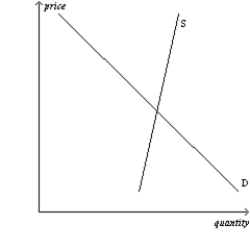
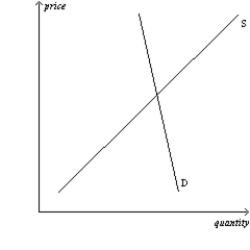 Panel (c)
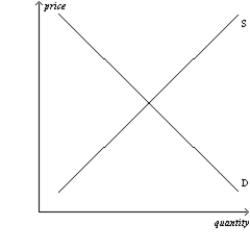 -Refer to Figure 6-30. In which market will the tax burden be most equally divided between buyers and sellers?
Panel (c)
-Refer to Figure 6-30. In which market will the tax burden be most equally divided between buyers and sellers? (Multiple Choice)
4.8/5 (90)
(90) 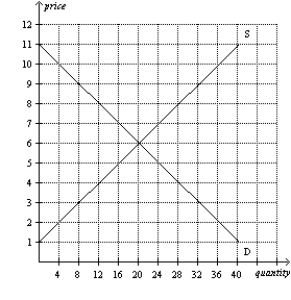 -Refer to Figure 6-9. A price floor set at
Price controls are usually enacted when policymakers believe that the market price of a good or service is unfair to buyers or sellers.
(True/False)
4.9/5 (77)
(77) 
Filters
- Essay(0)
- Multiple Choice(0)
- Short Answer(0)
- True False(0)
- Matching(0)