



 Chat with AI
Exam 6: Supply, Demand, and Government Policies

Exam 1: Ten Principles of Economics455 Questions
Exam 2: Thinking Like an Economist643 Questions
Exam 3: Interdependence and the Gains From Trade547 Questions
Exam 4: The Market Forces of Supply and Demand693 Questions
Exam 5: Elasticity and Its Application626 Questions
Exam 6: Supply, Demand, and Government Policies668 Questions
Exam 7: Consumers, Producers, and the Efficiency of Markets547 Questions
Exam 8: Applications: the Costs of Taxation509 Questions
Exam 9: Application: International Trade521 Questions
Exam 10: Externalities543 Questions
Exam 11: Public Goods and Common Resources452 Questions
Exam 12: The Design of the Tax System664 Questions
Exam 13: The Costs of Production649 Questions
Exam 14: Firms in Competitive Markets604 Questions
Exam 15: Monopoly662 Questions
Exam 16: Monopolistic Competition649 Questions
Exam 17: Oligopoly522 Questions
Exam 18: The Markets for the Factors of Production592 Questions
Exam 19: Earnings and Discrimination511 Questions
Exam 20: Income Inequality and Poverty478 Questions
Exam 21: The Theory of Consumer Choice570 Questions
Exam 22: Frontiers in Microeconomics461 Questions
Exam 23: Measuring a Nation S Income547 Questions
Exam 24: Measuring the Cost of Living565 Questions
Exam 25: Production and Growth527 Questions
Exam 26: Saving, Investment, and the Financial System637 Questions
Exam 27: Tools of Finance534 Questions
Exam 28: Unemployment and Its Natural Rate701 Questions
Exam 29: The Monetary System540 Questions
Exam 30: Money Growth and Inflation504 Questions
Exam 31: Open-Economy Macroeconomics: Basic Concepts540 Questions
Exam 32: A Macroeconomic Theory of the Open Economy511 Questions
Exam 33: Aggregate Demand and Aggregate Supply572 Questions
Exam 34: The Influence of Monetary and Fiscal Policy on Aggregate Demand523 Questions
Exam 35: The Short-Run Tradeoff Between Inflation and Unemployment536 Questions
Exam 36: Six Debates Over Macroeconomic Policy354 Questions
Select questions type


Which of the following is not an example of a public policy?
(Multiple Choice)
4.8/5  (88)
(88) The following table shows the demand and supply schedules in a particular market. 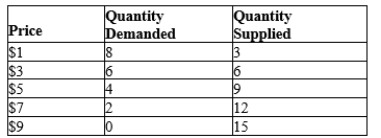 If the government sets a price floor $2 above the equilibrium price, how many units will be sold in this market?
 (Essay)
4.9/5 (81)
(81) Even though federal law mandates that workers and firms each pay half of the total FICA tax, the tax burden may not fall equally on workers and firms.
(True/False)
4.9/5 (79)
(79) A price floor set below the equilibrium price causes quantity supplied to exceed quantity demanded.
(True/False)
4.9/5 (78)
(78) Using a supply and demand diagram, show a labor market with a binding minimum wage. Use the diagram to show those who are helped by the minimum wage and those who are hurt by the minimum wage.
(Essay)
4.9/5 (92)
(92) Figure 6-13
This figure shows the market demand and market supply curves for good X. 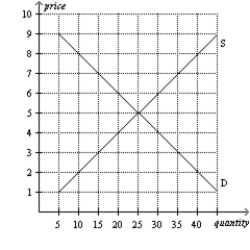 -Refer to Figure 6-13. Which of the following statements is correct?
 (Multiple Choice)
4.8/5 (86)
(86) Figure 6-33 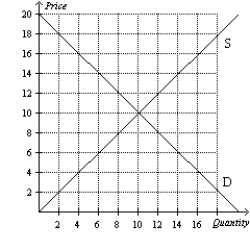 -Refer to Figure 6-33. Suppose a $3 per-unit tax is imposed on the sellers of this good. How much is the burden of this tax on the buyers in this market?
 (Short Answer)
4.9/5 (91)
(91) If the government levies a $5 tax per ticket on buyers of NFL game tickets, then the price paid by buyers of NFL game tickets would
(Multiple Choice)
5.0/5 (70)
(70) If a price floor is a binding constraint on a market, then
(Multiple Choice)
4.7/5 (87)
(87) The quantity sold in a market will decrease if the government
(Multiple Choice)
4.8/5 (80)
(80) Figure 6-21 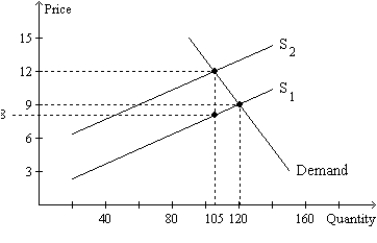 -Refer to Figure 6-21. Suppose buyers, rather than sellers, were required to pay this tax (in the same amount per unit as shown in the graph). Relative to the tax on sellers, the tax on buyers would result in
 (Multiple Choice)
4.9/5 (87)
(87) The term tax incidence refers to how the burden of a tax is distributed among the various people who make up the economy.
(True/False)
4.8/5 (72)
(72) The proportion of minimum-wage earners who are in families with incomes below the poverty line is
(Multiple Choice)
4.9/5 (91)
(91) Figure 6-35 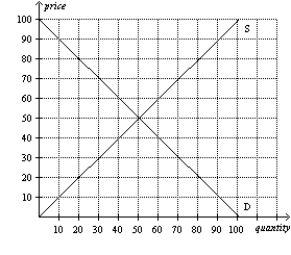 -Refer to Figure 6-35. A price floor set at $40 would create a surplus of 20 units.
 (True/False)
4.8/5 (87)
(87) Price is the rationing mechanism in a free, competitive market.
(True/False)
4.9/5 (77)
(77) 
Filters
- Essay(0)
- Multiple Choice(0)
- Short Answer(0)
- True False(0)
- Matching(0)