



 Chat with AI
Exam 6: Supply, Demand, and Government Policies

Exam 1: Ten Principles of Economics455 Questions
Exam 2: Thinking Like an Economist643 Questions
Exam 3: Interdependence and the Gains From Trade547 Questions
Exam 4: The Market Forces of Supply and Demand693 Questions
Exam 5: Elasticity and Its Application626 Questions
Exam 6: Supply, Demand, and Government Policies668 Questions
Exam 7: Consumers, Producers, and the Efficiency of Markets547 Questions
Exam 8: Applications: the Costs of Taxation509 Questions
Exam 9: Application: International Trade521 Questions
Exam 10: Externalities543 Questions
Exam 11: Public Goods and Common Resources452 Questions
Exam 12: The Design of the Tax System664 Questions
Exam 13: The Costs of Production649 Questions
Exam 14: Firms in Competitive Markets604 Questions
Exam 15: Monopoly662 Questions
Exam 16: Monopolistic Competition649 Questions
Exam 17: Oligopoly522 Questions
Exam 18: The Markets for the Factors of Production592 Questions
Exam 19: Earnings and Discrimination511 Questions
Exam 20: Income Inequality and Poverty478 Questions
Exam 21: The Theory of Consumer Choice570 Questions
Exam 22: Frontiers in Microeconomics461 Questions
Exam 23: Measuring a Nation S Income547 Questions
Exam 24: Measuring the Cost of Living565 Questions
Exam 25: Production and Growth527 Questions
Exam 26: Saving, Investment, and the Financial System637 Questions
Exam 27: Tools of Finance534 Questions
Exam 28: Unemployment and Its Natural Rate701 Questions
Exam 29: The Monetary System540 Questions
Exam 30: Money Growth and Inflation504 Questions
Exam 31: Open-Economy Macroeconomics: Basic Concepts540 Questions
Exam 32: A Macroeconomic Theory of the Open Economy511 Questions
Exam 33: Aggregate Demand and Aggregate Supply572 Questions
Exam 34: The Influence of Monetary and Fiscal Policy on Aggregate Demand523 Questions
Exam 35: The Short-Run Tradeoff Between Inflation and Unemployment536 Questions
Exam 36: Six Debates Over Macroeconomic Policy354 Questions
Select questions type


Economic policies often have effects that their architects did not intend or anticipate.
(True/False)
5.0/5  (88)
(88) Figure 6-31  -Refer to Figure 6-31. If the government set a price floor at $17, would there be a shortage or surplus, and how large would be the shortage/surplus?
 (Essay)
4.8/5 (75)
(75) A tax on buyers usually causes buyers to pay more for the good and sellers to receive less for the good than they did before the tax was levied.
(True/False)
4.9/5 (78)
(78) When a tax is placed on the buyers of tennis racquets, the size of the tennis racquet market
(Multiple Choice)
4.9/5 (81)
(81) Figure 6-9 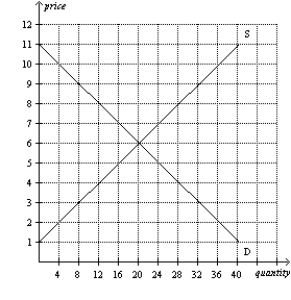 -Refer to Figure 6-9. At which price would a price ceiling be nonbinding?
 (Multiple Choice)
4.8/5 (99)
(99) Figure 6-12 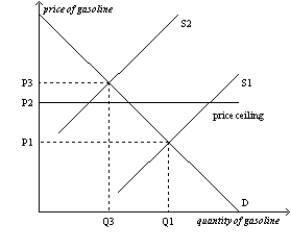 -Refer to Figure 6-12. When the price ceiling applies in this market and the supply curve for gasoline shifts from S1 to S2,
 (Multiple Choice)
4.8/5 (95)
(95) A $2.00 tax levied on the sellers of birdhouses will shift the supply curve
(Multiple Choice)
4.9/5 (84)
(84) If a binding price ceiling is imposed on the baby formula market, then
(Multiple Choice)
4.8/5 (76)
(76) Most labor economists believe that the supply of labor is much more elastic than the demand.
(True/False)
4.8/5 (80)
(80) Figure 6-4 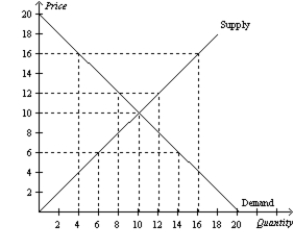 -Refer to Figure 6-4. Which of the following statements is not correct?
 (Multiple Choice)
4.8/5 (91)
(91) Figure 6-24  -Refer to Figure 6-24. What is the amount of the tax per unit?
 (Multiple Choice)
4.9/5 (64)
(64) Figure 6-7 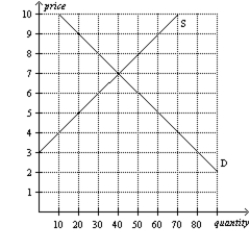 -Refer to Figure 6-7. For a price ceiling to be binding in this market, it would have to be set at
 (Multiple Choice)
4.9/5 (82)
(82) Table 6-3
The following table contains the demand schedule and supply schedule for a market for a particular good. Suppose sellers of the good successfully lobby Congress to impose a price floor $2 above the equilibrium price in this market. 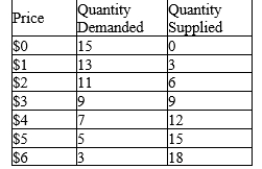 -Refer to Table 6-3. Following the imposition of a price floor $2 above the equilibrium price, irate buyers convince Congress to repeal the price floor and to impose a price ceiling $1 below the former price floor. The resulting shortage is
 (Multiple Choice)
4.9/5 (90)
(90) If the government levies a $500 tax per car on sellers of cars, then the price received by sellers of cars would
(Multiple Choice)
4.9/5 (70)
(70) A nonbinding price floor
(i)causes a surplus.
(ii)causes a shortage.
(iii)is set at a price above the equilibrium price.
(iv)is set at a price below the equilibrium price.
(Multiple Choice)
4.8/5 (82)
(82) Suppose there is currently a tax of $50 per ticket on airline tickets. Sellers of airline tickets are required to pay the tax to the government. If the tax is reduced from $50 per ticket to $30 per ticket, then the
(Multiple Choice)
4.9/5 (83)
(83) 
Filters
- Essay(0)
- Multiple Choice(0)
- Short Answer(0)
- True False(0)
- Matching(0)