



 Chat with AI
Exam 6: Supply, Demand, and Government Policies

Exam 1: Ten Principles of Economics455 Questions
Exam 2: Thinking Like an Economist643 Questions
Exam 3: Interdependence and the Gains From Trade547 Questions
Exam 4: The Market Forces of Supply and Demand693 Questions
Exam 5: Elasticity and Its Application626 Questions
Exam 6: Supply, Demand, and Government Policies668 Questions
Exam 7: Consumers, Producers, and the Efficiency of Markets547 Questions
Exam 8: Applications: the Costs of Taxation509 Questions
Exam 9: Application: International Trade521 Questions
Exam 10: Externalities543 Questions
Exam 11: Public Goods and Common Resources452 Questions
Exam 12: The Design of the Tax System664 Questions
Exam 13: The Costs of Production649 Questions
Exam 14: Firms in Competitive Markets604 Questions
Exam 15: Monopoly662 Questions
Exam 16: Monopolistic Competition649 Questions
Exam 17: Oligopoly522 Questions
Exam 18: The Markets for the Factors of Production592 Questions
Exam 19: Earnings and Discrimination511 Questions
Exam 20: Income Inequality and Poverty478 Questions
Exam 21: The Theory of Consumer Choice570 Questions
Exam 22: Frontiers in Microeconomics461 Questions
Exam 23: Measuring a Nation S Income547 Questions
Exam 24: Measuring the Cost of Living565 Questions
Exam 25: Production and Growth527 Questions
Exam 26: Saving, Investment, and the Financial System637 Questions
Exam 27: Tools of Finance534 Questions
Exam 28: Unemployment and Its Natural Rate701 Questions
Exam 29: The Monetary System540 Questions
Exam 30: Money Growth and Inflation504 Questions
Exam 31: Open-Economy Macroeconomics: Basic Concepts540 Questions
Exam 32: A Macroeconomic Theory of the Open Economy511 Questions
Exam 33: Aggregate Demand and Aggregate Supply572 Questions
Exam 34: The Influence of Monetary and Fiscal Policy on Aggregate Demand523 Questions
Exam 35: The Short-Run Tradeoff Between Inflation and Unemployment536 Questions
Exam 36: Six Debates Over Macroeconomic Policy354 Questions
Select questions type


Figure 6-32  -Refer to Figure 6-32. If the government set a price ceiling at $50, would there be a shortage or surplus, and how large would be the shortage/surplus?
 (Essay)
4.9/5  (78)
(78) If the government passes a law requiring sellers of mopeds to send $200 to the government for every moped they sell, then
(Multiple Choice)
4.9/5 (76)
(76) Table 6-4
The following table contains the demand schedule and supply schedule for a market for a particular good. Suppose sellers of the good successfully lobby Congress to impose a price floor $3 above the equilibrium price in this market. 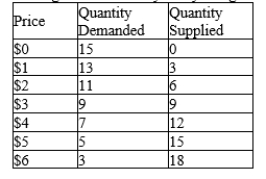 -Refer to Table 6-4. Following the imposition of a price floor $3 above the equilibrium price, irate buyers convince Congress to repeal the price floor and to impose a price ceiling $1 below the former price floor. The resulting shortage is
 (Multiple Choice)
4.9/5 (82)
(82) When a tax is placed on the buyers of cell phones, the size of the cell phone market
(Multiple Choice)
4.8/5 (93)
(93) In the short run, rent control causes the quantity supplied
(Multiple Choice)
4.7/5 (78)
(78) If a tax is levied on the sellers of a product, then there will be a(n)
(Multiple Choice)
4.9/5 (86)
(86) Figure 6-8 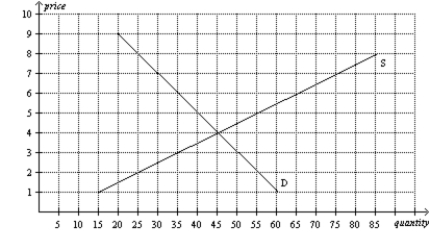 -Refer to Figure 6-8. If the government imposes a price floor of $5 on this market, then there will be
 (Multiple Choice)
4.7/5 (80)
(80) Figure 6-7 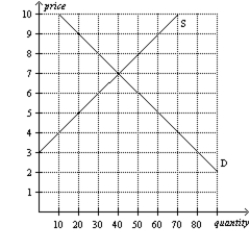 -Refer to Figure 6-7. Suppose a price ceiling of $5 is imposed on this market. As a result,
 (Multiple Choice)
4.9/5 (85)
(85) When a free market for a good reaches equilibrium, anyone who is willing and able to pay the market price can buy the good.
(True/False)
4.8/5 (78)
(78) Scenario 6-1
Suppose that demand in the market for good X is given by the equation  and that supply in the market for good X is given by the equation
 -Refer to Scenario 6-1. If the government set a price ceiling at $12, would there be a shortage or surplus, and how large would be the shortage/surplus?
and that supply in the market for good X is given by the equation
-Refer to Scenario 6-1. If the government set a price ceiling at $12, would there be a shortage or surplus, and how large would be the shortage/surplus? (Essay)
4.8/5 (77)
(77) Figure 6-20 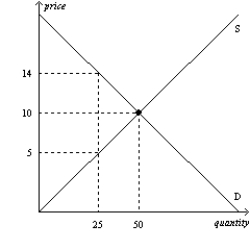 -Refer to Figure 6-20. Suppose a tax of $5 per unit is imposed on this market. What will be the new equilibrium quantity in this market?
 (Multiple Choice)
4.8/5 (76)
(76) If a tax is imposed on a market with inelastic supply and elastic demand, then
(Multiple Choice)
4.9/5 (101)
(101) When a tax of $1.00 per gallon is imposed on sellers of gasoline, the supply curve for gasoline shifts upward, but by less than $1.00.
(True/False)
4.9/5 (77)
(77) Which of the following observations would be consistent with the imposition of a binding price floor on a market? After the price floor becomes effective,
(Multiple Choice)
4.7/5 (95)
(95) Economists blame the long lines at gasoline stations in the U.S. in the 1970s on
(Multiple Choice)
4.9/5 (83)
(83) Which of the following is the most likely explanation for the imposition of a price ceiling on the market for milk?
(Multiple Choice)
4.9/5 (88)
(88) Regardless of whether a tax is levied on sellers or buyers, taxes encourage market activity.
(True/False)
4.9/5 (85)
(85) 
Filters
- Essay(0)
- Multiple Choice(0)
- Short Answer(0)
- True False(0)
- Matching(0)