



 Chat with AI
Exam 6: Supply, Demand, and Government Policies

Exam 1: Ten Principles of Economics455 Questions
Exam 2: Thinking Like an Economist643 Questions
Exam 3: Interdependence and the Gains From Trade547 Questions
Exam 4: The Market Forces of Supply and Demand693 Questions
Exam 5: Elasticity and Its Application626 Questions
Exam 6: Supply, Demand, and Government Policies668 Questions
Exam 7: Consumers, Producers, and the Efficiency of Markets547 Questions
Exam 8: Applications: the Costs of Taxation509 Questions
Exam 9: Application: International Trade521 Questions
Exam 10: Externalities543 Questions
Exam 11: Public Goods and Common Resources452 Questions
Exam 12: The Design of the Tax System664 Questions
Exam 13: The Costs of Production649 Questions
Exam 14: Firms in Competitive Markets604 Questions
Exam 15: Monopoly662 Questions
Exam 16: Monopolistic Competition649 Questions
Exam 17: Oligopoly522 Questions
Exam 18: The Markets for the Factors of Production592 Questions
Exam 19: Earnings and Discrimination511 Questions
Exam 20: Income Inequality and Poverty478 Questions
Exam 21: The Theory of Consumer Choice570 Questions
Exam 22: Frontiers in Microeconomics461 Questions
Exam 23: Measuring a Nation S Income547 Questions
Exam 24: Measuring the Cost of Living565 Questions
Exam 25: Production and Growth527 Questions
Exam 26: Saving, Investment, and the Financial System637 Questions
Exam 27: Tools of Finance534 Questions
Exam 28: Unemployment and Its Natural Rate701 Questions
Exam 29: The Monetary System540 Questions
Exam 30: Money Growth and Inflation504 Questions
Exam 31: Open-Economy Macroeconomics: Basic Concepts540 Questions
Exam 32: A Macroeconomic Theory of the Open Economy511 Questions
Exam 33: Aggregate Demand and Aggregate Supply572 Questions
Exam 34: The Influence of Monetary and Fiscal Policy on Aggregate Demand523 Questions
Exam 35: The Short-Run Tradeoff Between Inflation and Unemployment536 Questions
Exam 36: Six Debates Over Macroeconomic Policy354 Questions
Select questions type


If a binding price floor is imposed on the video game market, then
(Multiple Choice)
4.9/5  (76)
(76) Who bears the majority of a tax burden depends on the relative elasticity of supply and demand.
(True/False)
4.8/5 (66)
(66) There are several criticisms of the minimum wage. Which of the following is not one of those criticisms? The minimum wage
(Multiple Choice)
5.0/5 (77)
(77) Figure 6-16 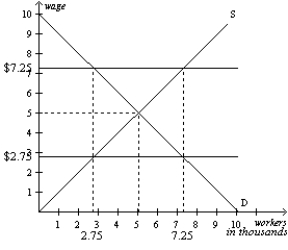 -Refer to Figure 6-16. In this market, a minimum wage of $2.75 is
 (Multiple Choice)
5.0/5 (96)
(96) Figure 6-31  -Refer to Figure 6-31. If the government set a price floor at $15, would there be a shortage or surplus, and how large would be the shortage/surplus?
 (Essay)
4.9/5 (65)
(65) If the government removes a binding price ceiling from a market, then the price received by sellers will
(Multiple Choice)
4.9/5 (83)
(83) Figure 6-29
Suppose the government imposes a $2 on this market. 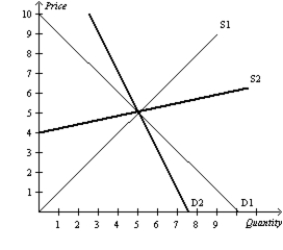 -Refer to Figure 6-29. The buyers and sellers will bear an equal share of the tax burden if the demand is
 (Multiple Choice)
4.7/5 (77)
(77) A tax on buyers decreases the quantity of the good sold in the market.
(True/False)
4.9/5 (89)
(89) Figure 6-34 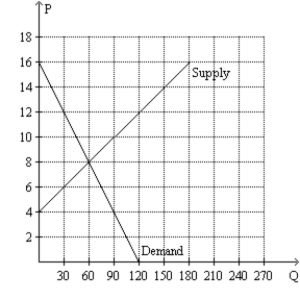 -Refer to Figure 6-34. If the government imposes a tax of $6 per unit in this market, how many units will be bought and sold in the market after the tax is imposed?
 (Essay)
5.0/5 (75)
(75) Figure 6-22 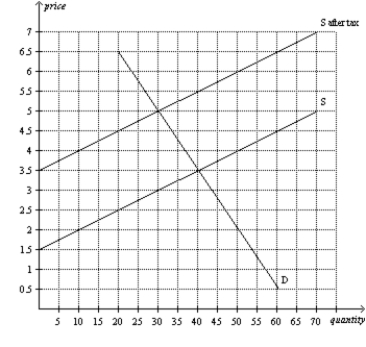 -Refer to Figure 6-22. Buyers pay how much of the tax per unit?
 (Multiple Choice)
4.9/5 (74)
(74) When government imposes a price ceiling or a price floor on a market,
(Multiple Choice)
4.9/5 (81)
(81) Figure 6-21 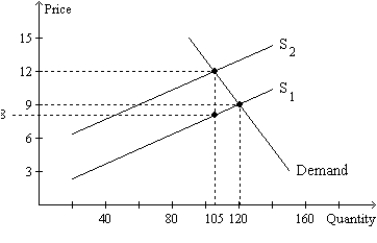 -Refer to Figure 6-21. What is the amount of the tax per unit?
 (Multiple Choice)
4.8/5 (79)
(79) Which of the following would be the most likely result of a binding price ceiling imposed on the market for rental cars?
(Multiple Choice)
4.7/5 (84)
(84) A binding price ceiling may not help all consumers, but it does not hurt any consumers.
(True/False)
4.8/5 (76)
(76) 
Filters
- Essay(0)
- Multiple Choice(0)
- Short Answer(0)
- True False(0)
- Matching(0)