



 Chat with AI
Exam 6: Supply, Demand, and Government Policies

Exam 1: Ten Principles of Economics455 Questions
Exam 2: Thinking Like an Economist643 Questions
Exam 3: Interdependence and the Gains From Trade547 Questions
Exam 4: The Market Forces of Supply and Demand693 Questions
Exam 5: Elasticity and Its Application626 Questions
Exam 6: Supply, Demand, and Government Policies668 Questions
Exam 7: Consumers, Producers, and the Efficiency of Markets547 Questions
Exam 8: Applications: the Costs of Taxation509 Questions
Exam 9: Application: International Trade521 Questions
Exam 10: Externalities543 Questions
Exam 11: Public Goods and Common Resources452 Questions
Exam 12: The Design of the Tax System664 Questions
Exam 13: The Costs of Production649 Questions
Exam 14: Firms in Competitive Markets604 Questions
Exam 15: Monopoly662 Questions
Exam 16: Monopolistic Competition649 Questions
Exam 17: Oligopoly522 Questions
Exam 18: The Markets for the Factors of Production592 Questions
Exam 19: Earnings and Discrimination511 Questions
Exam 20: Income Inequality and Poverty478 Questions
Exam 21: The Theory of Consumer Choice570 Questions
Exam 22: Frontiers in Microeconomics461 Questions
Exam 23: Measuring a Nation S Income547 Questions
Exam 24: Measuring the Cost of Living565 Questions
Exam 25: Production and Growth527 Questions
Exam 26: Saving, Investment, and the Financial System637 Questions
Exam 27: Tools of Finance534 Questions
Exam 28: Unemployment and Its Natural Rate701 Questions
Exam 29: The Monetary System540 Questions
Exam 30: Money Growth and Inflation504 Questions
Exam 31: Open-Economy Macroeconomics: Basic Concepts540 Questions
Exam 32: A Macroeconomic Theory of the Open Economy511 Questions
Exam 33: Aggregate Demand and Aggregate Supply572 Questions
Exam 34: The Influence of Monetary and Fiscal Policy on Aggregate Demand523 Questions
Exam 35: The Short-Run Tradeoff Between Inflation and Unemployment536 Questions
Exam 36: Six Debates Over Macroeconomic Policy354 Questions
Select questions type


To determine the incidence of a tax, it is necessary to have information on both the elasticity of demand and the elasticity of supply.
(True/False)
4.9/5  (82)
(82) Suppose the government has imposed a price ceiling on laptop computers. Which of the following events could transform the price ceiling from one that is not binding into one that is binding?
(Multiple Choice)
4.9/5 (78)
(78) When a tax is imposed on a good, the result is always a shortage of the good.
(True/False)
5.0/5 (91)
(91) Table 6-3
The following table contains the demand schedule and supply schedule for a market for a particular good. Suppose sellers of the good successfully lobby Congress to impose a price floor $2 above the equilibrium price in this market. 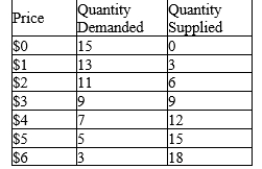 -Refer to Table 6-3. How many units of the good are sold after the imposition of the price floor?
 (Multiple Choice)
4.8/5 (93)
(93) When free markets ration goods with prices, it is both efficient and impersonal.
(True/False)
4.9/5 (69)
(69) Figure 6-12 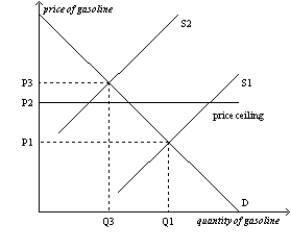 -Refer to Figure 6-12. Which of the following statements best relates the figure to the events that occurred in the United States in the 1970s?
 (Multiple Choice)
4.8/5 (93)
(93) Table 6-6 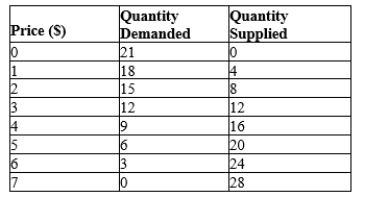 -Refer to Table 6-6. In this market, over what range of prices would a price floor set by the government be binding?
 (Essay)
4.8/5 (71)
(71) Table 6-5 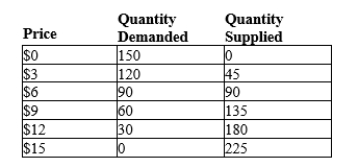 -Refer to Table 6-5. Which of the following price floors would be binding in this market?
 (Multiple Choice)
4.8/5 (88)
(88) A price floor is a legal minimum on the price at which a good or service can be sold.
(True/False)
4.9/5 (66)
(66) Figure 6-35 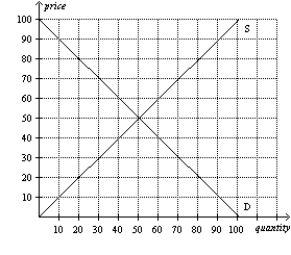 -Refer to Figure 6-35. A price floor set at $60 would create a surplus of 20 units.
 (True/False)
5.0/5 (77)
(77) Figure 6-25  -Refer to Figure 6-25. The effective price that sellers receive after the tax is imposed is
 (Multiple Choice)
4.8/5 (83)
(83) If a nonbinding price floor is imposed on a market, then the
(Multiple Choice)
4.8/5 (86)
(86) Although lawmakers legislated a fifty-fifty division of the payment of the FICA tax,
(Multiple Choice)
4.9/5 (70)
(70) Figure 6-28 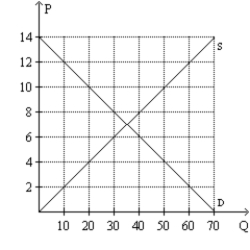 -Refer to Figure 6-28. Suppose a tax of $6 per unit is imposed on this market. How much will sellers receive per unit after the tax is imposed?
 (Multiple Choice)
5.0/5 (81)
(81) Figure 6-33 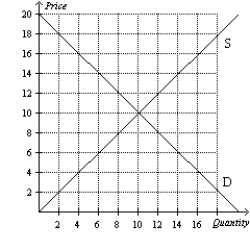 -Refer to Figure 6-33. Suppose a $3 per-unit tax is imposed on the sellers of this good. What is the effective price that sellers will receive for the good after the tax is imposed?
 (Essay)
4.9/5 (88)
(88) 
Filters
- Essay(0)
- Multiple Choice(0)
- Short Answer(0)
- True False(0)
- Matching(0)