



 Chat with AI
Exam 6: Supply, Demand, and Government Policies

Exam 1: Ten Principles of Economics455 Questions
Exam 2: Thinking Like an Economist643 Questions
Exam 3: Interdependence and the Gains From Trade547 Questions
Exam 4: The Market Forces of Supply and Demand693 Questions
Exam 5: Elasticity and Its Application626 Questions
Exam 6: Supply, Demand, and Government Policies668 Questions
Exam 7: Consumers, Producers, and the Efficiency of Markets547 Questions
Exam 8: Applications: the Costs of Taxation509 Questions
Exam 9: Application: International Trade521 Questions
Exam 10: Externalities543 Questions
Exam 11: Public Goods and Common Resources452 Questions
Exam 12: The Design of the Tax System664 Questions
Exam 13: The Costs of Production649 Questions
Exam 14: Firms in Competitive Markets604 Questions
Exam 15: Monopoly662 Questions
Exam 16: Monopolistic Competition649 Questions
Exam 17: Oligopoly522 Questions
Exam 18: The Markets for the Factors of Production592 Questions
Exam 19: Earnings and Discrimination511 Questions
Exam 20: Income Inequality and Poverty478 Questions
Exam 21: The Theory of Consumer Choice570 Questions
Exam 22: Frontiers in Microeconomics461 Questions
Exam 23: Measuring a Nation S Income547 Questions
Exam 24: Measuring the Cost of Living565 Questions
Exam 25: Production and Growth527 Questions
Exam 26: Saving, Investment, and the Financial System637 Questions
Exam 27: Tools of Finance534 Questions
Exam 28: Unemployment and Its Natural Rate701 Questions
Exam 29: The Monetary System540 Questions
Exam 30: Money Growth and Inflation504 Questions
Exam 31: Open-Economy Macroeconomics: Basic Concepts540 Questions
Exam 32: A Macroeconomic Theory of the Open Economy511 Questions
Exam 33: Aggregate Demand and Aggregate Supply572 Questions
Exam 34: The Influence of Monetary and Fiscal Policy on Aggregate Demand523 Questions
Exam 35: The Short-Run Tradeoff Between Inflation and Unemployment536 Questions
Exam 36: Six Debates Over Macroeconomic Policy354 Questions
Select questions type


Figure 6-29
Suppose the government imposes a $2 on this market. 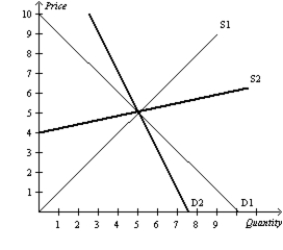 -Refer to Figure 6-29. Suppose D1 represents the demand curve for gasoline in both the short run and long run, S1 represents the supply curve for gasoline in the short run, and S2 represents the supply curve for gasoline in the long run. After the imposition of the $2, the price paid by buyers will be
 (Multiple Choice)
4.9/5  (75)
(75) Suppose sellers of liquor are required to send $5.00 to the government for every bottle of liquor they sell. Further, suppose this tax causes the price paid by buyers of liquor to rise by $3.00 per bottle. Which of the following statements is correct?
(Multiple Choice)
4.8/5 (78)
(78) If a price ceiling is a binding constraint on a market, then
(Multiple Choice)
4.9/5 (85)
(85) To say that a price ceiling is binding is to say that the price ceiling
(Multiple Choice)
4.9/5 (84)
(84) Suppose the equilibrium price of a tube of toothpaste is $2, and the government imposes a price floor of $3 per tube. As a result of the price floor,
(Multiple Choice)
4.8/5 (71)
(71) Figure 6-5 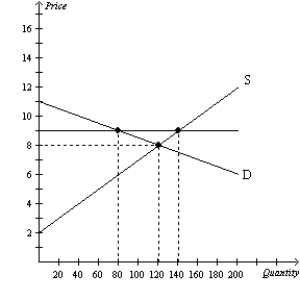 -Refer to Figure 6-5. If the solid horizontal line on the graph represents a price floor, then the price floor is
 (Multiple Choice)
4.9/5 (79)
(79) Studies of the effects of the minimum wage typically find that a 10 percent increase in the minimum wage depresses teenage employment by about
(Multiple Choice)
4.7/5 (74)
(74) Figure 6-4 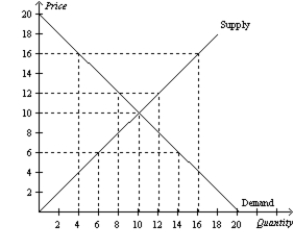 -Refer to Figure 6-4. A government-imposed price floor of $12 in this market results in
 (Multiple Choice)
4.8/5 (77)
(77) Figure 6-25  -Refer to Figure 6-25. How much tax revenue does this tax generate for the government?
 (Multiple Choice)
5.0/5 (85)
(85) When the government imposes a binding price ceiling on a competitive market, a surplus of the good arises, and sellers must ration the scarce goods among the large number of potential buyers.
(True/False)
4.8/5 (78)
(78) Workers determine the supply of labor, and firms determine the demand for labor.
(True/False)
4.8/5 (75)
(75) Which of the following is the most likely explanation for the imposition of a price floor on the market for corn?
(Multiple Choice)
4.8/5 (79)
(79) Which of the following was not a result of the luxury tax imposed by Congress in 1990?
(Multiple Choice)
4.9/5 (62)
(62) 
Filters
- Essay(0)
- Multiple Choice(0)
- Short Answer(0)
- True False(0)
- Matching(0)