



 Chat with AI
Exam 7: Consumers, Producers, and the Efficiency of Markets

Exam 1: Ten Principles of Economics455 Questions
Exam 2: Thinking Like an Economist645 Questions
Exam 3: Interdependence and the Gains From Trade550 Questions
Exam 4: The Market Forces of Supply and Demand693 Questions
Exam 5: Elasticity and Its Application625 Questions
Exam 6: Supply, Demand, and Government Policies671 Questions
Exam 7: Consumers, Producers, and the Efficiency of Markets547 Questions
Exam 8: Application: The Costs of Taxation507 Questions
Exam 9: Application: International Trade521 Questions
Exam 10: Externalities543 Questions
Exam 11: Public Goods and Common Resources453 Questions
Exam 12: The Design of the Tax System563 Questions
Exam 13: The Costs of Production649 Questions
Exam 14: Firms in Competitive Markets608 Questions
Exam 15: Monopoly662 Questions
Exam 16: Monopolistic Competition649 Questions
Exam 17: Oligopoly522 Questions
Exam 18: The Markets for the Factors of Production592 Questions
Exam 19: Earnings and Discrimination511 Questions
Exam 20: Income Inequality and Poverty478 Questions
Exam 21: The Theory of Consumer Choice568 Questions
Exam 22: Frontiers in Microeconomics461 Questions
Select questions type


Figure 7-22 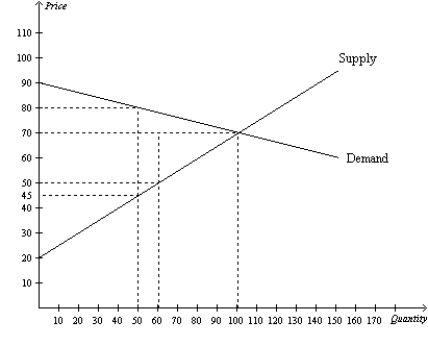 -Refer to Figure 7-22. Assume demand increases, which causes the equilibrium price to increase from $50 to $70. The increase in producer surplus would be
 (Multiple Choice)
4.9/5  (76)
(76) Wendy is willing to pay $50 for a concert ticket and Bruce would like to receive $25. If the market price is $40 for this transaction, then the total surplus would be $15.
(True/False)
4.7/5 (82)
(82) Donald produces nails at a cost of $350 per ton. If he sells the nails for $500 per ton, his producer surplus is
(Multiple Choice)
4.9/5 (82)
(82) Suppose Raymond and Victoria attend a charity benefit and participate in a silent auction. Each has in mind a maximum amount that he or she will bid for an oil painting by a locally famous artist. This maximum is called
(Multiple Choice)
4.8/5 (74)
(74) Table 7-16 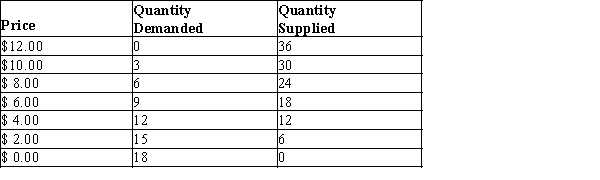 -Refer to Table 7-16. Both the demand curve and the supply curve are straight lines. If the price is $4 but only 6 units are bought and sold, total surplus will be
 (Multiple Choice)
4.7/5 (73)
(73) Figure 7-15 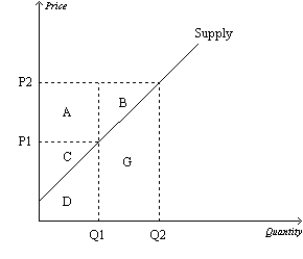 -Refer to Figure 7-15. Suppose producer surplus is larger than C but smaller than A+B+C. The price of the good must be
 (Multiple Choice)
5.0/5 (91)
(91) Table 7-8
During the last two days, Chad purchased a latte from two different stores. The table below shows Chad's willingness to pay on each day and his consumer surplus from each purchase.  -Refer to Table 7-8. The price that Chad paid for a latte on the second day is
 (Multiple Choice)
4.8/5 (102)
(102) Table 7-3
The only four consumers in a market have the following willingness to pay for a good:  -Refer to Table 7-3. If the price is $20, then consumer surplus in the market is
 (Multiple Choice)
4.8/5 (80)
(80) Table 7-5
For each of three potential buyers of oranges, the table displays the willingness to pay for the first three oranges of the day. Assume Allison, Bob, and Charisse are the only three buyers of oranges, and only three oranges can be supplied per day.  -Refer to Table 7-5. Which of the following statements is correct?
 (Multiple Choice)
4.7/5 (93)
(93) Which tools allow economists to determine if the allocation of resources determined by free markets is desirable?
(Multiple Choice)
4.8/5 (78)
(78) Figure 7-32 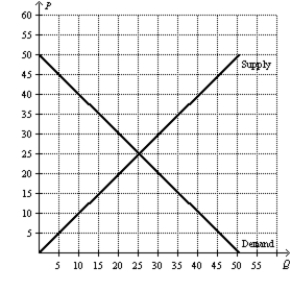 -Refer to Figure 7-32. At what price will total surplus be maximized in this market?
 (Essay)
4.9/5 (93)
(93) Figure 7-32
-Refer to Figure 7-32. If the government imposed a price ceiling at $20 in this market, how much are consumer surplus, producer surplus, and total surplus?
-Refer to Figure 7-32. If the government imposed a price ceiling at $20 in this market, how much are consumer surplus, producer surplus, and total surplus? (Essay)
4.9/5 (69)
(69) What do economists call the highest amount a consumer will pay to purchase a good?
(Short Answer)
4.9/5 (79)
(79) Which of the following statements is not correct about a market in equilibrium?
(Multiple Choice)
4.9/5 (76)
(76) Table 7-16
-Refer to Table 7-16. Both the demand curve and the supply curve are straight lines. At equilibrium, consumer surplus is
-Refer to Table 7-16. Both the demand curve and the supply curve are straight lines. At equilibrium, consumer surplus is (Multiple Choice)
4.9/5 (77)
(77) Figure 7-31 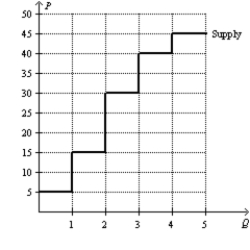 -Refer to Figure 7-31. If the market equilibrium price is $25, how much is total producer surplus in this market?
 (Short Answer)
4.8/5 (94)
(94) The 2005 Boston Globe article discussing ticket scalping points out that the price people will pay for tickets will rise when
(Multiple Choice)
4.8/5 (70)
(70) 
Filters
- Essay(0)
- Multiple Choice(0)
- Short Answer(0)
- True False(0)
- Matching(0)