



 Chat with AI
Exam 7: Consumers, Producers, and the Efficiency of Markets

Exam 1: Ten Principles of Economics455 Questions
Exam 2: Thinking Like an Economist645 Questions
Exam 3: Interdependence and the Gains From Trade550 Questions
Exam 4: The Market Forces of Supply and Demand693 Questions
Exam 5: Elasticity and Its Application625 Questions
Exam 6: Supply, Demand, and Government Policies671 Questions
Exam 7: Consumers, Producers, and the Efficiency of Markets547 Questions
Exam 8: Application: The Costs of Taxation507 Questions
Exam 9: Application: International Trade521 Questions
Exam 10: Externalities543 Questions
Exam 11: Public Goods and Common Resources453 Questions
Exam 12: The Design of the Tax System563 Questions
Exam 13: The Costs of Production649 Questions
Exam 14: Firms in Competitive Markets608 Questions
Exam 15: Monopoly662 Questions
Exam 16: Monopolistic Competition649 Questions
Exam 17: Oligopoly522 Questions
Exam 18: The Markets for the Factors of Production592 Questions
Exam 19: Earnings and Discrimination511 Questions
Exam 20: Income Inequality and Poverty478 Questions
Exam 21: The Theory of Consumer Choice568 Questions
Exam 22: Frontiers in Microeconomics461 Questions
Select questions type


Suppose that the equilibrium price in the market for tomatoes is $3 per pound. If a law reduced the maximum legal price for tomatoes to $2 per pound,
(Multiple Choice)
4.8/5  (80)
(80) Which of the following will cause a decrease in consumer surplus?
(Multiple Choice)
4.9/5 (76)
(76) Table 7-6
For each of three potential buyers of apples, the table displays the willingness to pay for the first three apples of the day. Assume Xavier, Yadier, and Zavi are the only three buyers of apples, and only three apples can be supplied per day.  -Refer to Table 7-6. If the market price of an apple is $1.40, then consumer surplus amounts to
 (Multiple Choice)
4.9/5 (83)
(83) The distinction between efficiency and equality can be described as follows:
(Multiple Choice)
4.9/5 (81)
(81) Welfare economics explains which of the following in the market for televisions?
(Multiple Choice)
4.9/5 (73)
(73) Suppose that the equilibrium price in the market for widgets is $5. If a law increased the minimum legal price for widgets to $6, producer surplus
(Multiple Choice)
4.9/5 (65)
(65) Figure 7-7 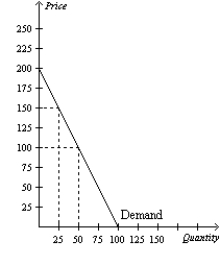 -Refer to Figure 7-7. What happens to the consumer surplus if the price rises from $100 to $150?
 (Multiple Choice)
4.7/5 (79)
(79) Figure 7-8 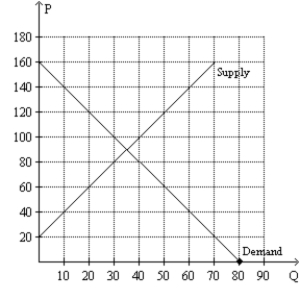 -Refer to Figure 7-8. If the government imposes a price floor of $100 in this market, then consumer surplus will decrease by
 (Multiple Choice)
5.0/5 (87)
(87) Which of the following events would increase producer surplus?
(Multiple Choice)
4.8/5 (60)
(60) Figure 7-2 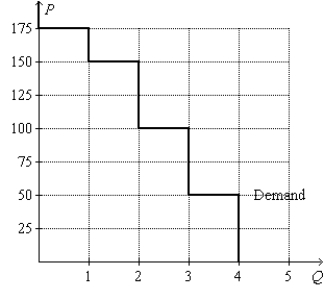 -Refer to Figure 7-2. If the price of the good is $100, then consumer surplus amounts to
 (Multiple Choice)
4.7/5 (74)
(74) Table 7-3
The only four consumers in a market have the following willingness to pay for a good:  -Refer to Table 7-3. Who experiences the largest loss of consumer surplus when the price of the good increases from $20 to $22?
 (Multiple Choice)
4.8/5 (80)
(80) Which of the following is not true when the price of a good or service falls?
(Multiple Choice)
4.9/5 (80)
(80) Kristi and Rebecca sell lemonade on the corner for $0.50 per cup. It costs them $0.10 to make each cup. On a certain day, their producer surplus is $20. How many cups did Kristi and Rebecca sell?
(Multiple Choice)
4.8/5 (86)
(86) Table 7-16 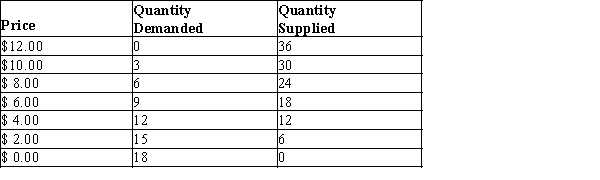 -Refer to Table 7-16. Both the demand curve and the supply curve are straight lines. If 6 units are bought and sold, then total surplus is
 (Multiple Choice)
4.9/5 (68)
(68) Table 7-4
The numbers in Table 7-1 reveal the maximum willingness to pay for a ticket to a Chicago Cubs vs. St. Louis Cardinal's baseball game at Wrigley Field.  -Refer to Table 7-4. If tickets sell for $40 each, then what is the total consumer surplus in the market?
 (Multiple Choice)
4.7/5 (94)
(94) Denise values a stainless steel dishwasher for her new house at $500, but she succeeds in buying one for $350. Denise's consumer surplus is
(Multiple Choice)
4.7/5 (91)
(91) Figure 7-31 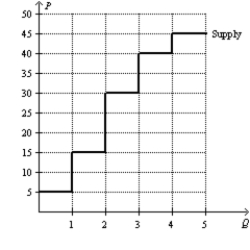 -Refer to Figure 7-31. If the market equilibrium price is $35, how much is total producer surplus in this market?
 (Short Answer)
4.9/5 (83)
(83) Which of the following is true when the price of a good or service rises?
(Multiple Choice)
4.9/5 (93)
(93) A simultaneous increase in both the demand for MP3 players and the supply of MP3 players would imply that
(Multiple Choice)
4.8/5 (85)
(85) 
Filters
- Essay(0)
- Multiple Choice(0)
- Short Answer(0)
- True False(0)
- Matching(0)