



 Chat with AI
Exam 7: Consumers, Producers, and the Efficiency of Markets

Exam 1: Ten Principles of Economics455 Questions
Exam 2: Thinking Like an Economist645 Questions
Exam 3: Interdependence and the Gains From Trade550 Questions
Exam 4: The Market Forces of Supply and Demand693 Questions
Exam 5: Elasticity and Its Application625 Questions
Exam 6: Supply, Demand, and Government Policies671 Questions
Exam 7: Consumers, Producers, and the Efficiency of Markets547 Questions
Exam 8: Application: The Costs of Taxation507 Questions
Exam 9: Application: International Trade521 Questions
Exam 10: Externalities543 Questions
Exam 11: Public Goods and Common Resources453 Questions
Exam 12: The Design of the Tax System563 Questions
Exam 13: The Costs of Production649 Questions
Exam 14: Firms in Competitive Markets608 Questions
Exam 15: Monopoly662 Questions
Exam 16: Monopolistic Competition649 Questions
Exam 17: Oligopoly522 Questions
Exam 18: The Markets for the Factors of Production592 Questions
Exam 19: Earnings and Discrimination511 Questions
Exam 20: Income Inequality and Poverty478 Questions
Exam 21: The Theory of Consumer Choice568 Questions
Exam 22: Frontiers in Microeconomics461 Questions
Select questions type


Table 7-16 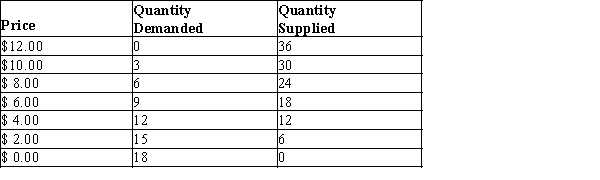 -Refer to Table 7-16. At a price of $2.00, total surplus is
 (Multiple Choice)
5.0/5  (84)
(84) Figure 7-34 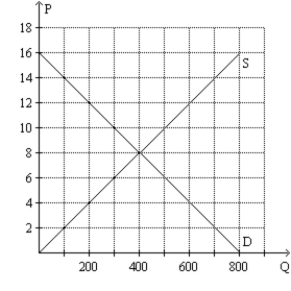 -Refer to Figure 7-34. Suppose there is initially a price floor set at $10 in this market. If the government removed the price floor, by how much would total consumer surplus increase for those consumers who enter the market after the price floor is removed?
 (Essay)
4.7/5 (77)
(77) Figure 7-33 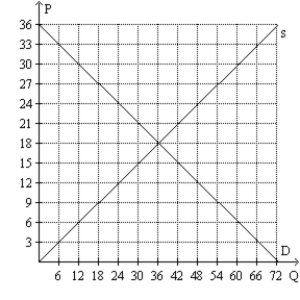 -Refer to Figure 7-33. Suppose demand shifts such that consumers wish to purchase 12 fewer units at every price. How much is total consumer surplus in this market at the new equilibrium price?
 (Essay)
4.9/5 (78)
(78) Table 7-5
For each of three potential buyers of oranges, the table displays the willingness to pay for the first three oranges of the day. Assume Allison, Bob, and Charisse are the only three buyers of oranges, and only three oranges can be supplied per day.  -Refer to Table 7-5. If the market price of an orange is $0.90, then the market quantity of oranges demanded per day is
 (Multiple Choice)
4.8/5 (88)
(88) Figure 7-18 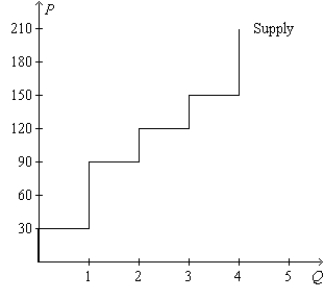 -Refer to Figure 7-18. Total surplus amounts to $500 if consumer surplus amounts to
 (Multiple Choice)
4.9/5 (74)
(74) If the cost of producing sofas decreases, then consumer surplus in the sofa market will
(Multiple Choice)
4.8/5 (80)
(80) Table 7-12
The numbers reveal the opportunity costs of providing 10 piano lessons of equal quality. 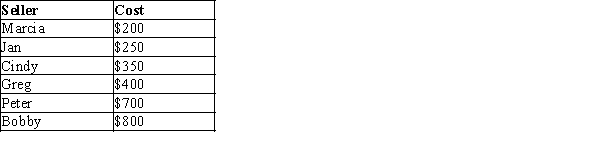 -Refer to Table 7-12. You wish to purchase 10 piano lessons for yourself and for your brother, so you take bids from each of the sellers. You will take lessons at the same time, so one teacher cannot provide lessons to both of you. You must pay the same price for both sets of lessons, and you will not accept a bid below a seller's cost because you are concerned that the seller will not provide all 10 lessons. What bid will you accept?
 (Multiple Choice)
4.7/5 (76)
(76) Figure 7-1 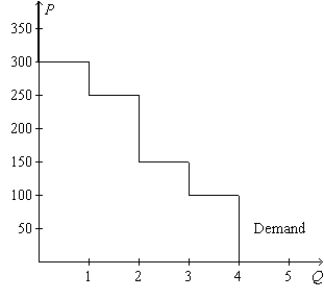 -Refer to Figure 7-1. If the price of the good is $250, then consumer surplus amounts to
 (Multiple Choice)
4.8/5 (75)
(75) Figure 7-27 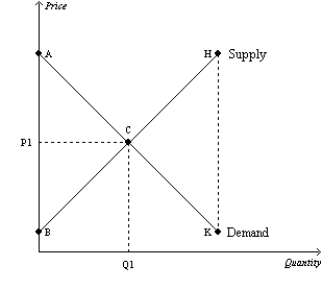 -Refer to Figure 7-27. Sellers whose costs are less than the equilibrium price are represented by which line segment?
 (Multiple Choice)
4.7/5 (65)
(65) The Surgeon General announces that eating chocolate increases tooth decay. As a result, the equilibrium price of chocolate
(Multiple Choice)
4.8/5 (68)
(68) Figure 7-1
-Refer to Figure 7-1. The value of the good to consumers minus the cost of the good to consumers amounts to $325 if the price of the good is
-Refer to Figure 7-1. The value of the good to consumers minus the cost of the good to consumers amounts to $325 if the price of the good is (Multiple Choice)
4.7/5 (79)
(79) Bill created a new software program he is willing to sell for $200. He sells his first copy and enjoys a producer surplus of $150. What is the price paid for the software?
(Multiple Choice)
4.8/5 (85)
(85) Figure 7-19 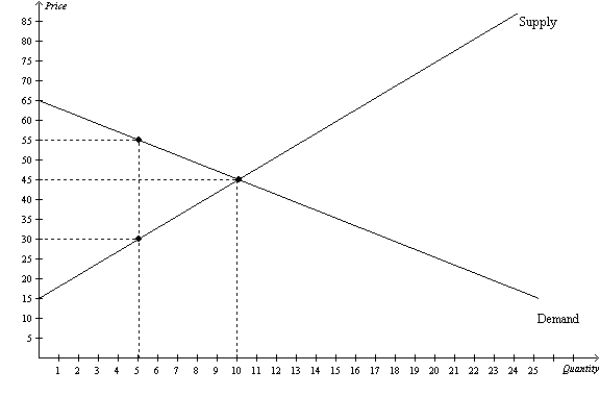 -Refer to Figure 7-19. If the government imposes a price floor of $55 in this market, then total surplus will be
 (Multiple Choice)
4.8/5 (88)
(88) Figure 7-22 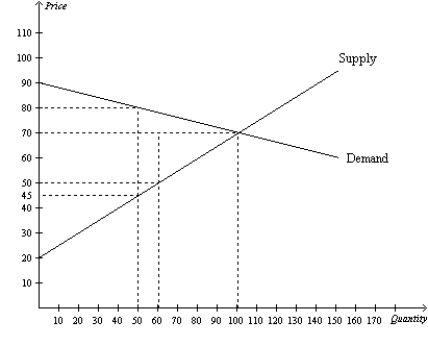 -Refer to Figure 7-22. If 40 units of the good are bought and sold, then
 (Multiple Choice)
4.8/5 (81)
(81) Connie can clean windows in large office buildings at a cost of $1 per window. The market price for window-cleaning services is $3 per window. If Connie cleans 100 windows, her producer surplus is $100.
(True/False)
4.9/5 (74)
(74) 
Filters
- Essay(0)
- Multiple Choice(0)
- Short Answer(0)
- True False(0)
- Matching(0)