



 Chat with AI
Exam 7: Consumers, Producers, and the Efficiency of Markets

Exam 1: Ten Principles of Economics455 Questions
Exam 2: Thinking Like an Economist645 Questions
Exam 3: Interdependence and the Gains From Trade550 Questions
Exam 4: The Market Forces of Supply and Demand693 Questions
Exam 5: Elasticity and Its Application625 Questions
Exam 6: Supply, Demand, and Government Policies671 Questions
Exam 7: Consumers, Producers, and the Efficiency of Markets547 Questions
Exam 8: Application: The Costs of Taxation507 Questions
Exam 9: Application: International Trade521 Questions
Exam 10: Externalities543 Questions
Exam 11: Public Goods and Common Resources453 Questions
Exam 12: The Design of the Tax System563 Questions
Exam 13: The Costs of Production649 Questions
Exam 14: Firms in Competitive Markets608 Questions
Exam 15: Monopoly662 Questions
Exam 16: Monopolistic Competition649 Questions
Exam 17: Oligopoly522 Questions
Exam 18: The Markets for the Factors of Production592 Questions
Exam 19: Earnings and Discrimination511 Questions
Exam 20: Income Inequality and Poverty478 Questions
Exam 21: The Theory of Consumer Choice568 Questions
Exam 22: Frontiers in Microeconomics461 Questions
Select questions type


The particular price that results in quantity supplied being equal to quantity demanded is the best price because it
(Multiple Choice)
5.0/5  (94)
(94) The maximum price that a buyer will pay for a good is called
(Multiple Choice)
4.8/5 (81)
(81) Consumer surplus is the amount a buyer is willing to pay for a good minus the amount the buyer actually has to pay for it.
(True/False)
4.8/5 (77)
(77) Figure 7-13 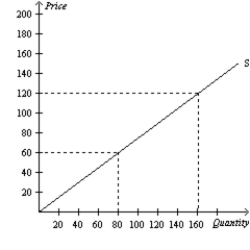 -Refer to Figure 7-13. If the equilibrium price rises from $60 to $120, what is the producer surplus to new producers in the market?
 (Multiple Choice)
4.7/5 (90)
(90) Figure 7-34 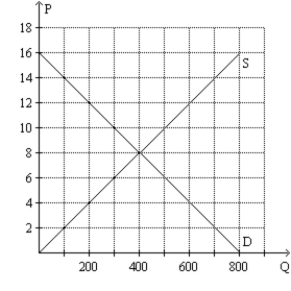 -Refer to Figure 7-34. Suppose there is initially a price ceiling set at $4 in this market. How much is total producer surplus with the price ceiling in place?
 (Essay)
4.8/5 (86)
(86) Table 7-7  -Refer to Table 7-7. You have an extra ticket to the Midwest Regional Sweet 16 game in the men's NCAA basketball tournament. The table shows the willingness to pay of the four potential buyers in the market for a ticket to the game. You hold an auction to sell the ticket. Michael bids $410 for the ticket, and you sell him the ticket. What is his consumer surplus?
 (Multiple Choice)
4.7/5 (77)
(77) Table 7-9
The only four consumers in a market have the following willingness to pay for a good:  -Refer to Table 7-9. If the market price for the good is $20, who will purchase the good?
 (Multiple Choice)
4.8/5 (91)
(91) Figure 7-22 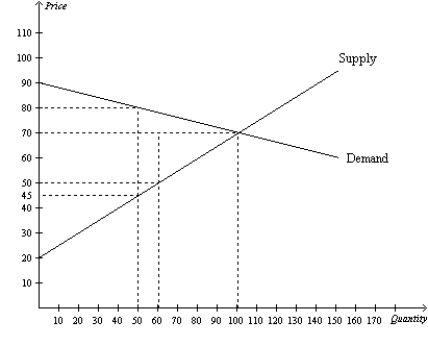 -Refer to Figure 7-22. Assume demand increases, which causes the equilibrium price to increase from $50 to $70. The increase in producer surplus due to new producers entering the market would be
 (Multiple Choice)
4.7/5 (72)
(72) Figure 7-4 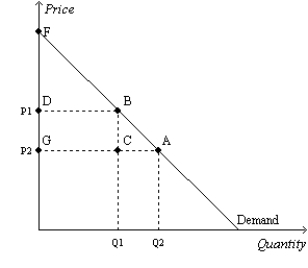 -Refer to Figure 7-4. When the price falls from P1 to P2, which area represents the increase in consumer surplus to new buyers entering the market?
 (Multiple Choice)
4.7/5 (68)
(68) Efficiency is related to the size of the economic pie, whereas equality is related to how the pie gets sliced and distributed.
(True/False)
4.8/5 (82)
(82) Table 7-7
-Refer to Table 7-7. You have four essentially identical extra tickets to the Midwest Regional Sweet 16 game in the men's NCAA basketball tournament. The table shows the willingness to pay of the four potential buyers in the market for a ticket to the game. You offer to sell the tickets for $400. How many tickets do you sell, and what is the total consumer surplus in the market?
-Refer to Table 7-7. You have four essentially identical extra tickets to the Midwest Regional Sweet 16 game in the men's NCAA basketball tournament. The table shows the willingness to pay of the four potential buyers in the market for a ticket to the game. You offer to sell the tickets for $400. How many tickets do you sell, and what is the total consumer surplus in the market? (Multiple Choice)
4.9/5 (71)
(71) Tammy loves donuts. The table shown reflects the value Tammy places on each donut she eats: 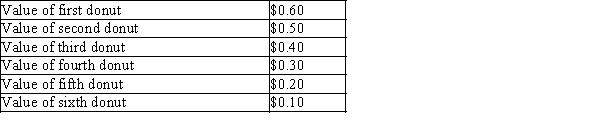 a.Use this information to construct Tammy's demand curve for donuts.
b.If the price of donuts is $0.20, how many donuts will Tammy buy?
c.Show Tammy's consumer surplus on your graph. How much consumer surplus would she have at a price of $0.20?
d.If the price of donuts rose to $0.40, how many donuts would she purchase now? What would happen to Tammy's consumer surplus? Show this change on your graph.
a.Use this information to construct Tammy's demand curve for donuts.
b.If the price of donuts is $0.20, how many donuts will Tammy buy?
c.Show Tammy's consumer surplus on your graph. How much consumer surplus would she have at a price of $0.20?
d.If the price of donuts rose to $0.40, how many donuts would she purchase now? What would happen to Tammy's consumer surplus? Show this change on your graph. (Essay)
4.7/5 (75)
(75) Figure 7-23 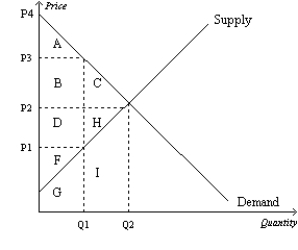 -Refer to Figure 7-23. The equilibrium price is
 (Multiple Choice)
4.8/5 (73)
(73) Table 7-5
For each of three potential buyers of oranges, the table displays the willingness to pay for the first three oranges of the day. Assume Allison, Bob, and Charisse are the only three buyers of oranges, and only three oranges can be supplied per day.  -Refer to Table 7-5. If the market price of an orange increases from $0.80 to $1.05, then consumer surplus
 (Multiple Choice)
4.8/5 (86)
(86) On a graph, the area below a demand curve and above the price measures
(Multiple Choice)
4.9/5 (80)
(80) If Darby values a soccer ball at $50, and she pays $40 for it, her consumer surplus is $90.
(True/False)
4.9/5 (77)
(77) Chad is willing to pay $5.00 to get his first cup of morning latté; he is willing to pay $4.50 for a second cup. He buys his first cup from a vendor selling latté for $3.75 per cup. He returns to that vendor later in the morning to find that the vendor has increased her price to $3.90 per cup. Chad buys a second cup. Which of the following statements is correct?
(Multiple Choice)
4.9/5 (89)
(89) Figure 7-10 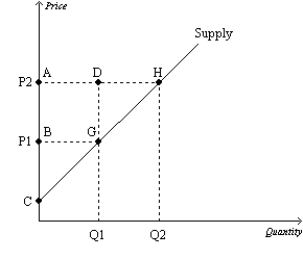 -Refer to Figure 7-10. Which area represents the increase in producer surplus when the price rises from P1 to P2 due to new producers entering the market?
 (Multiple Choice)
4.8/5 (76)
(76) Which of the following will cause a decrease in producer surplus?
(Multiple Choice)
4.9/5 (76)
(76) 
Filters
- Essay(0)
- Multiple Choice(0)
- Short Answer(0)
- True False(0)
- Matching(0)