



 Chat with AI
Exam 7: Consumers, Producers, and the Efficiency of Markets

Exam 1: Ten Principles of Economics455 Questions
Exam 2: Thinking Like an Economist645 Questions
Exam 3: Interdependence and the Gains From Trade550 Questions
Exam 4: The Market Forces of Supply and Demand693 Questions
Exam 5: Elasticity and Its Application625 Questions
Exam 6: Supply, Demand, and Government Policies671 Questions
Exam 7: Consumers, Producers, and the Efficiency of Markets547 Questions
Exam 8: Application: The Costs of Taxation507 Questions
Exam 9: Application: International Trade521 Questions
Exam 10: Externalities543 Questions
Exam 11: Public Goods and Common Resources453 Questions
Exam 12: The Design of the Tax System563 Questions
Exam 13: The Costs of Production649 Questions
Exam 14: Firms in Competitive Markets608 Questions
Exam 15: Monopoly662 Questions
Exam 16: Monopolistic Competition649 Questions
Exam 17: Oligopoly522 Questions
Exam 18: The Markets for the Factors of Production592 Questions
Exam 19: Earnings and Discrimination511 Questions
Exam 20: Income Inequality and Poverty478 Questions
Exam 21: The Theory of Consumer Choice568 Questions
Exam 22: Frontiers in Microeconomics461 Questions
Select questions type


The decisions of buyers and sellers that affect people who are not participants in the market create
(Multiple Choice)
4.8/5  (89)
(89) Figure 7-30 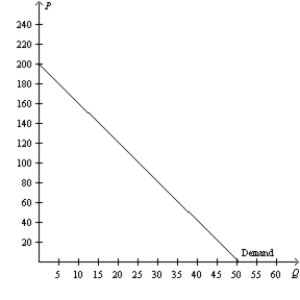 -Refer to Figure 7-30. If the market equilibrium price falls from $120 to $80, how much is the increase in consumer surplus to the consumers who were initially in the market at the $120 price?
 (Essay)
5.0/5 (70)
(70) A buyer is willing to buy a product at a price greater than or equal to his willingness to pay, but would refuse to buy a product at a price less than his willingness to pay.
(True/False)
4.8/5 (76)
(76) Scenario 7-2
Suppose market demand and market supply are given by the equations:  -Refer to Scenario 7-2. Suppose a reduction in input prices shifts the market supply curve to
 By how much does total producer surplus increase as a result of this supply shift?
-Refer to Scenario 7-2. Suppose a reduction in input prices shifts the market supply curve to By how much does total producer surplus increase as a result of this supply shift? (Essay)
4.8/5 (88)
(88) Figure 7-5 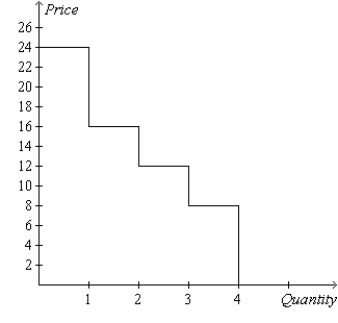 -Refer to Figure 7-5. If the price of the good is $12, then consumer surplus is
 (Multiple Choice)
4.8/5 (63)
(63) Janine would be willing to pay $50 to see Les Misérables, but she buys a ticket for only $30. Janine values the performance at
(Multiple Choice)
4.9/5 (69)
(69) Figure 7-4 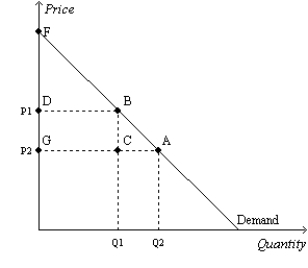 -Refer to Figure 7-4. Which area represents consumer surplus at a price of P1?
 (Multiple Choice)
4.9/5 (79)
(79) If Rosa is willing to pay $450 for hockey tickets and has consumer surplus of $175, the price of the tickets is $625.
(True/False)
4.9/5 (87)
(87) Table 7-16 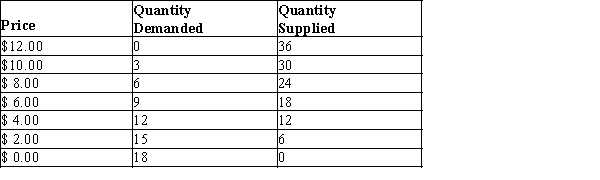 -Refer to Table 7-16. Both the demand curve and the supply curve are straight lines. At equilibrium, total surplus is
 (Multiple Choice)
4.8/5 (74)
(74) Alex is willing to pay $10, and Bella is willing to pay $8, for 1 pound of ribeye steak. When the price of ribeye steak increases from $9 to $11,
(Multiple Choice)
4.9/5 (85)
(85) Suppose Brent, Callie, and Danielle each purchase a particular type of electric pencil sharpener at a price of $20. Brent's willingness to pay was $22, Callie's willingness to pay was $25, and Danielle's willingness to pay was $30. Which of the following statements is correct?
(Multiple Choice)
4.9/5 (85)
(85) Five hundred units of good x are currently bought and sold. The marginal buyer is willing to pay $40 for the 500th unit, and the cost to the marginal seller is $35 for the 500th unit. We know that
(Multiple Choice)
4.7/5 (67)
(67) Kristi and Rebecca sell lemonade on the corner. It costs them 7 cents to make each cup. On a certain day, they sell 40 cups. Their producer surplus for that day amounts to $19.20. Kristi & Rebecca sold each cup for
(Multiple Choice)
4.8/5 (104)
(104) At the equilibrium price of a good, the good will be purchased by those buyers who
(Multiple Choice)
4.8/5 (75)
(75) Figure 7-21 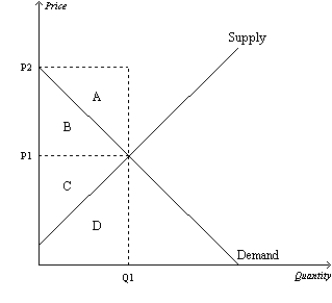 -Refer to Figure 7-21. When the price is P1, area A represents
 (Multiple Choice)
4.8/5 (75)
(75) Suppose that Firms A and B each produce high-resolution computer monitors, but Firm A can do so at a lower cost. Cassie and David each want to purchase a high-resolution computer monitor, but David is willing to pay more than Cassie. If Firm A produces a monitor that Cassie buys but David does not, then the market outcome illustrates which of the following principles? (i)
Free markets allocate the supply of goods to the buyers who value them most highly, as measured by their willingness to pay.
(ii)
Free markets allocate the demand for goods to the sellers who can produce them at the least cost.
(Multiple Choice)
4.8/5 (72)
(72) Table 7-1  -Refer to Table 7-1. If the price of the product is $130, then who would be willing to purchase the product?
 (Multiple Choice)
4.8/5 (79)
(79) When demand increases so that market price increases, producer surplus increases because (1) producer surplus received by existing sellers increases, and (2) new sellers enter the market.
(True/False)
4.8/5 (76)
(76) Figure 7-31 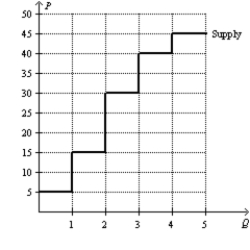 -Refer to Figure 7-31. If the market equilibrium price rises from $25 to $35, how much is the increase in producer surplus to the producers supplying units at the initial $25 price?
 (Essay)
4.9/5 (73)
(73) 
Filters
- Essay(0)
- Multiple Choice(0)
- Short Answer(0)
- True False(0)
- Matching(0)