



 Chat with AI
Exam 8: Application: The Costs of Taxation

Exam 1: Ten Principles of Economics455 Questions
Exam 2: Thinking Like an Economist645 Questions
Exam 3: Interdependence and the Gains From Trade550 Questions
Exam 4: The Market Forces of Supply and Demand693 Questions
Exam 5: Elasticity and Its Application625 Questions
Exam 6: Supply, Demand, and Government Policies671 Questions
Exam 7: Consumers, Producers, and the Efficiency of Markets547 Questions
Exam 8: Application: The Costs of Taxation507 Questions
Exam 9: Application: International Trade521 Questions
Exam 10: Externalities543 Questions
Exam 11: Public Goods and Common Resources453 Questions
Exam 12: The Design of the Tax System563 Questions
Exam 13: The Costs of Production649 Questions
Exam 14: Firms in Competitive Markets608 Questions
Exam 15: Monopoly662 Questions
Exam 16: Monopolistic Competition649 Questions
Exam 17: Oligopoly522 Questions
Exam 18: The Markets for the Factors of Production592 Questions
Exam 19: Earnings and Discrimination511 Questions
Exam 20: Income Inequality and Poverty478 Questions
Exam 21: The Theory of Consumer Choice568 Questions
Exam 22: Frontiers in Microeconomics461 Questions
Select questions type


Figure 8-6
The vertical distance between points A and B represents a tax in the market. 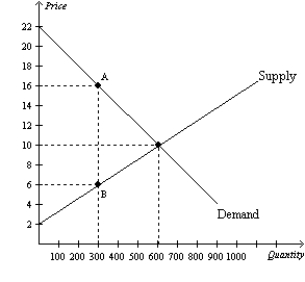 -Refer to Figure 8-6. When the tax is imposed in this market, producer surplus is
 (Multiple Choice)
4.9/5  (95)
(95) When a tax is imposed on sellers, consumer surplus and producer surplus both decrease.
(True/False)
4.8/5 (67)
(67) Figure 8-8
Suppose the government imposes a $10 per unit tax on a good. 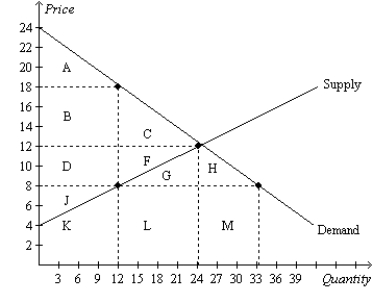 -Refer to Figure 8-8. The government collects tax revenue that is the area
 (Multiple Choice)
5.0/5 (97)
(97) Figure 8-15 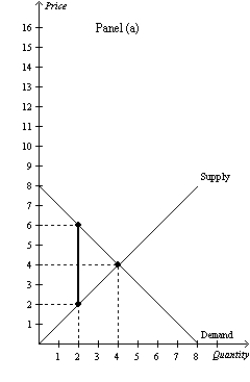
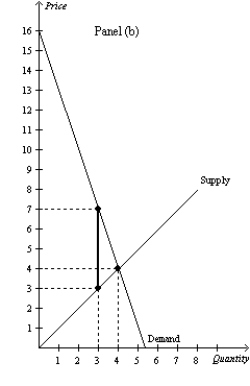 -Refer to Figure 8-15. Panel (a) and Panel (b) each illustrate a $4 tax placed on a market. In comparison to Panel (a), Panel (b) illustrates which of the following statements?
 (Multiple Choice)
5.0/5 (69)
(69) Figure 8-27 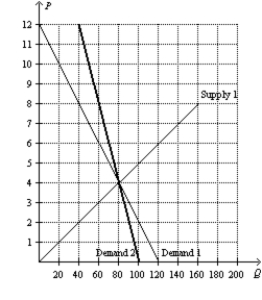 -Refer to Figure 8-27. Suppose that Market A is characterized by Demand 1 and Supply 1, and Market B is characterized by Demand 2 and Supply 1. If an identical tax is imposed on each market, the tax will create a larger deadweight loss in which market? Explain.
 (Essay)
4.9/5 (72)
(72) For the purpose of analyzing the gains and losses from a tax on a good, we use tax revenue as a direct measure of the
(Multiple Choice)
4.9/5 (78)
(78) Figure 8-10 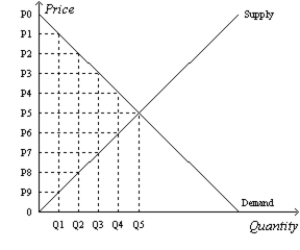 -Refer to Figure 8-10. Suppose the government imposes a tax that reduces the quantity sold in the market after the tax to Q2. With the tax, the producer surplus is
 (Multiple Choice)
4.9/5 (79)
(79) If a tax shifts the demand curve downward (or to the left), we can infer that the tax was levied on
(Multiple Choice)
4.9/5 (91)
(91) If the tax on a good is doubled, the deadweight loss of the tax
(Multiple Choice)
4.8/5 (76)
(76) If the government imposes a $3 tax in a market, the equilibrium price will rise by $3.
(True/False)
4.7/5 (81)
(81) Suppose the price of milk is $2.39 per gallon, and the equilibrium quantity of milk is 100 thousand gallons per day with no tax on milk. Starting from this initial situation, which of the following scenarios would result in the smallest deadweight loss?
(Multiple Choice)
4.8/5 (85)
(85) In which of the following cases is it most likely that an increase in the size of a tax will decrease tax revenue?
(Multiple Choice)
5.0/5 (87)
(87) A tax of $0.25 is imposed on each bag of potato chips that is sold. The tax decreases producer surplus by $600 per day, generates tax revenue of $1,220 per day, and decreases the equilibrium quantity of potato chips by 120 bags per day. The tax
(Multiple Choice)
4.8/5 (77)
(77) Figure 8-7
The vertical distance between points A and B represents a tax in the market. 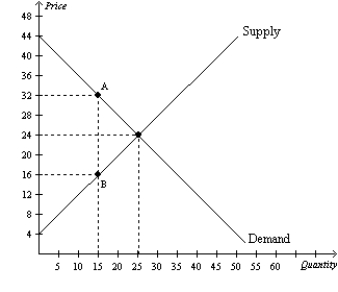 -Refer to Figure 8-7. As a result of the tax, buyers effectively pay
 (Multiple Choice)
4.9/5 (90)
(90) Figure 8-11 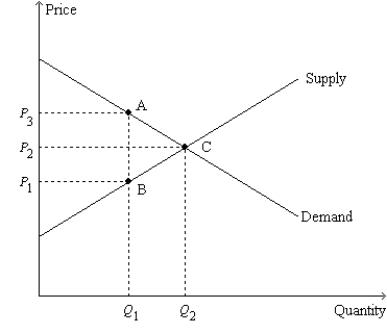 -Refer to Figure 8-11. The tax revenue that the government collects equals
 (Multiple Choice)
4.8/5 (72)
(72) Who once said that taxes are the price we pay for a civilized society?
(Multiple Choice)
4.7/5 (67)
(67) Figure 8-3
The vertical distance between points A and C represents a tax in the market. 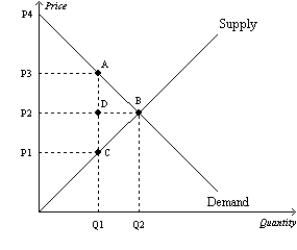 -Refer to Figure 8-3. The amount of the tax on each unit of the good is
 (Multiple Choice)
4.9/5 (67)
(67) 
Filters
- Essay(0)
- Multiple Choice(0)
- Short Answer(0)
- True False(0)
- Matching(0)