



 Chat with AI
Exam 8: Application: The Costs of Taxation

Exam 1: Ten Principles of Economics455 Questions
Exam 2: Thinking Like an Economist645 Questions
Exam 3: Interdependence and the Gains From Trade550 Questions
Exam 4: The Market Forces of Supply and Demand693 Questions
Exam 5: Elasticity and Its Application625 Questions
Exam 6: Supply, Demand, and Government Policies671 Questions
Exam 7: Consumers, Producers, and the Efficiency of Markets547 Questions
Exam 8: Application: The Costs of Taxation507 Questions
Exam 9: Application: International Trade521 Questions
Exam 10: Externalities543 Questions
Exam 11: Public Goods and Common Resources453 Questions
Exam 12: The Design of the Tax System563 Questions
Exam 13: The Costs of Production649 Questions
Exam 14: Firms in Competitive Markets608 Questions
Exam 15: Monopoly662 Questions
Exam 16: Monopolistic Competition649 Questions
Exam 17: Oligopoly522 Questions
Exam 18: The Markets for the Factors of Production592 Questions
Exam 19: Earnings and Discrimination511 Questions
Exam 20: Income Inequality and Poverty478 Questions
Exam 21: The Theory of Consumer Choice568 Questions
Exam 22: Frontiers in Microeconomics461 Questions
Select questions type


Figure 8-9
The vertical distance between points A and C represents a tax in the market. 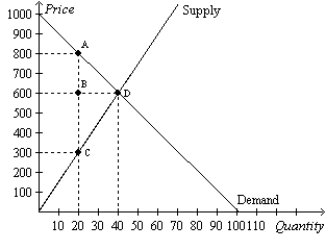 -Refer to Figure 8-9. The imposition of the tax causes the quantity sold to
 (Multiple Choice)
4.9/5  (70)
(70) Figure 8-5
Suppose that the government imposes a tax of P3 - P1. 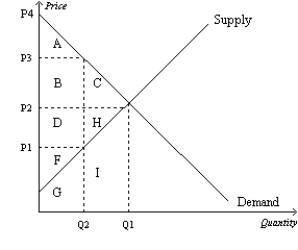 -Refer to Figure 8-5. The price that buyers effectively pay after the tax is imposed is
 (Multiple Choice)
5.0/5 (76)
(76) Figure 8-18 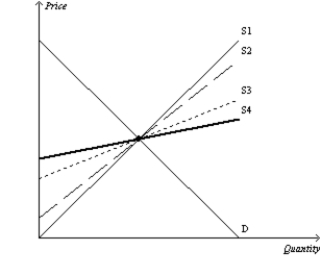 -Refer to Figure 8-18. Suppose the government imposes a $1 tax in each of the four markets represented by supply curves S1, S2, S3, and S4. The deadweight will be the smallest in the market represented by
 (Multiple Choice)
4.9/5 (81)
(81) Figure 8-13 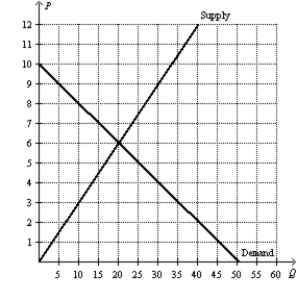 -Refer to Figure 8-13. Suppose the government places a $5 per-unit tax on this good. The amount of deadweight loss resulting from this tax is
 (Multiple Choice)
4.9/5 (64)
(64) Figure 8-11 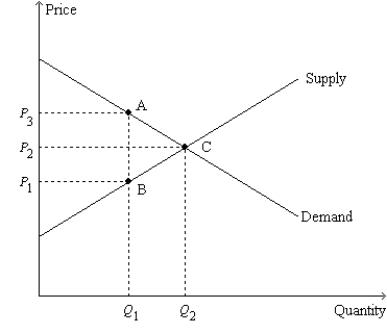 -Refer to Figure 8-11. The length of the line segment connecting points A and B represents
 (Multiple Choice)
4.8/5 (92)
(92) Figure 8-2
The vertical distance between points A and B represents a tax in the market. 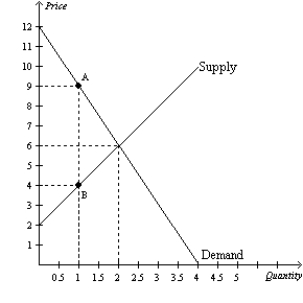 -Refer to Figure 8-2. The loss of producer surplus associated with some sellers dropping out of the market as a result of the tax is
 (Multiple Choice)
4.8/5 (74)
(74) Figure 8-22 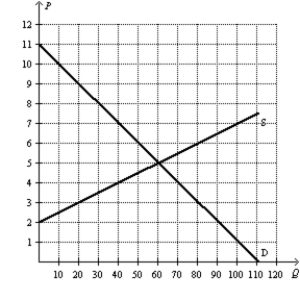 -Refer to Figure 8-22. Suppose the government initially imposes a $3 per-unit tax on this good. Now suppose the government is deciding whether to lower the tax to $1.50 or raise it to $4.50. Which of the following statements is not correct?
 (Multiple Choice)
4.8/5 (89)
(89) A tax raises the price received by sellers and lowers the price paid by buyers.
(True/False)
5.0/5 (83)
(83) Suppose a tax of $1 per unit is imposed on a good. The more elastic the supply of the good, other things equal, the
(Multiple Choice)
4.7/5 (72)
(72) The view held by Arthur Laffer and Ronald Reagan that cuts in tax rates would encourage people to increase the quantity of labor they supplied became known as
(Multiple Choice)
4.9/5 (65)
(65) Figure 8-2
The vertical distance between points A and B represents a tax in the market.
-Refer to Figure 8-2. Consumer surplus without the tax is
-Refer to Figure 8-2. Consumer surplus without the tax is (Multiple Choice)
4.8/5 (71)
(71) Figure 8-10 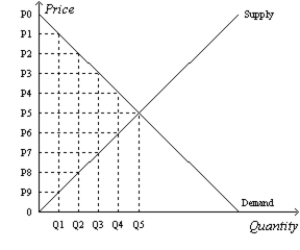 -Refer to Figure 8-10. Suppose the government imposes a tax that reduces the quantity sold in the market after the tax to Q2. Without the tax, the consumer surplus is
 (Multiple Choice)
4.8/5 (84)
(84) Consider a good to which a per-unit tax applies. The size of the deadweight that results from the tax is smaller, the
(Multiple Choice)
4.9/5 (73)
(73) Taxes cause deadweight losses because they prevent buyers and sellers from realizing some of the gains from trade.
(True/False)
4.8/5 (70)
(70) Figure 8-14 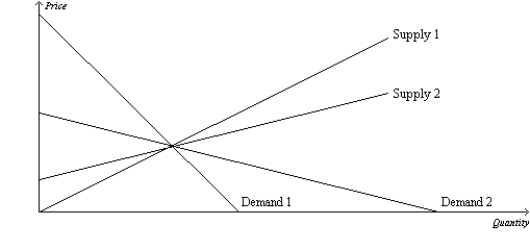 -Refer to Figure 8-14. Which of the following combinations will minimize the deadweight loss from a tax?
 (Multiple Choice)
4.9/5 (70)
(70) 
Filters
- Essay(0)
- Multiple Choice(0)
- Short Answer(0)
- True False(0)
- Matching(0)