



 Chat with AI
Exam 8: Application: The Costs of Taxation

Exam 1: Ten Principles of Economics455 Questions
Exam 2: Thinking Like an Economist645 Questions
Exam 3: Interdependence and the Gains From Trade550 Questions
Exam 4: The Market Forces of Supply and Demand693 Questions
Exam 5: Elasticity and Its Application625 Questions
Exam 6: Supply, Demand, and Government Policies671 Questions
Exam 7: Consumers, Producers, and the Efficiency of Markets547 Questions
Exam 8: Application: The Costs of Taxation507 Questions
Exam 9: Application: International Trade521 Questions
Exam 10: Externalities543 Questions
Exam 11: Public Goods and Common Resources453 Questions
Exam 12: The Design of the Tax System563 Questions
Exam 13: The Costs of Production649 Questions
Exam 14: Firms in Competitive Markets608 Questions
Exam 15: Monopoly662 Questions
Exam 16: Monopolistic Competition649 Questions
Exam 17: Oligopoly522 Questions
Exam 18: The Markets for the Factors of Production592 Questions
Exam 19: Earnings and Discrimination511 Questions
Exam 20: Income Inequality and Poverty478 Questions
Exam 21: The Theory of Consumer Choice568 Questions
Exam 22: Frontiers in Microeconomics461 Questions
Select questions type


Figure 8-9
The vertical distance between points A and C represents a tax in the market. 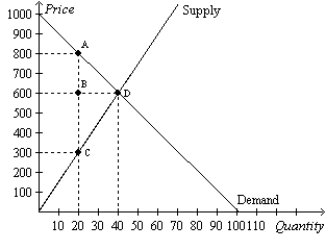 -Refer to Figure 8-9. The loss of consumer surplus as a result of the tax is
 (Multiple Choice)
4.7/5  (90)
(90) Figure 8-11 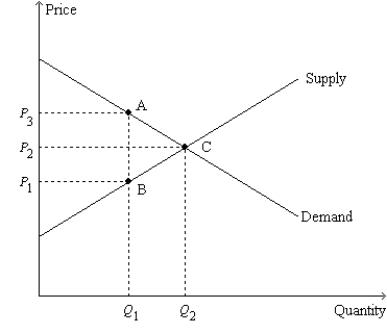 -Refer to Figure 8-11. The size of the tax is represented by the
 (Multiple Choice)
4.8/5 (78)
(78) The demand for chicken wings is more elastic than the demand for razor blades. Suppose the government levies an equivalent tax on chicken wings and razor blades. The deadweight loss would be larger in the market for
(Multiple Choice)
5.0/5 (84)
(84) Suppose that the market for product X is characterized by a typical, downward-sloping, linear demand curve and a typical, upward-sloping, linear supply curve. If a $2 tax per unit results in a deadweight loss of $200, how large would be the deadweight loss from a $6 tax per unit?
(Essay)
4.9/5 (82)
(82) If the tax on a good is tripled, the deadweight loss of the tax
(Multiple Choice)
4.8/5 (87)
(87) Figure 8-13 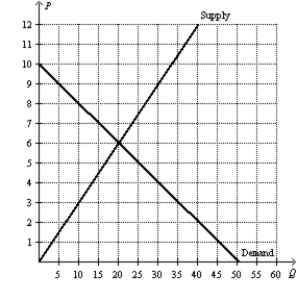 -Refer to Figure 8-13. Suppose the government places a $5 per-unit tax on this good. The tax causes the price paid by buyers to
 (Multiple Choice)
4.7/5 (92)
(92) Figure 8-26 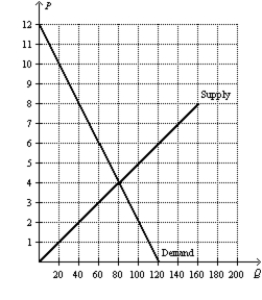 -Refer to Figure 8-26. Suppose the government places a $3 tax per unit on this good. What price will consumers pay for the good after the tax is imposed?
 (Essay)
5.0/5 (79)
(79) Suppose the federal government doubles the gasoline tax. The deadweight loss associated with the tax
(Multiple Choice)
4.9/5 (75)
(75) Scenario 8-1
Erin would be willing to pay as much as $100 per week to have her house cleaned. Ernesto's opportunity cost of cleaning Erin's house is $70 per week.
-Refer to Scenario 8-1. Assume Erin is required to pay a tax of $40 when she hires someone to clean her house for a week. Which of the following is correct?
(Multiple Choice)
4.8/5 (86)
(86) Figure 8-6
The vertical distance between points A and B represents a tax in the market. 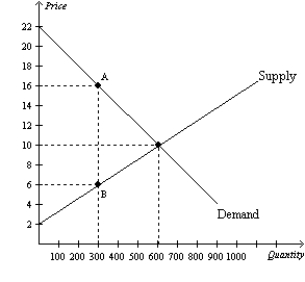 -Refer to Figure 8-6. When the tax is imposed in this market, consumer surplus is
 (Multiple Choice)
4.8/5 (67)
(67) Figure 8-2
The vertical distance between points A and B represents a tax in the market. 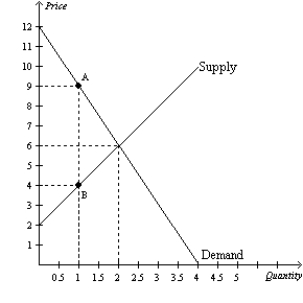 -Refer to Figure 8-2. The loss of consumer surplus associated with some buyers dropping out of the market as a result of the tax is
 (Multiple Choice)
5.0/5 (74)
(74) Kate is a personal trainer whose client William pays $80 per hour-long session. William values this service at $100 per hour, while the opportunity cost of Kate's time is $75 per hour. The government places a tax of $10 per hour on personal trainers. After the tax, what is likely to happen in the market for personal training?
(Multiple Choice)
4.8/5 (77)
(77) Suppose that a university charges students a $100 "tax" to register for business classes. The next year the university raises the "tax" to $150. The deadweight loss from the "tax" triples.
(True/False)
4.7/5 (75)
(75) Figure 8-3
The vertical distance between points A and C represents a tax in the market. 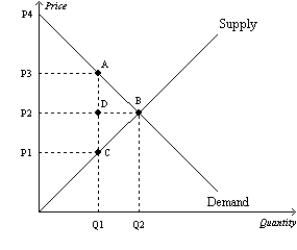 -Refer to Figure 8-3. Which of the following equations is valid for the deadweight loss of the tax?
 (Multiple Choice)
4.9/5 (70)
(70) The demand for bread is less elastic than the demand for donuts; hence, a tax on bread will create a larger deadweight loss than will the same tax on donuts, other things equal.
(True/False)
4.9/5 (80)
(80) Figure 8-12 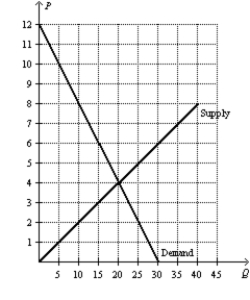 -Refer to Figure 8-12. Suppose a $3 per-unit tax is placed on this good. The loss of producer surplus resulting from this tax is
 (Multiple Choice)
4.8/5 (92)
(92) Figure 8-11
-Refer to Figure 8-11. The price labeled as P3 on the vertical axis represents the price
-Refer to Figure 8-11. The price labeled as P3 on the vertical axis represents the price (Multiple Choice)
4.9/5 (90)
(90) The benefit to sellers of participating in a market is measured by the
(Multiple Choice)
4.8/5 (93)
(93) 
Filters
- Essay(0)
- Multiple Choice(0)
- Short Answer(0)
- True False(0)
- Matching(0)