



 Chat with AI
Exam 8: Application: The Costs of Taxation

Exam 1: Ten Principles of Economics455 Questions
Exam 2: Thinking Like an Economist645 Questions
Exam 3: Interdependence and the Gains From Trade550 Questions
Exam 4: The Market Forces of Supply and Demand693 Questions
Exam 5: Elasticity and Its Application625 Questions
Exam 6: Supply, Demand, and Government Policies671 Questions
Exam 7: Consumers, Producers, and the Efficiency of Markets547 Questions
Exam 8: Application: The Costs of Taxation507 Questions
Exam 9: Application: International Trade521 Questions
Exam 10: Externalities543 Questions
Exam 11: Public Goods and Common Resources453 Questions
Exam 12: The Design of the Tax System563 Questions
Exam 13: The Costs of Production649 Questions
Exam 14: Firms in Competitive Markets608 Questions
Exam 15: Monopoly662 Questions
Exam 16: Monopolistic Competition649 Questions
Exam 17: Oligopoly522 Questions
Exam 18: The Markets for the Factors of Production592 Questions
Exam 19: Earnings and Discrimination511 Questions
Exam 20: Income Inequality and Poverty478 Questions
Exam 21: The Theory of Consumer Choice568 Questions
Exam 22: Frontiers in Microeconomics461 Questions
Select questions type


Figure 8-6
The vertical distance between points A and B represents a tax in the market. 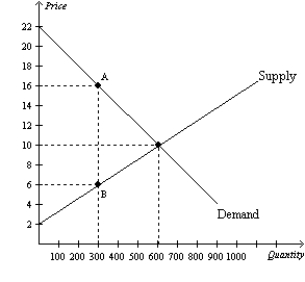 -Refer to Figure 8-6. When the tax is imposed in this market, buyers effectively pay what amount of the $10 tax?
 (Multiple Choice)
4.9/5  (77)
(77) Taxes drive a wedge into the market by raising the price that sellers receive and lowering the price that buyers pay.
(True/False)
4.8/5 (101)
(101) Figure 8-5
Suppose that the government imposes a tax of P3 - P1. 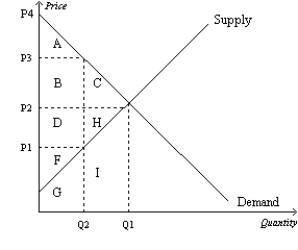 -Refer to Figure 8-5. The total surplus with the tax is represented by area
 (Multiple Choice)
4.8/5 (87)
(87) Figure 8-7
The vertical distance between points A and B represents a tax in the market. 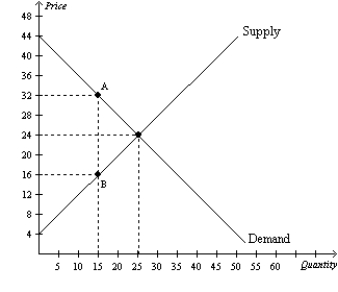 -Refer to Figure 8-7. Which of the following statements is correct?
 (Multiple Choice)
4.8/5 (79)
(79) Figure 8-14 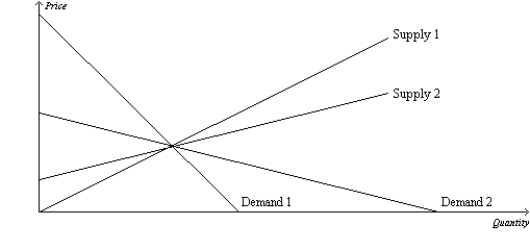 -Refer to Figure 8-14. Which of the following statements is correct?
 (Multiple Choice)
4.8/5 (71)
(71) If a tax did not induce buyers or sellers to change their behavior, it would not cause a deadweight loss.
(True/False)
4.9/5 (81)
(81) Figure 8-6
The vertical distance between points A and B represents a tax in the market.
-Refer to Figure 8-6. When the tax is imposed in this market, sellers effectively pay what amount of the $10 tax?
-Refer to Figure 8-6. When the tax is imposed in this market, sellers effectively pay what amount of the $10 tax? (Multiple Choice)
4.8/5 (87)
(87) In terms of gains from trade, why is it true that taxes cause deadweight losses?
(Essay)
4.9/5 (91)
(91) The most important tax in the U.S. economy is the tax on corporations' profits.
(True/False)
4.8/5 (92)
(92) Assume that for good X the supply curve for a good is a typical, upward-sloping straight line, and the demand curve is a typical downward-sloping straight line. If the good is taxed, and the tax is doubled, the
(Multiple Choice)
4.8/5 (97)
(97) Figure 8-11 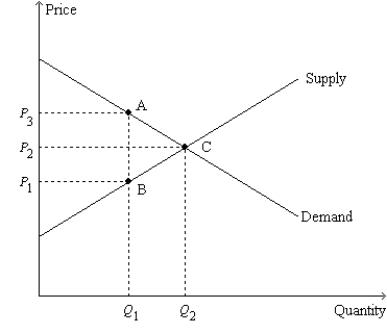 -Refer to Figure 8-11. Suppose Q1 = 4; Q2 = 7; P1 = $6; P2 = $8; and P3 = $10. Then the deadweight loss of the tax is
 (Multiple Choice)
4.9/5 (82)
(82) Figure 8-3
The vertical distance between points A and C represents a tax in the market. 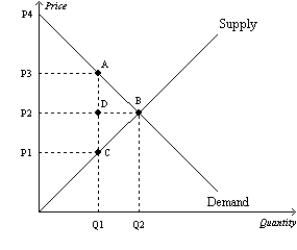 -Refer to Figure 8-3. The amount of deadweight loss associated with the tax is equal to
 (Multiple Choice)
4.8/5 (75)
(75) Concerning the labor market and taxes on labor, economists disagree about
(Multiple Choice)
4.9/5 (78)
(78) Figure 8-5
Suppose that the government imposes a tax of P3 - P1.
-Refer to Figure 8-5. Consumer surplus before the tax was levied is represented by area
-Refer to Figure 8-5. Consumer surplus before the tax was levied is represented by area (Multiple Choice)
4.8/5 (73)
(73) Tom walks Bethany's dog once a day for $50 per week. Bethany values this service at $60 per week, while the opportunity cost of Tom's time is $30 per week. The government places a tax of $35 per week on dog walkers. After the tax, what is the total surplus?
(Multiple Choice)
5.0/5 (87)
(87) Figure 8-8
Suppose the government imposes a $10 per unit tax on a good. 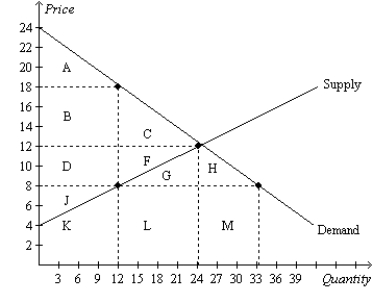 -Refer to Figure 8-8. The deadweight loss of the tax is the area
 (Multiple Choice)
4.8/5 (75)
(75) The more inelastic are demand and supply, the greater is the deadweight loss of a tax.
(True/False)
5.0/5 (92)
(92) Suppose the demand curve and the supply curve in a market are both linear. To begin, there was a $5 tax per unit, and the $5 tax resulted in a deadweight loss of $1,500. Now, the tax per unit is higher, with the higher tax resulting in a deadweight loss of $6,000. What is the amount of the new tax per unit?
(Essay)
4.8/5 (81)
(81) Figure 8-10 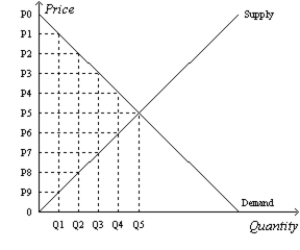 -Refer to Figure 8-10. Suppose the government imposes a tax that reduces the quantity sold in the market after the tax to Q2. The tax revenue is
 (Multiple Choice)
4.9/5 (90)
(90) 
Filters
- Essay(0)
- Multiple Choice(0)
- Short Answer(0)
- True False(0)
- Matching(0)