



 Chat with AI
Exam 8: Application: The Costs of Taxation

Exam 1: Ten Principles of Economics455 Questions
Exam 2: Thinking Like an Economist645 Questions
Exam 3: Interdependence and the Gains From Trade550 Questions
Exam 4: The Market Forces of Supply and Demand693 Questions
Exam 5: Elasticity and Its Application625 Questions
Exam 6: Supply, Demand, and Government Policies671 Questions
Exam 7: Consumers, Producers, and the Efficiency of Markets547 Questions
Exam 8: Application: The Costs of Taxation507 Questions
Exam 9: Application: International Trade521 Questions
Exam 10: Externalities543 Questions
Exam 11: Public Goods and Common Resources453 Questions
Exam 12: The Design of the Tax System563 Questions
Exam 13: The Costs of Production649 Questions
Exam 14: Firms in Competitive Markets608 Questions
Exam 15: Monopoly662 Questions
Exam 16: Monopolistic Competition649 Questions
Exam 17: Oligopoly522 Questions
Exam 18: The Markets for the Factors of Production592 Questions
Exam 19: Earnings and Discrimination511 Questions
Exam 20: Income Inequality and Poverty478 Questions
Exam 21: The Theory of Consumer Choice568 Questions
Exam 22: Frontiers in Microeconomics461 Questions
Select questions type


Suppose that policymakers are considering placing a tax on either of two markets. In Market A, the tax will have a significant effect on the price consumers pay, but it will not affect equilibrium quantity very much. In Market B, the same tax will have only a small effect on the price consumers pay, but it will have a large effect on the equilibrium quantity. Other factors are held constant. In which market will the tax have a larger deadweight loss?
(Multiple Choice)
4.7/5  (80)
(80) Suppose the demand curve and the supply curve in a market are both linear. If a $2 tax per unit results in a deadweight loss of $200, how large would be the deadweight loss from a $3 tax per unit?
(Short Answer)
4.7/5 (77)
(77) The greater the elasticity of demand, the smaller the deadweight loss of a tax.
(True/False)
4.9/5 (65)
(65) Economists disagree on whether labor taxes have a small or large deadweight loss.
(True/False)
4.8/5 (80)
(80) Taxes affect market participants by increasing the price paid by the buyer and received by the seller.
(True/False)
5.0/5 (65)
(65) A tax on insulin is likely to cause a very large deadweight loss to society.
(True/False)
4.9/5 (75)
(75) According to Arthur Laffer, the graph that represents the amount of tax revenue (measured on the vertical axis) as a function of the size of the tax (measured on the horizontal axis) looks like
(Multiple Choice)
4.9/5 (91)
(91) If the tax on a good is increased from $0.30 per unit to $0.90 per unit, the deadweight loss from the tax
(Multiple Choice)
4.8/5 (68)
(68) Suppose a tax of $1 per unit is imposed on a good. The more elastic the demand for the good, other things equal,
(Multiple Choice)
4.7/5 (76)
(76) When a tax is imposed on a good for which both demand and supply are very elastic,
(Multiple Choice)
4.8/5 (75)
(75) Figure 8-2
The vertical distance between points A and B represents a tax in the market. 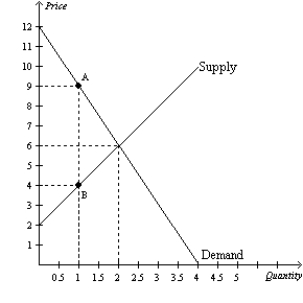 -Refer to Figure 8-2. The amount of tax revenue received by the government is
 (Multiple Choice)
4.9/5 (78)
(78) Suppose a tax of $0.50 per unit on a good creates a deadweight loss of $100. If the tax is increased to $2.50 per unit, the deadweight loss from the new tax would be
(Multiple Choice)
4.9/5 (78)
(78) Figure 8-14 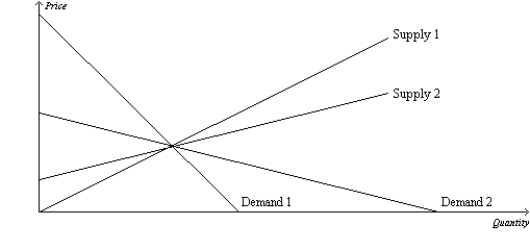 -Refer to Figure 8-14. Which of the following statements is not correct?
 (Multiple Choice)
4.9/5 (74)
(74) The supply curve for motor oil is the typical upward-sloping straight line, and the demand curve for motor oil is the typical downward-sloping straight line. When motor oil is taxed, the area on the relevant supply-and-demand graph that represents the deadweight loss is
(Multiple Choice)
4.7/5 (104)
(104) When a country is on the downward-sloping side of the Laffer curves, a cut in the tax rate will
(Multiple Choice)
4.8/5 (82)
(82) Figure 8-9
The vertical distance between points A and C represents a tax in the market. 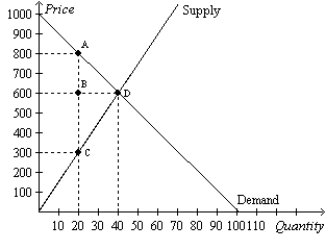 -Refer to Figure 8-9. The imposition of the tax causes the price paid by buyers to
 (Multiple Choice)
4.8/5 (98)
(98) Figure 8-26 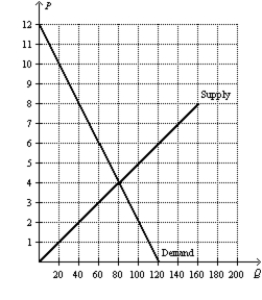 -Refer to Figure 8-26. Suppose the government increases the size of the tax on this good from $3 per unit to $6 per unit. Will the tax revenue collected from the tax increase, decrease, or stay the same?
 (Essay)
4.7/5 (90)
(90) 
Filters
- Essay(0)
- Multiple Choice(0)
- Short Answer(0)
- True False(0)
- Matching(0)