



 Chat with AI
Exam 8: Application: The Costs of Taxation

Exam 1: Ten Principles of Economics455 Questions
Exam 2: Thinking Like an Economist645 Questions
Exam 3: Interdependence and the Gains From Trade550 Questions
Exam 4: The Market Forces of Supply and Demand693 Questions
Exam 5: Elasticity and Its Application625 Questions
Exam 6: Supply, Demand, and Government Policies671 Questions
Exam 7: Consumers, Producers, and the Efficiency of Markets547 Questions
Exam 8: Application: The Costs of Taxation507 Questions
Exam 9: Application: International Trade521 Questions
Exam 10: Externalities543 Questions
Exam 11: Public Goods and Common Resources453 Questions
Exam 12: The Design of the Tax System563 Questions
Exam 13: The Costs of Production649 Questions
Exam 14: Firms in Competitive Markets608 Questions
Exam 15: Monopoly662 Questions
Exam 16: Monopolistic Competition649 Questions
Exam 17: Oligopoly522 Questions
Exam 18: The Markets for the Factors of Production592 Questions
Exam 19: Earnings and Discrimination511 Questions
Exam 20: Income Inequality and Poverty478 Questions
Exam 21: The Theory of Consumer Choice568 Questions
Exam 22: Frontiers in Microeconomics461 Questions
Select questions type


Figure 8-2
The vertical distance between points A and B represents a tax in the market. 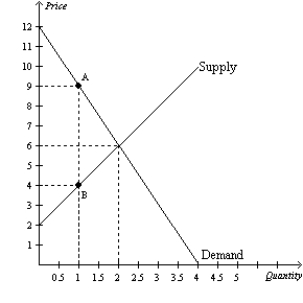 -Refer to Figure 8-2. The amount of deadweight loss as a result of the tax is
 (Multiple Choice)
4.7/5  (81)
(81) When a tax is imposed on the buyers of a good, the demand curve shifts
(Multiple Choice)
4.8/5 (87)
(87) Figure 8-1 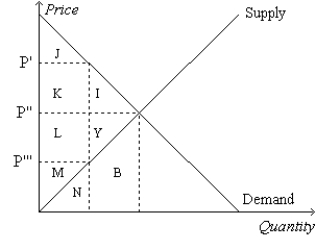 -Refer to Figure 8-1. Suppose the government imposes a tax of P' - P'''. The area measured by J+K+I represents
 (Multiple Choice)
4.9/5 (84)
(84) Figure 8-9
The vertical distance between points A and C represents a tax in the market. 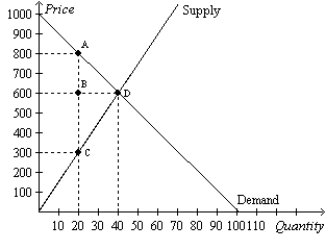 -Refer to Figure 8-9. The equilibrium price and quantity before the imposition of the tax is
 (Multiple Choice)
4.9/5 (81)
(81) Figure 8-1
-Refer to Figure 8-1. Suppose the government imposes a tax of P' - P'''. The area measured by K+L represents
-Refer to Figure 8-1. Suppose the government imposes a tax of P' - P'''. The area measured by K+L represents (Multiple Choice)
5.0/5 (61)
(61) Figure 8-17 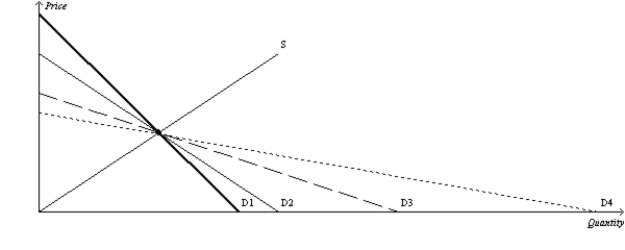 -Refer to Figure 8-17. Suppose the government imposes a $1 tax in each of the four markets represented by demand curves D1, D2, D3, and D4. The deadweight will be the largest in the market represented by
 (Multiple Choice)
4.7/5 (83)
(83) When a tax is imposed on buyers, consumer surplus decreases but producer surplus increases.
(True/False)
4.9/5 (80)
(80) Figure 8-13 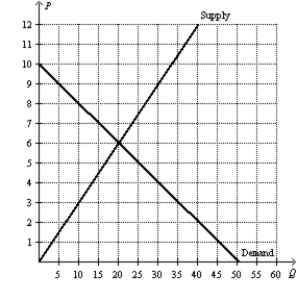 -Refer to Figure 8-13. Suppose the government places a $5 per-unit tax on this good. The tax causes the price received by sellers to
 (Multiple Choice)
4.7/5 (81)
(81) Figure 8-4
The vertical distance between points A and B represents a tax in the market. 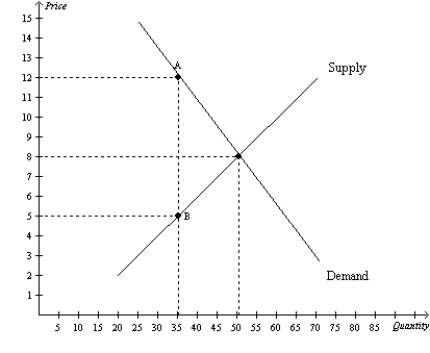 -Refer to Figure 8-4. The equilibrium price before the tax is imposed is
 (Multiple Choice)
4.9/5 (100)
(100) Figure 8-12 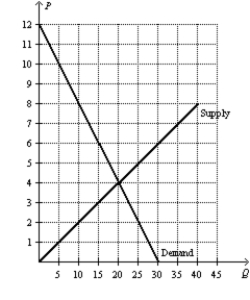 -Refer to Figure 8-12. Suppose a $3 per-unit tax is placed on this good. The loss of consumer surplus resulting from this tax is
 (Multiple Choice)
4.8/5 (83)
(83) Provide several examples of important taxes on labor in the United States. For a typical worker, what is the marginal tax rate on labor income once all the labor taxes are summed?
(Essay)
4.9/5 (85)
(85) Figure 8-10 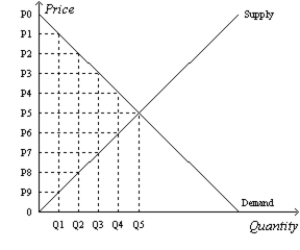 -Refer to Figure 8-10. Suppose the government imposes a tax that reduces the quantity sold in the market after the tax to Q2. Without the tax, the producer surplus is
 (Multiple Choice)
4.8/5 (69)
(69) Figure 8-22 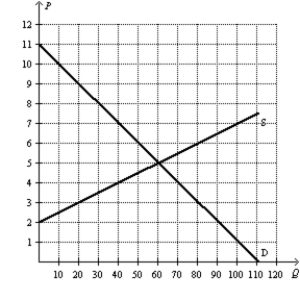 -Refer to Figure 8-22. Suppose the government initially imposes a $3 per-unit tax on this good. Now suppose the government is deciding whether to lower the tax to $1.50 or raise it to $4.50. Which of the following statements is not correct?
 (Multiple Choice)
4.9/5 (75)
(75) Figure 8-3
The vertical distance between points A and C represents a tax in the market. 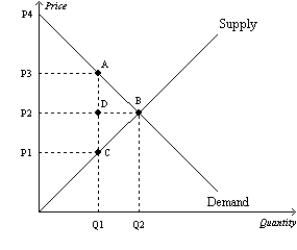 -Refer to Figure 8-3. The per-unit burden of the tax on sellers is
 (Multiple Choice)
4.9/5 (84)
(84) Figure 8-9
The vertical distance between points A and C represents a tax in the market.
-Refer to Figure 8-9. The per-unit burden of the tax on sellers is
-Refer to Figure 8-9. The per-unit burden of the tax on sellers is (Multiple Choice)
4.9/5 (69)
(69) Tax revenue equals the size of the tax multiplied by the quantity sold in the market after the tax is levied.
(True/False)
4.8/5 (76)
(76) Figure 8-25 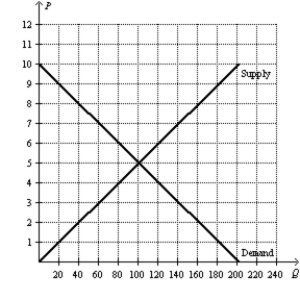 -Refer to Figure 8-25. Suppose the government places a $4 tax per unit on this good. How many units of this good will be bought and sold after the tax is imposed?
 (Essay)
4.8/5 (81)
(81) Figure 8-5
Suppose that the government imposes a tax of P3 - P1. 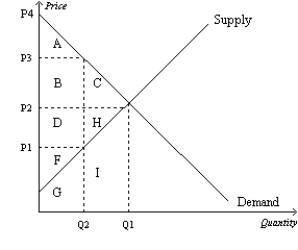 -Refer to Figure 8-5. After the tax is levied, consumer surplus is represented by area
 (Multiple Choice)
4.8/5 (79)
(79) When a tax is imposed, the loss of consumer surplus and producer surplus as a result of the tax exceeds the tax revenue collected by the government.
(True/False)
4.9/5 (85)
(85) The optimal tax is difficult to determine because although revenues rise and fall as the size of the tax increases, deadweight loss continues to increase.
(True/False)
4.8/5 (77)
(77) 
Filters
- Essay(0)
- Multiple Choice(0)
- Short Answer(0)
- True False(0)
- Matching(0)