



 Chat with AI
Exam 8: Application: The Costs of Taxation

Exam 1: Ten Principles of Economics455 Questions
Exam 2: Thinking Like an Economist645 Questions
Exam 3: Interdependence and the Gains From Trade550 Questions
Exam 4: The Market Forces of Supply and Demand693 Questions
Exam 5: Elasticity and Its Application625 Questions
Exam 6: Supply, Demand, and Government Policies671 Questions
Exam 7: Consumers, Producers, and the Efficiency of Markets547 Questions
Exam 8: Application: The Costs of Taxation507 Questions
Exam 9: Application: International Trade521 Questions
Exam 10: Externalities543 Questions
Exam 11: Public Goods and Common Resources453 Questions
Exam 12: The Design of the Tax System563 Questions
Exam 13: The Costs of Production649 Questions
Exam 14: Firms in Competitive Markets608 Questions
Exam 15: Monopoly662 Questions
Exam 16: Monopolistic Competition649 Questions
Exam 17: Oligopoly522 Questions
Exam 18: The Markets for the Factors of Production592 Questions
Exam 19: Earnings and Discrimination511 Questions
Exam 20: Income Inequality and Poverty478 Questions
Exam 21: The Theory of Consumer Choice568 Questions
Exam 22: Frontiers in Microeconomics461 Questions
Select questions type


Assume that for good X the supply curve for a good is a typical, upward-sloping straight line, and the demand curve is a typical downward-sloping straight line. If the good is taxed, and the tax is tripled, the
(Multiple Choice)
4.8/5  (93)
(93) Figure 8-10 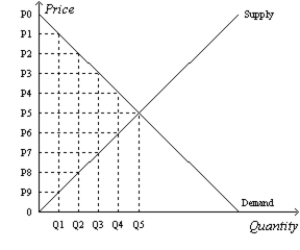 -Refer to Figure 8-10. Suppose the government imposes a tax that reduces the quantity sold in the market after the tax to Q2. Without the tax, the total surplus is
 (Multiple Choice)
4.8/5 (90)
(90) Scenario 8-3
Suppose the market demand and market supply curves are given by the equations:  -Refer to Scenario 8-3. Suppose that a tax of T is placed on buyers so that the demand curve becomes:
 What price will sellers receive and what price will buyers pay after the tax is imposed?
-Refer to Scenario 8-3. Suppose that a tax of T is placed on buyers so that the demand curve becomes: What price will sellers receive and what price will buyers pay after the tax is imposed? (Essay)
4.8/5 (84)
(84) Figure 8-8
Suppose the government imposes a $10 per unit tax on a good. 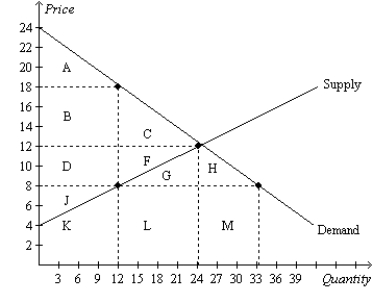 -Refer to Figure 8-8. After the tax goes into effect, consumer surplus is the area
 (Multiple Choice)
4.9/5 (83)
(83) Suppose a tax is imposed on the sellers of fast-food French fries. The burden of the tax will
(Multiple Choice)
4.9/5 (79)
(79) John has been in the habit of mowing Willa's lawn each week for $20. John's opportunity cost is $15, and Willa would be willing to pay $25 to have her lawn mowed. What is the maximum tax the government can impose on lawn mowing without discouraging John and Willa from continuing their mutually beneficial arrangement?
(Essay)
4.8/5 (90)
(90) The elasticities of the supply and demand curves in the market for cigarettes affect how much a tax distorts that market.
(True/False)
4.9/5 (84)
(84) Scenario 8-3
Suppose the market demand and market supply curves are given by the equations:
-Refer to Scenario 8-3. Suppose that a tax of T is placed on buyers so that the demand curve becomes:  If T = 40, what price will buyers pay and what price will sellers receive?
-Refer to Scenario 8-3. Suppose that a tax of T is placed on buyers so that the demand curve becomes: If T = 40, what price will buyers pay and what price will sellers receive? (Essay)
4.8/5 (94)
(94) Figure 8-12 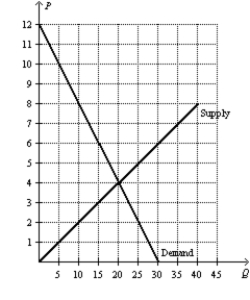 -Refer to Figure 8-12. Suppose a $3 per-unit tax is placed on this good. The per-unit burden of the tax on sellers is
 (Multiple Choice)
5.0/5 (70)
(70) The deadweight loss from a tax of $2 per unit will be smallest in a market with
(Multiple Choice)
4.8/5 (69)
(69) When the price of a good is measured in dollars, then the size of the deadweight loss that results from taxing that good is measured in
(Multiple Choice)
4.8/5 (82)
(82) Figure 8-2
The vertical distance between points A and B represents a tax in the market. 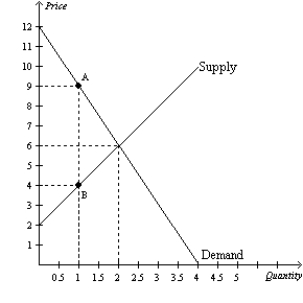 -Refer to Figure 8-2. The per-unit burden of the tax on buyers is
 (Multiple Choice)
4.8/5 (84)
(84) Figure 8-6
The vertical distance between points A and B represents a tax in the market. 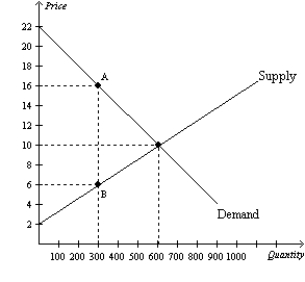 -Refer to Figure 8-6. Without a tax, consumer surplus in this market is
 (Multiple Choice)
4.7/5 (86)
(86) Scenario 8-3
Suppose the market demand and market supply curves are given by the equations:
-Refer to Scenario 8-3. Suppose that a tax of T is placed on buyers so that the demand curve becomes:  If T = 40, how much will be the deadweight loss from this tax?
-Refer to Scenario 8-3. Suppose that a tax of T is placed on buyers so that the demand curve becomes: If T = 40, how much will be the deadweight loss from this tax? (Essay)
4.9/5 (79)
(79) In the market for widgets, the supply curve is the typical upward-sloping straight line, and the demand curve is the typical downward-sloping straight line. The equilibrium quantity in the market for widgets is 200 per month when there is no tax. Then a tax of $5 per widget is imposed. As a result, the government is able to raise $800 per month in tax revenue. We can conclude that the equilibrium quantity of widgets has fallen by
(Multiple Choice)
4.9/5 (96)
(96) Buyers of a product will bear the larger part of the tax burden, and sellers will bear a smaller part of the tax burden, when the
(Multiple Choice)
4.9/5 (82)
(82) 
Filters
- Essay(0)
- Multiple Choice(0)
- Short Answer(0)
- True False(0)
- Matching(0)