



 Chat with AI
Exam 8: Application: The Costs of Taxation

Exam 1: Ten Principles of Economics455 Questions
Exam 2: Thinking Like an Economist645 Questions
Exam 3: Interdependence and the Gains From Trade550 Questions
Exam 4: The Market Forces of Supply and Demand693 Questions
Exam 5: Elasticity and Its Application625 Questions
Exam 6: Supply, Demand, and Government Policies671 Questions
Exam 7: Consumers, Producers, and the Efficiency of Markets547 Questions
Exam 8: Application: The Costs of Taxation507 Questions
Exam 9: Application: International Trade521 Questions
Exam 10: Externalities543 Questions
Exam 11: Public Goods and Common Resources453 Questions
Exam 12: The Design of the Tax System563 Questions
Exam 13: The Costs of Production649 Questions
Exam 14: Firms in Competitive Markets608 Questions
Exam 15: Monopoly662 Questions
Exam 16: Monopolistic Competition649 Questions
Exam 17: Oligopoly522 Questions
Exam 18: The Markets for the Factors of Production592 Questions
Exam 19: Earnings and Discrimination511 Questions
Exam 20: Income Inequality and Poverty478 Questions
Exam 21: The Theory of Consumer Choice568 Questions
Exam 22: Frontiers in Microeconomics461 Questions
Select questions type


Scenario 8-2
Roland mows Karla's lawn for $25. Roland's opportunity cost of mowing Karla's lawn is $20, and Karla's willingness to pay Roland to mow her lawn is $28.
-Refer to Scenario 8-2. If Karla hires Roland to mow her lawn, Roland's producer surplus is
(Multiple Choice)
4.9/5  (80)
(80) The deadweight loss from a $3 tax will be largest in a market with
(Multiple Choice)
4.8/5 (77)
(77) Figure 8-25 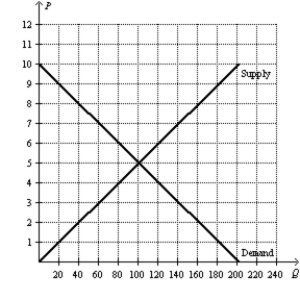 -Refer to Figure 8-25. How much is producer surplus at the market equilibrium?
 (Essay)
4.9/5 (92)
(92) Economists disagree on whether labor taxes cause small or large deadweight losses. This disagreement arises primarily because economists hold different views about
(Multiple Choice)
4.9/5 (87)
(87) Figure 8-23. The figure represents the relationship between the size of a tax and the tax revenue raised by that tax. 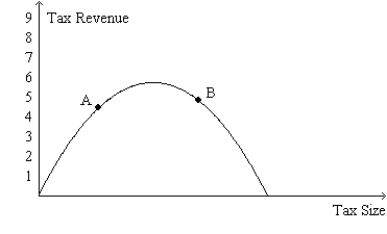 -Refer to Figure 8-23. If the economy is at point B on the curve, then a small decrease in the tax rate will
 (Multiple Choice)
4.8/5 (59)
(59) Figure 8-6
The vertical distance between points A and B represents a tax in the market. 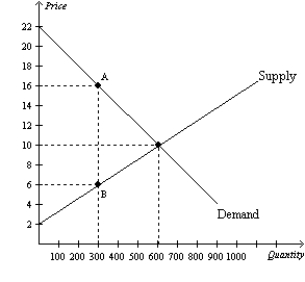 -Refer to Figure 8-6. What happens to consumer surplus when the tax is imposed in this market?
 (Multiple Choice)
4.7/5 (86)
(86) Suppose that the market for product X is characterized by a typical, downward-sloping, linear demand curve and a typical, upward-sloping, linear supply curve. If a $2 tax per unit results in a deadweight loss of $200, how large would be the deadweight loss from a $4 tax per unit?
(Essay)
4.8/5 (78)
(78) The result of the large tax cuts in the first Reagan Administration demonstrated very convincingly that Arthur Laffer was correct when he asserted that cuts in tax rates would increase tax revenue.
(True/False)
4.8/5 (89)
(89) Figure 8-6
The vertical distance between points A and B represents a tax in the market.
-Refer to Figure 8-6. Without a tax, the equilibrium price and quantity are
-Refer to Figure 8-6. Without a tax, the equilibrium price and quantity are (Multiple Choice)
4.8/5 (72)
(72) Figure 8-1 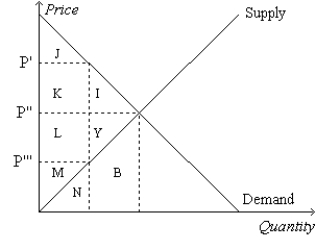 -Refer to Figure 8-1. Suppose the government imposes a tax of P' - P'''. The producer surplus after the tax is measured by the area
 (Multiple Choice)
4.9/5 (70)
(70) Figure 8-14 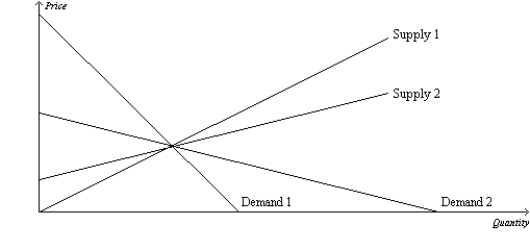 -Refer to Figure 8-14. Which of the following combinations will maximize the deadweight loss from a tax?
 (Multiple Choice)
4.9/5 (75)
(75) Figure 8-1
-Refer to Figure 8-1. Suppose the government imposes a tax of P' - P'''. The consumer surplus after the tax is measured by the area
-Refer to Figure 8-1. Suppose the government imposes a tax of P' - P'''. The consumer surplus after the tax is measured by the area (Multiple Choice)
4.8/5 (86)
(86) If the tax on gasoline increases from $2 to $4 per gallon, the deadweight loss from the tax increases by a factor of
(Multiple Choice)
4.9/5 (69)
(69) Figure 8-8
Suppose the government imposes a $10 per unit tax on a good. 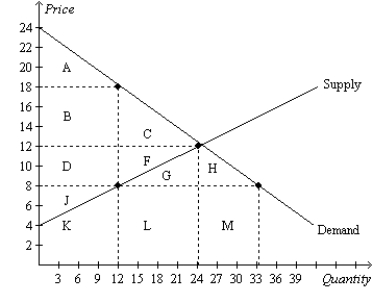 -Refer to Figure 8-8. The tax causes consumer surplus to decrease by the area
 (Multiple Choice)
4.9/5 (86)
(86) In the market for widgets, the supply curve is the typical upward-sloping straight line, and the demand curve is the typical downward-sloping straight line. The equilibrium quantity in the market for widgets is 200 per month when there is no tax. Then a tax of $5 per widget is imposed. The price paid by buyers increases by $2 and the after-tax price received by sellers falls by $3. The government is able to raise $750 per month in revenue from the tax. The deadweight loss from the tax is
(Multiple Choice)
4.8/5 (98)
(98) One result of a tax, regardless of whether the tax is placed on the buyers or the sellers, is that the
(Multiple Choice)
4.7/5 (78)
(78) Scenario 8-3
Suppose the market demand and market supply curves are given by the equations:  -Refer to Scenario 8-3. Suppose that a tax of T is placed on buyers so that the demand curve becomes:
 What will be the deadweight loss from this tax?
-Refer to Scenario 8-3. Suppose that a tax of T is placed on buyers so that the demand curve becomes: What will be the deadweight loss from this tax? (Essay)
4.9/5 (82)
(82) Suppose a tax is imposed on baseball bats. In which of the following cases will the tax cause the equilibrium quantity of baseball bats to shrink by the smallest amount?
(Multiple Choice)
4.8/5 (93)
(93) When a tax is placed on a product, the price paid by buyers
(Multiple Choice)
4.8/5 (78)
(78) 
Filters
- Essay(0)
- Multiple Choice(0)
- Short Answer(0)
- True False(0)
- Matching(0)