



 Chat with AI
Exam 9: Application: International Trade

Exam 1: Ten Principles of Economics455 Questions
Exam 2: Thinking Like an Economist645 Questions
Exam 3: Interdependence and the Gains From Trade550 Questions
Exam 4: The Market Forces of Supply and Demand693 Questions
Exam 5: Elasticity and Its Application625 Questions
Exam 6: Supply, Demand, and Government Policies671 Questions
Exam 7: Consumers, Producers, and the Efficiency of Markets547 Questions
Exam 8: Application: The Costs of Taxation507 Questions
Exam 9: Application: International Trade521 Questions
Exam 10: Externalities543 Questions
Exam 11: Public Goods and Common Resources453 Questions
Exam 12: The Design of the Tax System563 Questions
Exam 13: The Costs of Production649 Questions
Exam 14: Firms in Competitive Markets608 Questions
Exam 15: Monopoly662 Questions
Exam 16: Monopolistic Competition649 Questions
Exam 17: Oligopoly522 Questions
Exam 18: The Markets for the Factors of Production592 Questions
Exam 19: Earnings and Discrimination511 Questions
Exam 20: Income Inequality and Poverty478 Questions
Exam 21: The Theory of Consumer Choice568 Questions
Exam 22: Frontiers in Microeconomics461 Questions
Select questions type


Figure 9-15 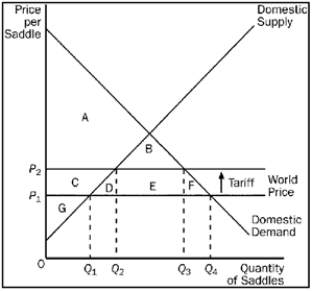 -Refer to Figure 9-15. As a result of the tariff, there is a deadweight loss that amounts to
 (Multiple Choice)
4.8/5  (79)
(79) When the nation of Worldova allows trade and becomes an exporter of silk,
(Multiple Choice)
4.9/5 (69)
(69) For a country that is considering the adoption of either a tariff or an import quota on a particular good, an important difference is that
(Multiple Choice)
4.8/5 (76)
(76) "Trade raises the economic well-being of a nation in the sense that the gains of the winners exceed the losses of the losers." This statement is correct for a nation that exports manufactured goods, but it is not correct for a nation that imports manufactured goods.
(True/False)
5.0/5 (74)
(74) If a country allows trade and, for a certain good, the domestic price without trade is lower than the world price,
(Multiple Choice)
4.8/5 (77)
(77) Scenario 9-1
The before-trade domestic price of peaches in the United States is $40 per bushel. The world price of peaches is $52 per bushel. The U.S. is a price-taker in the market for peaches.
-Refer to Scenario 9-1. If trade in peaches is allowed, the
(Multiple Choice)
4.8/5 (69)
(69) Figure 9-18. On the diagram below, Q represents the quantity of peaches and P represents the price of peaches. The domestic country is Isoland. 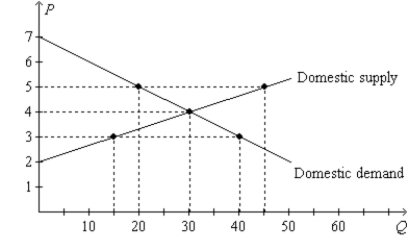 -Refer to Figure 9-18. Suppose Isoland changes from a no-trade policy to a policy that allows international trade. If the world price of peaches is $5, then the policy change results in
 (Multiple Choice)
4.7/5 (75)
(75) Assume for Guatemala that the domestic price of coffee without international trade is higher than the world price of coffee. This suggests that
(Multiple Choice)
4.9/5 (76)
(76) An important factor in the decline of the U.S. textile industry over the past 100 or so years is
(Multiple Choice)
4.8/5 (77)
(77) Figure 9-29
The following diagram shows the domestic demand and domestic supply curves in a market. Assume that the world price in this market is $1 per unit. 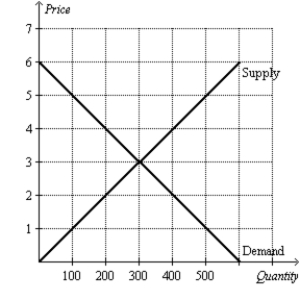 -Refer to Figure 9-29. Suppose the country imposes a $1 per unit tariff. If the country allows trade with a tariff, how much is the deadweight loss caused by the tariff?
 (Short Answer)
4.8/5 (73)
(73) For Country A, the world price of soybeans exceeds the domestic equilibrium price of soybeans. As a result, international trade allows buyers of soybeans in Country A to experience greater consumer surplus than they otherwise would experience.
(True/False)
4.8/5 (89)
(89) Figure 9-25
The following diagram shows the domestic demand and supply in a market. Assume that the world price in this market is $10 per unit. 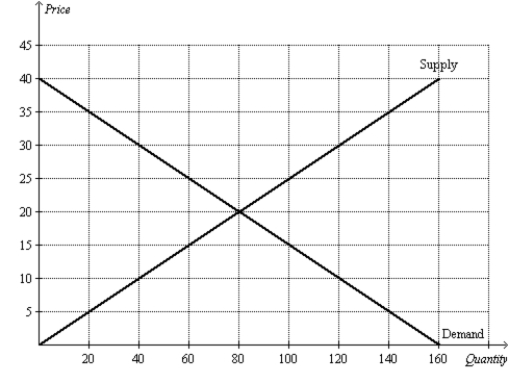 -Refer to Figure 9-25. Suppose the government imposes a tariff of $5 per unit. The amount of revenue collected by the government from the tariff is
 (Multiple Choice)
4.8/5 (77)
(77) The nation of Cranolia used to prohibit international trade, but now trade is allowed, and Cranolia is exporting furniture. Relative to the previous no-trade situation, buyers of furniture in Cranolia are now better off.
(True/False)
4.8/5 (78)
(78) Figure 9-27
The following diagram shows the domestic demand and supply curves in a market. Assume that the world price in this market is $20 per unit. 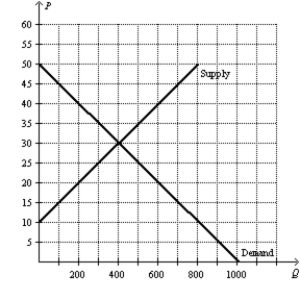 -Refer to Figure 9-27. If the country allows free trade, how many units will domestic consumers demand and how many units will domestic producers produce?
 (Essay)
4.9/5 (92)
(92) Figure 9-22
The following diagram shows the domestic demand and domestic supply in a market. In addition, assume that the world price in this market is $40 per unit. 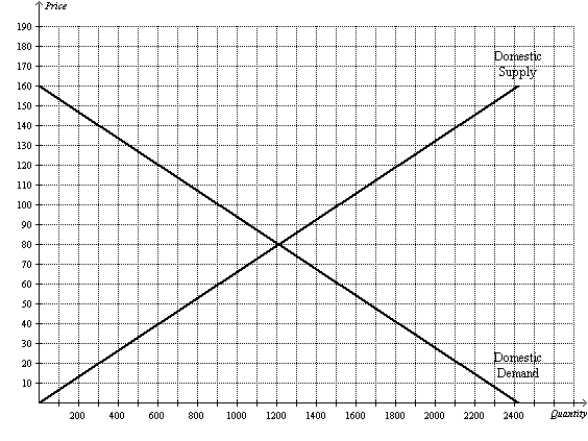 -Refer to Figure 9-22. Suppose the government imposes a tariff of $20 per unit. The amount of revenue collected by the government from the tariff is
 (Multiple Choice)
4.7/5 (87)
(87) Figure 9-5
The figure illustrates the market for tricycles in a country. 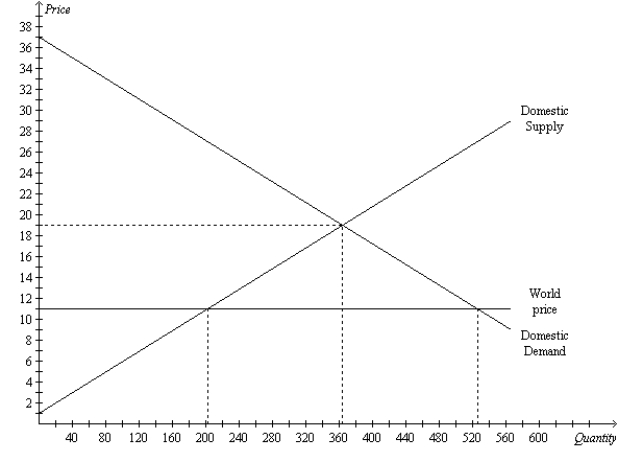 -Refer to Figure 9-5. Without trade, consumer surplus amounts to
 (Multiple Choice)
4.7/5 (89)
(89) Figure 9-29
The following diagram shows the domestic demand and domestic supply curves in a market. Assume that the world price in this market is $1 per unit.
-Refer to Figure 9-29. Suppose the country imposes a $1 per unit tariff. If the country allows trade with a tariff, how much is tariff revenue?
-Refer to Figure 9-29. Suppose the country imposes a $1 per unit tariff. If the country allows trade with a tariff, how much is tariff revenue? (Essay)
4.8/5 (85)
(85) Figure 9-1
The figure illustrates the market for coffee in Guatemala. 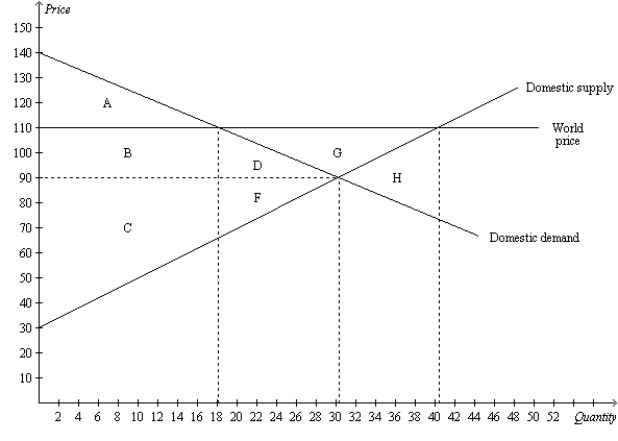 -Refer to Figure 9-1. With trade, total surplus in the Guatemalan coffee market amounts to
 (Multiple Choice)
4.9/5 (81)
(81) Figure 9-7. The figure applies to the nation of Wales and the good is cheese. 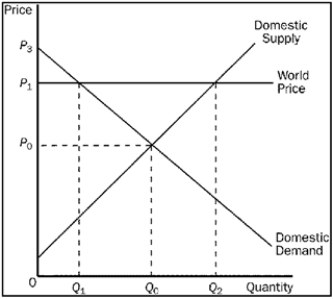 -Refer to Figure 9-7. Which of the following is a valid equation for the gains from trade?
 (Multiple Choice)
4.9/5 (93)
(93) 
Filters
- Essay(0)
- Multiple Choice(0)
- Short Answer(0)
- True False(0)
- Matching(0)