



 Chat with AI
Exam 9: Application: International Trade

Exam 1: Ten Principles of Economics455 Questions
Exam 2: Thinking Like an Economist645 Questions
Exam 3: Interdependence and the Gains From Trade550 Questions
Exam 4: The Market Forces of Supply and Demand693 Questions
Exam 5: Elasticity and Its Application625 Questions
Exam 6: Supply, Demand, and Government Policies671 Questions
Exam 7: Consumers, Producers, and the Efficiency of Markets547 Questions
Exam 8: Application: The Costs of Taxation507 Questions
Exam 9: Application: International Trade521 Questions
Exam 10: Externalities543 Questions
Exam 11: Public Goods and Common Resources453 Questions
Exam 12: The Design of the Tax System563 Questions
Exam 13: The Costs of Production649 Questions
Exam 14: Firms in Competitive Markets608 Questions
Exam 15: Monopoly662 Questions
Exam 16: Monopolistic Competition649 Questions
Exam 17: Oligopoly522 Questions
Exam 18: The Markets for the Factors of Production592 Questions
Exam 19: Earnings and Discrimination511 Questions
Exam 20: Income Inequality and Poverty478 Questions
Exam 21: The Theory of Consumer Choice568 Questions
Exam 22: Frontiers in Microeconomics461 Questions
Select questions type


One should be especially wary of the national-security argument for restricting trade when that argument is made by
(Multiple Choice)
4.9/5  (85)
(85) Which of the following is not an advantage of a multilateral approach to free trade over a unilateral approach?
(Multiple Choice)
4.9/5 (75)
(75) Trade decisions are based on the principle of absolute advantage.
(True/False)
4.8/5 (79)
(79) Import quotas and tariffs produce similar results. Which of the following is not one of those results?
(Multiple Choice)
4.7/5 (71)
(71) Suppose the nation of Canada forbids international trade. In Canada, you can obtain a hockey stick by trading 5 baseball bats. In other countries, you can obtain a hockey stick by trading 8 baseball bats. These facts indicate that
(Multiple Choice)
4.8/5 (82)
(82) Figure 9-5
The figure illustrates the market for tricycles in a country. 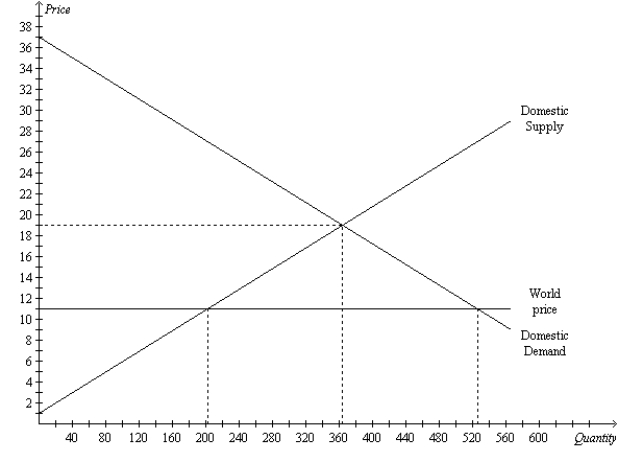 -Refer to Figure 9-5. With trade, total surplus is
 (Multiple Choice)
4.8/5 (67)
(67) Figure 9-9 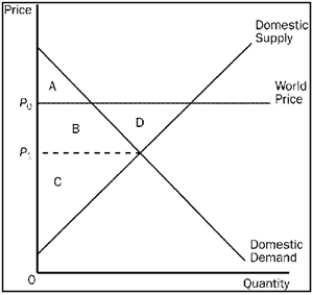 -Refer to Figure 9-9. The change in total surplus in this market because of trade is
 (Multiple Choice)
4.7/5 (78)
(78) Most economists view the United States' experience with trade as
(Multiple Choice)
4.8/5 (89)
(89) Figure 9-13 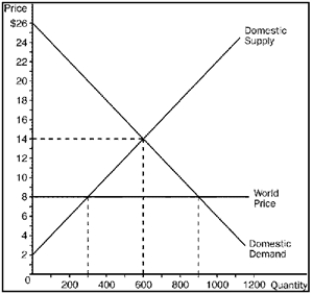 -Refer to Figure 9-13. Consumer surplus after trade is
 (Multiple Choice)
4.8/5 (99)
(99) Honduras is an importer of goose-down pillows. The world price of these pillows is $50. Honduras imposes a $7 tariff on pillows. Honduras is a price-taker in the pillow market. As a result of the tariff, the price of goose-down pillows in Honduras
(Multiple Choice)
4.9/5 (69)
(69) Figure 9-21
The following diagram shows the domestic demand and domestic supply for a market. In addition, assume that the world price in this market is $40 per unit. 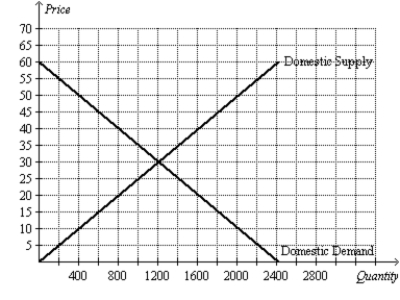 -Refer to Figure 9-21. Producer surplus with free trade is
 (Multiple Choice)
4.7/5 (77)
(77) When a country that imports a particular good imposes an import quota on that good,
(Multiple Choice)
5.0/5 (88)
(88) Since a tariff can increase employment in an industry, the result is a net increase in total surplus.
(True/False)
4.8/5 (76)
(76) Figure 9-17 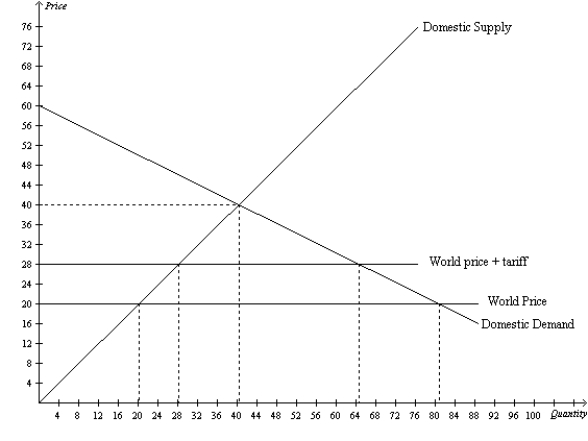 -Refer to Figure 9-17. The deadweight loss caused by the tariff is
 (Multiple Choice)
4.8/5 (78)
(78) The small-economy assumption is necessary to analyze the gains and losses from international trade.
(True/False)
4.8/5 (85)
(85) If the world price of a good is greater than the domestic price in a country that can engage in international trade, then that country becomes an importer of that good.
(True/False)
5.0/5 (70)
(70) Figure 9-1
The figure illustrates the market for coffee in Guatemala. 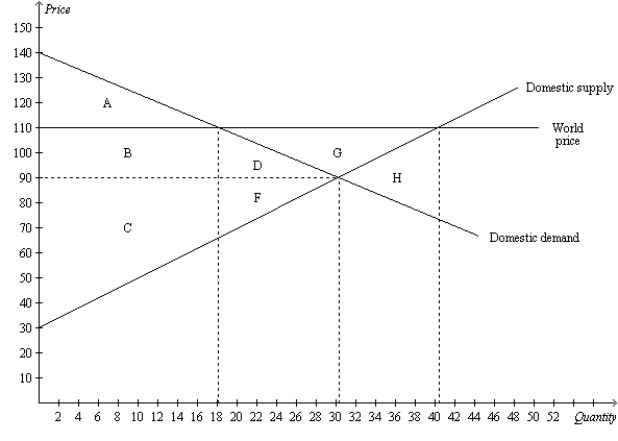 -Refer to Figure 9-1. When trade in coffee is allowed, consumer surplus in Guatemala
 (Multiple Choice)
4.8/5 (60)
(60) Figure 9-12 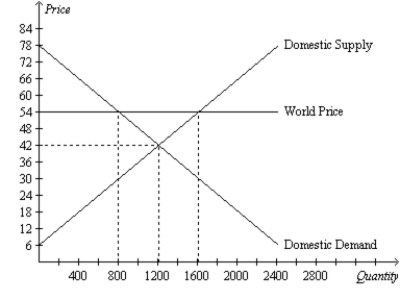 -Refer to Figure 9-12. With trade, the domestic price and domestic quantity demanded are
 (Multiple Choice)
4.9/5 (96)
(96) 
Filters
- Essay(0)
- Multiple Choice(0)
- Short Answer(0)
- True False(0)
- Matching(0)