



 Chat with AI
Exam 9: Application: International Trade

Exam 1: Ten Principles of Economics455 Questions
Exam 2: Thinking Like an Economist645 Questions
Exam 3: Interdependence and the Gains From Trade550 Questions
Exam 4: The Market Forces of Supply and Demand693 Questions
Exam 5: Elasticity and Its Application625 Questions
Exam 6: Supply, Demand, and Government Policies671 Questions
Exam 7: Consumers, Producers, and the Efficiency of Markets547 Questions
Exam 8: Application: The Costs of Taxation507 Questions
Exam 9: Application: International Trade521 Questions
Exam 10: Externalities543 Questions
Exam 11: Public Goods and Common Resources453 Questions
Exam 12: The Design of the Tax System563 Questions
Exam 13: The Costs of Production649 Questions
Exam 14: Firms in Competitive Markets608 Questions
Exam 15: Monopoly662 Questions
Exam 16: Monopolistic Competition649 Questions
Exam 17: Oligopoly522 Questions
Exam 18: The Markets for the Factors of Production592 Questions
Exam 19: Earnings and Discrimination511 Questions
Exam 20: Income Inequality and Poverty478 Questions
Exam 21: The Theory of Consumer Choice568 Questions
Exam 22: Frontiers in Microeconomics461 Questions
Select questions type


When a country takes a unilateral approach to free trade, it
(Multiple Choice)
4.8/5  (85)
(85) The "unfair-competition" argument might be cited by an American who believes that
(Multiple Choice)
4.8/5 (77)
(77) When a nation first begins to trade with other countries and the nation becomes an exporter of soybeans,
(Multiple Choice)
4.8/5 (70)
(70) Suppose Russia exports sunflower seeds to Ireland and imports coffee from Brazil. This situation suggests
(Multiple Choice)
4.9/5 (83)
(83) Figure 9-26
The diagram below illustrates the market for baseballs in the U.S. 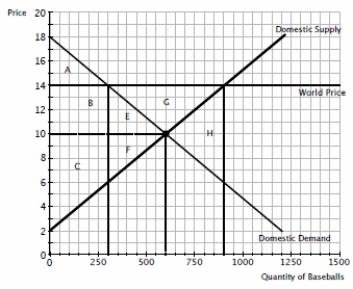 -Refer to figure 9-26. After opening the U.S. baseball market to international trade, total surplus is
 (Multiple Choice)
4.9/5 (82)
(82) Figure 9-15 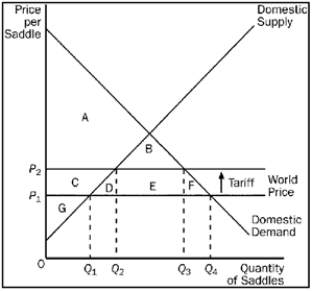 -Refer to Figure 9-15. Producer surplus with the tariff is
 (Multiple Choice)
4.9/5 (80)
(80) In 2008, the Los Angeles Times asked members of the American public whether free international trade has helped or hurt the economy. Of those surveyed,
(Multiple Choice)
4.8/5 (77)
(77) Suppose Ireland exports beer to China and imports pineapples from the United States. This situation suggests that
(Multiple Choice)
4.8/5 (75)
(75) A major difference between tariffs and import quotas is that
(Multiple Choice)
4.7/5 (71)
(71) Suppose a country begins to allow international trade in steel. Which of the following outcomes will be observed regardless of whether the country finds itself importing steel or exporting steel?
(Multiple Choice)
4.8/5 (73)
(73) Import quotas and tariffs both cause the quantity of imports to fall.
(True/False)
4.9/5 (84)
(84) Figure 9-5
The figure illustrates the market for tricycles in a country. 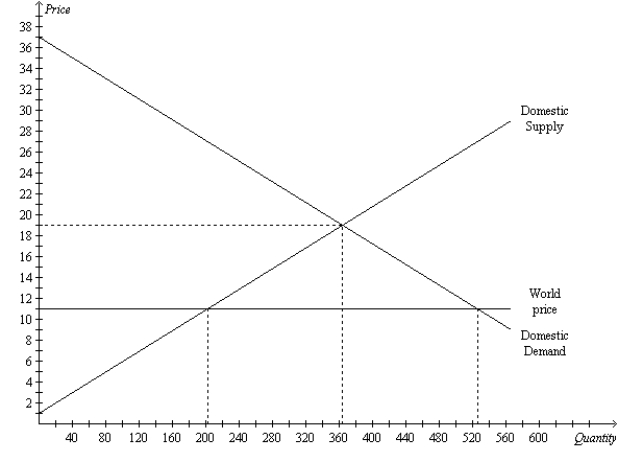 -Refer to Figure 9-5. The increase in total surplus resulting from trade is
 (Multiple Choice)
4.8/5 (75)
(75) Figure 9-24
The following diagram shows the domestic demand and supply in a market. Assume that the world price in this market is $20 per unit. 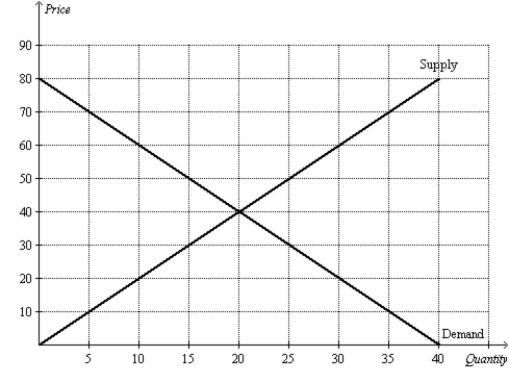 -Refer to Figure 9-24. Suppose the government imposes a tariff of $10 per unit. The amount of revenue collected by the government from the tariff is
 (Multiple Choice)
4.7/5 (78)
(78) For Country A, the world price of textiles exceeds the domestic equilibrium price of textiles. As a result, international trade allows sellers of textiles in Country A to experience greater producer surplus than they otherwise would experience.
(True/False)
4.8/5 (77)
(77) If a country allows free trade and imports cars, then it is the case that the gains to domestic producers outweigh the losses to domestic consumers.
(True/False)
4.9/5 (83)
(83) Figure 9-28
The following diagram shows the domestic demand and domestic supply curves in a market. 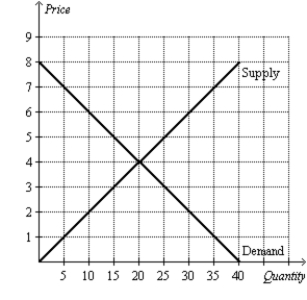 -Refer to Figure 9-28. Suppose the world price in this market is $6. If the country allows free trade, how much is producer surplus?
 (Short Answer)
4.9/5 (72)
(72) In the market for apples in a certain country, consumer surplus increases and total surplus increases when that country
(Multiple Choice)
4.8/5 (93)
(93) Figure 9-17 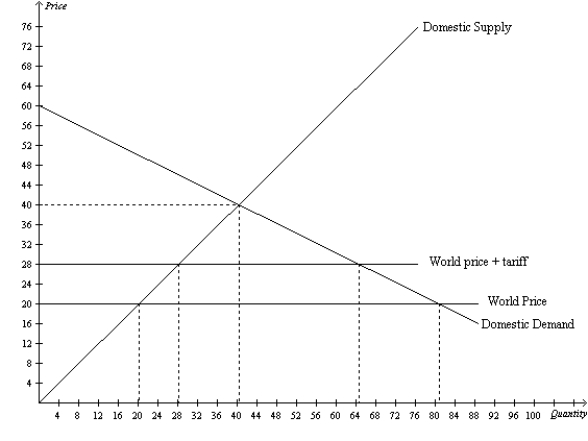 -Refer to Figure 9-17. With trade and a tariff, consumer surplus is
 (Multiple Choice)
4.9/5 (76)
(76) Suppose that Honduras opens its markets to international trade. As a result of this, the domestic price of coffee decreases. We can conclude that
(Multiple Choice)
4.8/5 (77)
(77) Figure 9-17
-Refer to Figure 9-17. With trade and a tariff, total surplus is
-Refer to Figure 9-17. With trade and a tariff, total surplus is (Multiple Choice)
4.9/5 (97)
(97) 
Filters
- Essay(0)
- Multiple Choice(0)
- Short Answer(0)
- True False(0)
- Matching(0)