



 Chat with AI
Exam 9: Application: International Trade

Exam 1: Ten Principles of Economics455 Questions
Exam 2: Thinking Like an Economist645 Questions
Exam 3: Interdependence and the Gains From Trade550 Questions
Exam 4: The Market Forces of Supply and Demand693 Questions
Exam 5: Elasticity and Its Application625 Questions
Exam 6: Supply, Demand, and Government Policies671 Questions
Exam 7: Consumers, Producers, and the Efficiency of Markets547 Questions
Exam 8: Application: The Costs of Taxation507 Questions
Exam 9: Application: International Trade521 Questions
Exam 10: Externalities543 Questions
Exam 11: Public Goods and Common Resources453 Questions
Exam 12: The Design of the Tax System563 Questions
Exam 13: The Costs of Production649 Questions
Exam 14: Firms in Competitive Markets608 Questions
Exam 15: Monopoly662 Questions
Exam 16: Monopolistic Competition649 Questions
Exam 17: Oligopoly522 Questions
Exam 18: The Markets for the Factors of Production592 Questions
Exam 19: Earnings and Discrimination511 Questions
Exam 20: Income Inequality and Poverty478 Questions
Exam 21: The Theory of Consumer Choice568 Questions
Exam 22: Frontiers in Microeconomics461 Questions
Select questions type


Figure 9-6
The figure illustrates the market for roses in a country. 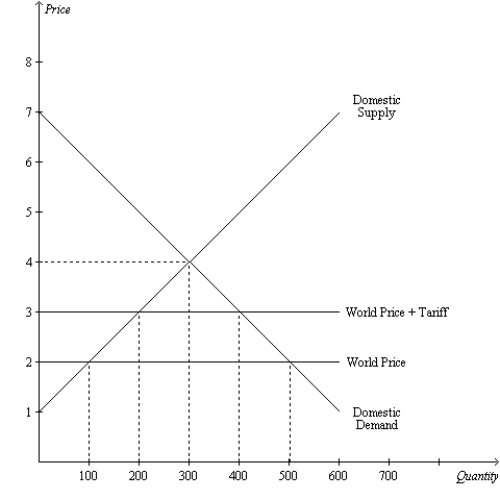 -Refer to Figure 9-6. The amount of deadweight loss caused by the tariff equals
 (Multiple Choice)
4.8/5  (81)
(81) If the United States threatens to impose a tariff on Honduran blueberries if Honduras does not remove agricultural subsidies, the United States will be
(Multiple Choice)
4.7/5 (80)
(80) The before-trade price of fish in Denmark is $10.00 per pound. The world price of fish is $6.00 per pound. Denmark is a price-taker in the fish market. If Denmark begins to allow trade in fish, its consumers of fish will become
(Multiple Choice)
4.8/5 (76)
(76) Suppose that Australia imposes a tariff on imported beef. If the increase in producer surplus is $100 million, the increase in tariff revenue is $200 million, and the reduction in consumer surplus is $500 million, the deadweight loss of the tariff is $300 million.
(True/False)
4.7/5 (74)
(74) Figure 9-15 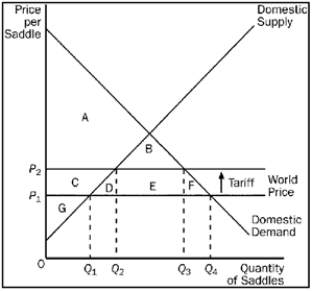 -Refer to Figure 9-15. With trade and without a tariff, the price and domestic quantity demanded are
 (Multiple Choice)
4.9/5 (86)
(86) Figure 9-12 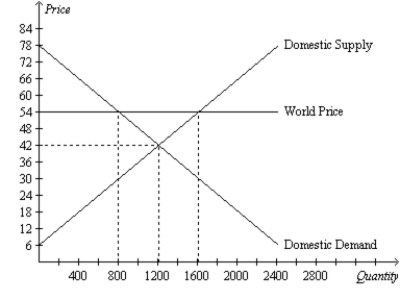 -Refer to Figure 9-12. Producer surplus before trade is
 (Multiple Choice)
4.8/5 (69)
(69) The nation of Spritzland used to prohibit international trade, but now trade is allowed, and Spritzland is exporting wristwatches. Relative to the previous no-trade situation, total surplus in the market for wristwatches in Spritzland has increased.
(True/False)
5.0/5 (87)
(87) When a country allows international trade and becomes an importer of a good,
(Multiple Choice)
4.8/5 (80)
(80) Suppose a certain country imposes a tariff on a good. Which of the following results of the tariff is possible?
(Multiple Choice)
5.0/5 (88)
(88) When a country that imported a particular good abandons a free-trade policy and adopts a no-trade policy,
(Multiple Choice)
4.8/5 (79)
(79) The market for soybeans in Canada consists solely of domestic buyers of soybeans and domestic sellers of soybeans if
(Multiple Choice)
4.9/5 (75)
(75) Figure 9-17 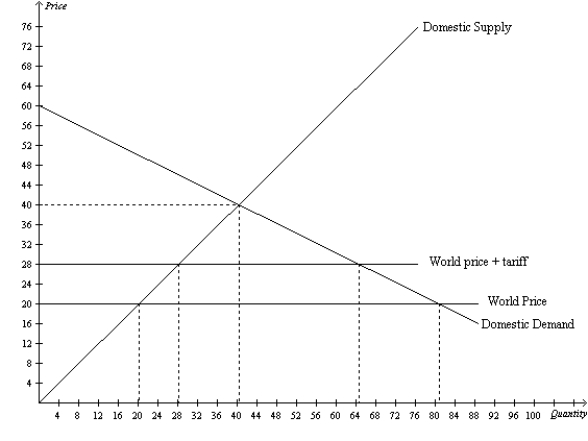 -Refer to Figure 9-17. Without trade, total surplus is
 (Multiple Choice)
4.8/5 (85)
(85) Figure 9-29
The following diagram shows the domestic demand and domestic supply curves in a market. Assume that the world price in this market is $1 per unit. 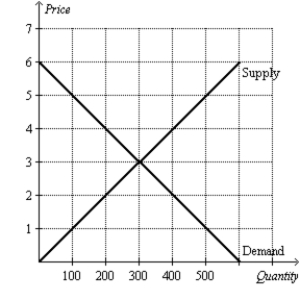 -Refer to Figure 9-29. Suppose the country imposes a $1 per unit tariff. If the country allows trade with a tariff, how much is total surplus?
 (Essay)
4.7/5 (77)
(77) Scenario 9-2
• For a small country called Boxland, the equation of the domestic demand curve for
cardboard is  ,
where
 represents the domestic quantity of cardboard demanded, in tons, and
 represents the price of a ton of cardboard.
• For Boxland, the equation of the domestic supply curve for cardboard is
 ,
where
 represents the domestic quantity of cardboard supplied, in tons, and
 again
represents the price of a ton of cardboard.
-Refer to Scenario 9-2. If Boxland prohibits international trade in cardboard, then the equilibrium price of a ton of cardboard is
,
where represents the domestic quantity of cardboard demanded, in tons, and represents the price of a ton of cardboard.
• For Boxland, the equation of the domestic supply curve for cardboard is ,
where represents the domestic quantity of cardboard supplied, in tons, and again
represents the price of a ton of cardboard.
-Refer to Scenario 9-2. If Boxland prohibits international trade in cardboard, then the equilibrium price of a ton of cardboard is (Multiple Choice)
4.8/5 (85)
(85) Free trade allows firms to realize economies of scale, resulting in higher costs of production.
(True/False)
4.9/5 (76)
(76) Import quotas and tariffs produce some common results. Which of the following is not one of those common results?
(Multiple Choice)
4.9/5 (64)
(64) If the demand curve and the supply curve for a good are straight lines, then the deadweight loss that results from a tariff is represented on the supply-and-demand graph by
(Multiple Choice)
4.9/5 (92)
(92) Figure 9-26
The diagram below illustrates the market for baseballs in the U.S. 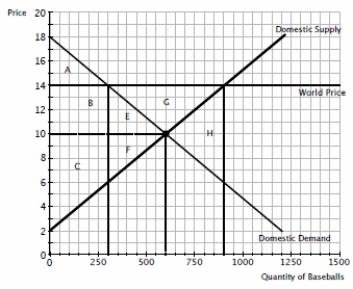 -Refer to figure 9-26. After the opening of the U.S. baseball market to international trade, it's possible to conclude that
 (Multiple Choice)
4.7/5 (81)
(81) The world price of a ton of steel is $650. Before Russia allowed trade in steel, the price of a ton of steel there was $1,000. Once Russia allowed trade in steel with other countries, Russia began
(Multiple Choice)
4.7/5 (75)
(75) 
Filters
- Essay(0)
- Multiple Choice(0)
- Short Answer(0)
- True False(0)
- Matching(0)