



 Chat with AI
Exam 9: Application: International Trade

Exam 1: Ten Principles of Economics455 Questions
Exam 2: Thinking Like an Economist645 Questions
Exam 3: Interdependence and the Gains From Trade550 Questions
Exam 4: The Market Forces of Supply and Demand693 Questions
Exam 5: Elasticity and Its Application625 Questions
Exam 6: Supply, Demand, and Government Policies671 Questions
Exam 7: Consumers, Producers, and the Efficiency of Markets547 Questions
Exam 8: Application: The Costs of Taxation507 Questions
Exam 9: Application: International Trade521 Questions
Exam 10: Externalities543 Questions
Exam 11: Public Goods and Common Resources453 Questions
Exam 12: The Design of the Tax System563 Questions
Exam 13: The Costs of Production649 Questions
Exam 14: Firms in Competitive Markets608 Questions
Exam 15: Monopoly662 Questions
Exam 16: Monopolistic Competition649 Questions
Exam 17: Oligopoly522 Questions
Exam 18: The Markets for the Factors of Production592 Questions
Exam 19: Earnings and Discrimination511 Questions
Exam 20: Income Inequality and Poverty478 Questions
Exam 21: The Theory of Consumer Choice568 Questions
Exam 22: Frontiers in Microeconomics461 Questions
Select questions type


The United States has imposed taxes on some imported goods that have been sold here by foreign countries at below their cost of production. These taxes
(Multiple Choice)
4.8/5  (75)
(75) Figure 9-1
The figure illustrates the market for coffee in Guatemala. 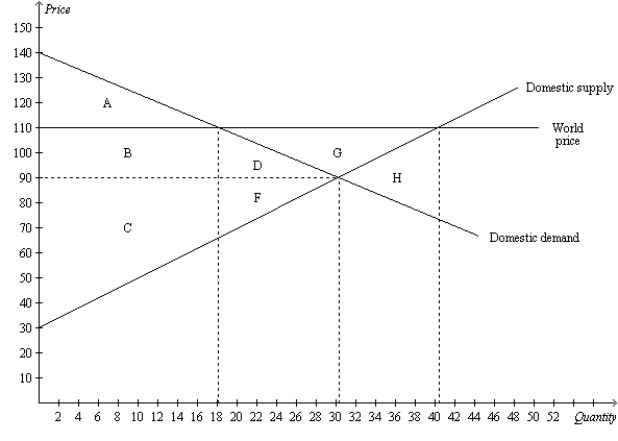 -Refer to Figure 9-1. When trade is allowed,
 (Multiple Choice)
5.0/5 (64)
(64) For any country, if the world price of copper is lower than the domestic price of copper without trade, that country should
(Multiple Choice)
4.8/5 (73)
(73) Which of the following is not a commonly-advanced argument for trade restrictions?
(Multiple Choice)
4.9/5 (79)
(79) Scenario 9-2
• For a small country called Boxland, the equation of the domestic demand curve for
cardboard is  ,
where
 represents the domestic quantity of cardboard demanded, in tons, and
 represents the price of a ton of cardboard.
• For Boxland, the equation of the domestic supply curve for cardboard is
 ,
where
 represents the domestic quantity of cardboard supplied, in tons, and
 again
represents the price of a ton of cardboard.
-Refer to Scenario 9-2. Suppose the world price of cardboard is $45. Then, if Boxland goes from prohibiting international trade in cardboard to allowing international trade in cardboard,
,
where represents the domestic quantity of cardboard demanded, in tons, and represents the price of a ton of cardboard.
• For Boxland, the equation of the domestic supply curve for cardboard is ,
where represents the domestic quantity of cardboard supplied, in tons, and again
represents the price of a ton of cardboard.
-Refer to Scenario 9-2. Suppose the world price of cardboard is $45. Then, if Boxland goes from prohibiting international trade in cardboard to allowing international trade in cardboard, (Multiple Choice)
4.9/5 (74)
(74) Figure 9-2
The figure illustrates the market for calculators in a country. 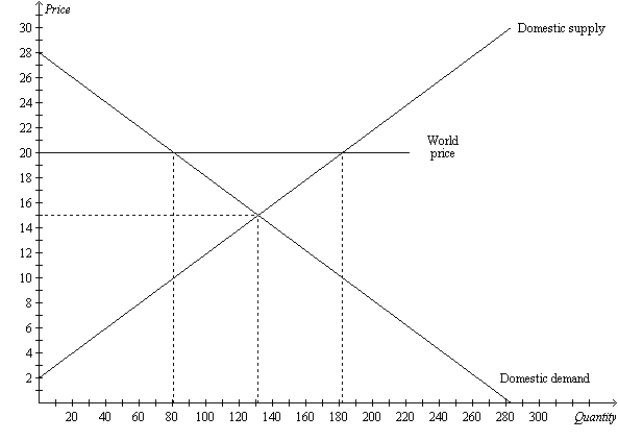 -Refer to Figure 9-2. With free trade, producer surplus is
 (Multiple Choice)
4.9/5 (67)
(67) Assume, for England, that the domestic price of wine without international trade is lower than the world price of wine. This suggests that, in the production of wine,
(Multiple Choice)
4.8/5 (81)
(81) Figure 9-13 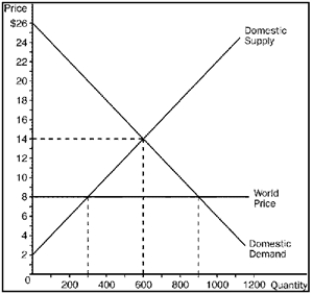 -Refer to Figure 9-13. With trade, the country
 (Multiple Choice)
5.0/5 (89)
(89) Figure 9-8. On the diagram below, Q represents the quantity of cars and P represents the price of cars. 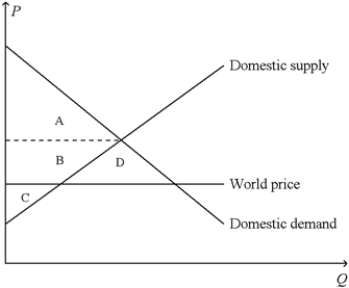 -Refer to Figure 9-8. The price corresponding to the horizontal dotted line on the graph represents the price of cars
 (Multiple Choice)
5.0/5 (76)
(76) Denmark is an importer of computer chips, taking the world price of $12 per chip as given. Suppose Denmark imposes a $5 tariff on chips. Which of the following outcomes is possible?
(Multiple Choice)
5.0/5 (74)
(74) Zelzar has decided to end its policy of not trading with the rest of the world. When it ends its trade restrictions, it discovers that it is importing incense, exporting steel, and neither importing nor exporting rugs. Which groups in Zelzar are better off as a result of the new free-trade policy?
(Multiple Choice)
4.8/5 (87)
(87) Figure 9-4. The domestic country is Nicaragua. 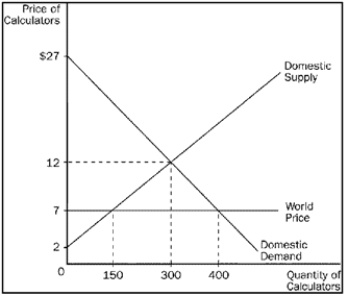 -Refer to Figure 9-4. With trade, Nicaragua
 (Multiple Choice)
5.0/5 (83)
(83) We can conclude that international trade is beneficial because, regardless of whether the country imports or exports a good, the overall increase in well-being outweighs the losses associated with trade.
(True/False)
4.8/5 (88)
(88) If a country allows free trade and its domestic price for a given good is lower than the world price, then it will import that good.
(True/False)
4.9/5 (64)
(64) Jamaica has a comparative advantage in the production of aluminum, but currently allows no international trade in aluminum. We can conclude that
(Multiple Choice)
4.9/5 (83)
(83) Figure 9-5
The figure illustrates the market for tricycles in a country. 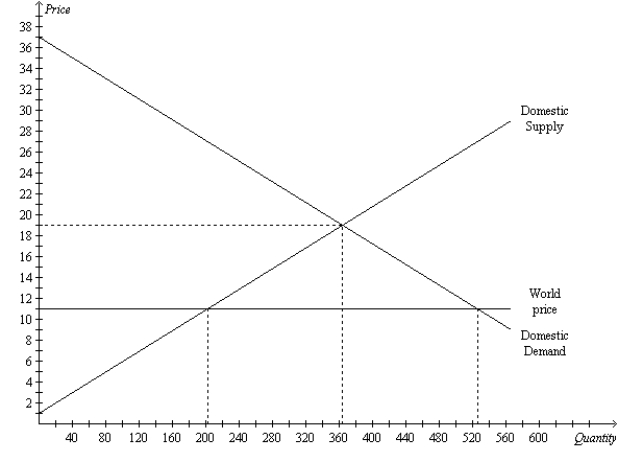 -Refer to Figure 9-5. The horizontal line at the world price of tricycles represents the
 (Multiple Choice)
4.8/5 (77)
(77) When, in our analysis of the gains and losses from international trade, we assume that a country is small, we are in effect assuming that the country
(Multiple Choice)
4.9/5 (72)
(72) When a country that imported a particular good abandons a free-trade policy and adopts a no-trade policy,
(Multiple Choice)
4.9/5 (80)
(80) Figure 9-5
The figure illustrates the market for tricycles in a country.
-Refer to Figure 9-5. Bearing in mind that this country is "small," what would happen if there were a decrease in the price of tricycle helmets within this country, given that tricycles and tricycle helmets are complements?
-Refer to Figure 9-5. Bearing in mind that this country is "small," what would happen if there were a decrease in the price of tricycle helmets within this country, given that tricycles and tricycle helmets are complements? (Multiple Choice)
4.8/5 (84)
(84) 
Filters
- Essay(0)
- Multiple Choice(0)
- Short Answer(0)
- True False(0)
- Matching(0)