



 Chat with AI
Exam 9: Application: International Trade

Exam 1: Ten Principles of Economics455 Questions
Exam 2: Thinking Like an Economist645 Questions
Exam 3: Interdependence and the Gains From Trade550 Questions
Exam 4: The Market Forces of Supply and Demand693 Questions
Exam 5: Elasticity and Its Application625 Questions
Exam 6: Supply, Demand, and Government Policies671 Questions
Exam 7: Consumers, Producers, and the Efficiency of Markets547 Questions
Exam 8: Application: The Costs of Taxation507 Questions
Exam 9: Application: International Trade521 Questions
Exam 10: Externalities543 Questions
Exam 11: Public Goods and Common Resources453 Questions
Exam 12: The Design of the Tax System563 Questions
Exam 13: The Costs of Production649 Questions
Exam 14: Firms in Competitive Markets608 Questions
Exam 15: Monopoly662 Questions
Exam 16: Monopolistic Competition649 Questions
Exam 17: Oligopoly522 Questions
Exam 18: The Markets for the Factors of Production592 Questions
Exam 19: Earnings and Discrimination511 Questions
Exam 20: Income Inequality and Poverty478 Questions
Exam 21: The Theory of Consumer Choice568 Questions
Exam 22: Frontiers in Microeconomics461 Questions
Select questions type


Figure 9-1
The figure illustrates the market for coffee in Guatemala. 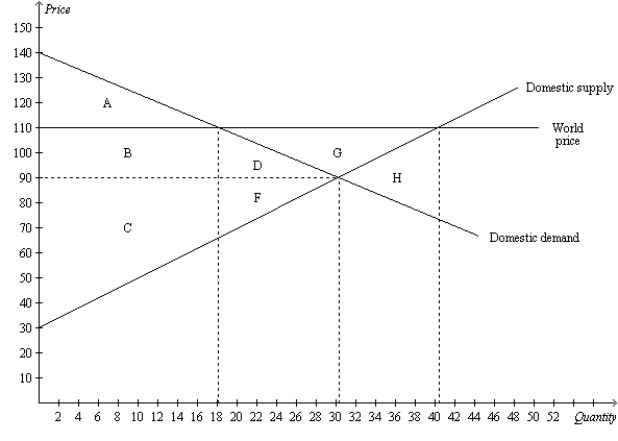 -Refer to Figure 9-1. From the figure it is apparent that
 (Multiple Choice)
4.9/5  (78)
(78) Scenario 9-3
Suppose domestic demand and domestic supply in a market are given by the following equations:  -Refer to Scenario 9-3. Suppose the world price in this market is $8 per unit. If the country allows free trade, will the country import or export this good, and how many units will be imported/exported?
 (Short Answer)
4.8/5 (79)
(79) William and Jamal live in the country of Dumexia. As a result of Dumexia's legalization of international trade in bananas, William becomes better off and Jamal becomes worse off. It follows that William is a seller, and Jamal is a buyer, of bananas.
(True/False)
4.7/5 (83)
(83) "Owners of firms in young industries should be willing to incur temporary losses if they believe that those firms will be profitable in the long run." This observation helps to explain why many economists are skeptical about the
(Multiple Choice)
5.0/5 (70)
(70) When a country that imports a particular good imposes a tariff on that good,
(Multiple Choice)
4.8/5 (66)
(66) Figure 9-11 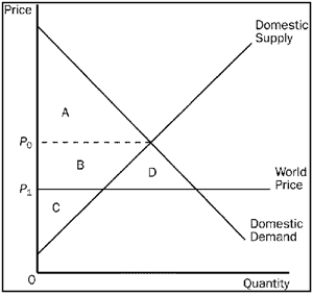 -Refer to Figure 9-11. Producer surplus in this market before trade is
 (Multiple Choice)
4.9/5 (91)
(91) Figure 9-7. The figure applies to the nation of Wales and the good is cheese. 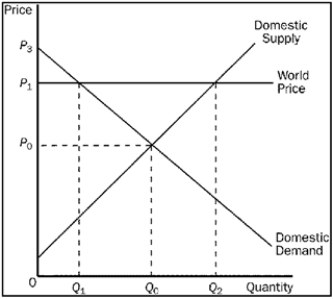 -Refer to Figure 9-7. With trade, the Welsh price of cheese and the Welsh quantity of cheese demanded are
 (Multiple Choice)
4.8/5 (76)
(76) If the world price of apples is higher than Argentina's domestic price of apples without trade, then Argentina
(Multiple Choice)
4.8/5 (72)
(72) Suppose Iran imposes a tariff on lumber. For the tariff to have any effect, it must be the case that
(Multiple Choice)
4.8/5 (79)
(79) Figure 9-5
The figure illustrates the market for tricycles in a country. 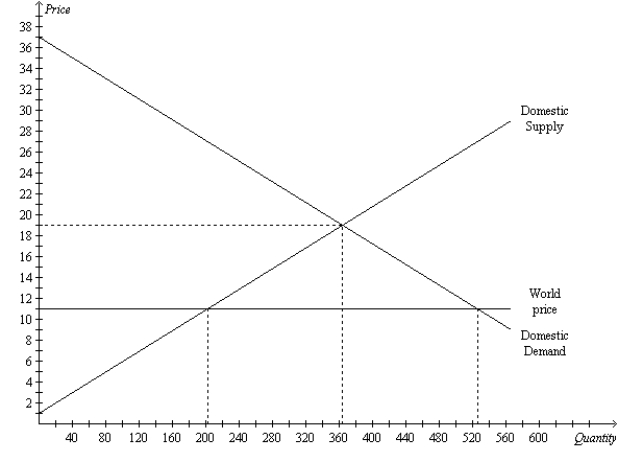 -Refer to Figure 9-5. Without trade, total surplus amounts to
 (Multiple Choice)
4.8/5 (82)
(82) For any country, if the world price of copper is higher than the domestic price of copper without trade, that country should
(Multiple Choice)
4.9/5 (79)
(79) When a country allows trade and becomes an exporter of a good,
(Multiple Choice)
4.8/5 (80)
(80) Figure 9-13 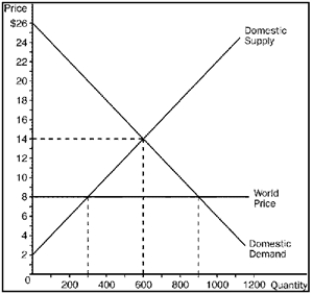 -Refer to Figure 9-13. Producer surplus before trade is
 (Multiple Choice)
4.8/5 (65)
(65) Figure 9-15 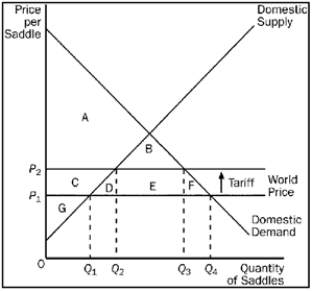 -Refer to Figure 9-15. For the saddle market, area E represents
 (Multiple Choice)
4.8/5 (85)
(85) In analyzing international trade, we often focus on a country whose economy is small relative to the rest of the world. We do so
(Multiple Choice)
4.7/5 (88)
(88) Figure 9-18. On the diagram below, Q represents the quantity of peaches and P represents the price of peaches. The domestic country is Isoland. 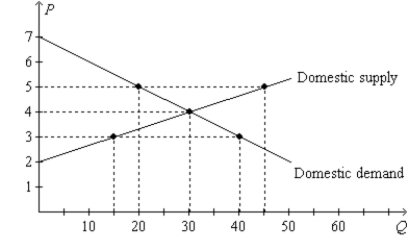 -Refer to Figure 9-18. Suppose Isoland changes from a no-trade policy to a policy that allows international trade. If the world price of peaches is $3, then the policy change results in a
 (Multiple Choice)
5.0/5 (98)
(98) When a country allows trade and becomes an exporter of a good,
(Multiple Choice)
4.8/5 (73)
(73) Suppose Iceland goes from being an isolated country to being an importer of coats. As a result,
(Multiple Choice)
4.9/5 (77)
(77) The results of a 2008 Los Angeles Times poll suggest that a significant majority of Americans believe that free international trade helps the American economy.
(True/False)
4.7/5 (82)
(82) 
Filters
- Essay(0)
- Multiple Choice(0)
- Short Answer(0)
- True False(0)
- Matching(0)