



 Chat with AI
Exam 9: Application: International Trade

Exam 1: Ten Principles of Economics455 Questions
Exam 2: Thinking Like an Economist645 Questions
Exam 3: Interdependence and the Gains From Trade550 Questions
Exam 4: The Market Forces of Supply and Demand693 Questions
Exam 5: Elasticity and Its Application625 Questions
Exam 6: Supply, Demand, and Government Policies671 Questions
Exam 7: Consumers, Producers, and the Efficiency of Markets547 Questions
Exam 8: Application: The Costs of Taxation507 Questions
Exam 9: Application: International Trade521 Questions
Exam 10: Externalities543 Questions
Exam 11: Public Goods and Common Resources453 Questions
Exam 12: The Design of the Tax System563 Questions
Exam 13: The Costs of Production649 Questions
Exam 14: Firms in Competitive Markets608 Questions
Exam 15: Monopoly662 Questions
Exam 16: Monopolistic Competition649 Questions
Exam 17: Oligopoly522 Questions
Exam 18: The Markets for the Factors of Production592 Questions
Exam 19: Earnings and Discrimination511 Questions
Exam 20: Income Inequality and Poverty478 Questions
Exam 21: The Theory of Consumer Choice568 Questions
Exam 22: Frontiers in Microeconomics461 Questions
Select questions type


Figure 9-16. The figure below illustrates a tariff. On the graph, Q represents quantity and P represents price. 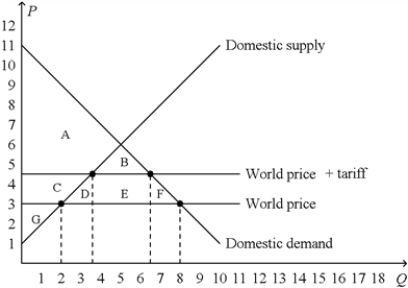 -Refer to Figure 9-16. The tariff
 (Multiple Choice)
4.8/5  (86)
(86) The nation of Isolani forbids international trade. In Isolani, you can exchange 1 car for 5 motorcycles. In other countries, you can exchange 1 car for 4 motorcycles. These facts indicate that
(Multiple Choice)
4.9/5 (78)
(78) Figure 9-2
The figure illustrates the market for calculators in a country. 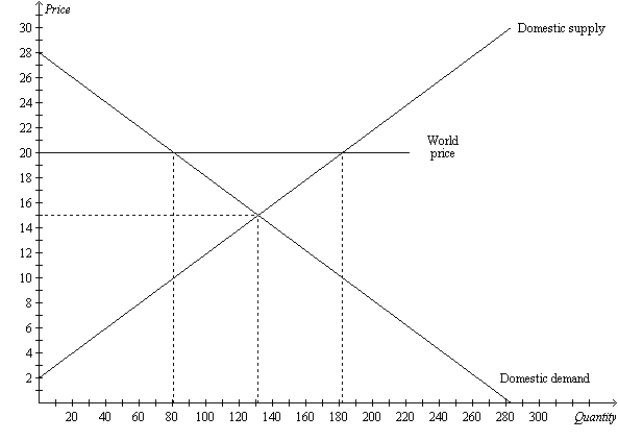 -Refer to Figure 9-2. With free trade, consumer surplus is
 (Multiple Choice)
4.9/5 (64)
(64) Figure 9-15 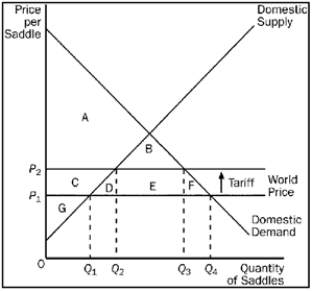 -Refer to Figure 9-15. With the tariff, the price paid and quantity demanded by domestic buyers are
 (Multiple Choice)
4.9/5 (75)
(75) Figure 9-21
The following diagram shows the domestic demand and domestic supply for a market. In addition, assume that the world price in this market is $40 per unit. 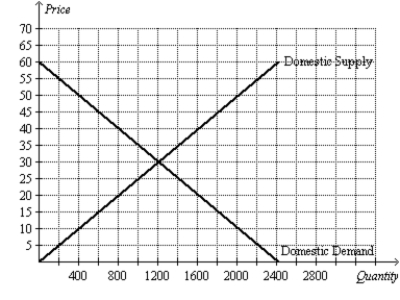 -Refer to Figure 9-21. With free trade, domestic production and domestic consumption, respectively, are
 (Multiple Choice)
4.9/5 (84)
(84) A multilateral approach to free trade has greater potential to increase the gains from trade than a unilateral approach, because the multilateral approach can reduce trade restrictions abroad as well as at home.
(True/False)
4.9/5 (75)
(75) Assume, for Vietnam, that the domestic price of textiles without international trade is higher than the world price of textiles. This suggests that, in the production of textiles,
(Multiple Choice)
4.8/5 (82)
(82) After a certain nation changed its policy from one that banned international trade in wheat to one that allowed international trade in wheat, the nation began importing wheat. As a result, total surplus in the wheat market increased by $10 million. Which of the following changes could have occurred as well?
(Multiple Choice)
4.8/5 (75)
(75) Suppose in the country of Jumanji that the price of coffee with no trade allowed is below the world price of coffee. If Jumanji allows free trade, will Jumanji be an importer or an exporter of coffee?
(Short Answer)
4.7/5 (82)
(82) Figure 9-26
The following diagram shows the domestic demand and domestic supply curves in a market. 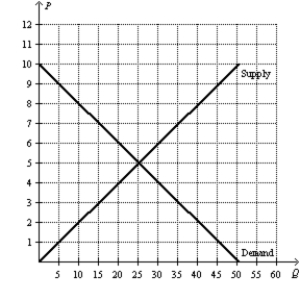 -Refer to Figure 9-26. Suppose the world price in this market is $7. If the country allows free trade, how many units will domestic consumers demand, and how many units will domestic producers produce?
 (Essay)
4.9/5 (75)
(75) When a country abandons a no-trade policy, adopts a free-trade policy, and becomes an importer of a particular good,
(Multiple Choice)
4.8/5 (92)
(92) Suppose the Ivory Coast, a small country, imports wheat at the world price of $4 per bushel. If the Ivory Coast imposes a tariff of $1 per bushel on imported wheat, then, other things equal, the price of wheat in Ivory Coast will increase, but by less than $1.
(True/False)
4.9/5 (75)
(75) Figure 9-3. The domestic country is China. 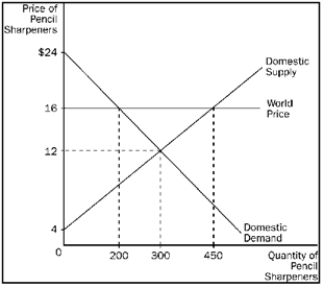 -Refer to Figure 9-3. With trade, producer surplus in China is
 (Multiple Choice)
4.7/5 (77)
(77) Scenario 9-3
Suppose domestic demand and domestic supply in a market are given by the following equations:  -Refer to Scenario 9-3. Suppose the world price in this market is $8 per unit. If the country allows free trade, by how much do consumer surplus, producer surplus, and producer surplus change?
 (Essay)
4.8/5 (82)
(82) If Belgium exports chocolate to the rest of the world, then Belgian chocolate producers benefit from higher producer surplus, Belgian chocolate consumers are worse off because of lower consumer surplus, and total surplus in Belgium increases because of the exports of chocolate.
(True/False)
4.8/5 (82)
(82) In a December 2007 New York Times column Paul Krugman argued in favor of
(Multiple Choice)
4.9/5 (96)
(96) Relative to a situation in which domestic firms do not compete with foreign firms, firms in countries that engage in free trade
(Multiple Choice)
4.8/5 (83)
(83) Figure 9-14. On the diagram below, Q represents the quantity of crude oil and P represents the price of crude oil. 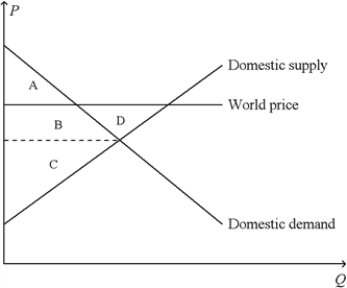 -Refer to Figure 9-14. When the country for which the figure is drawn allows international trade in crude oil,
 (Multiple Choice)
4.9/5 (71)
(71) When a country that exported a particular good abandons a free-trade policy and adopts a no-trade policy,
(Multiple Choice)
4.9/5 (87)
(87) 
Filters
- Essay(0)
- Multiple Choice(0)
- Short Answer(0)
- True False(0)
- Matching(0)