



 Chat with AI
Exam 9: Application: International Trade

Exam 1: Ten Principles of Economics455 Questions
Exam 2: Thinking Like an Economist645 Questions
Exam 3: Interdependence and the Gains From Trade550 Questions
Exam 4: The Market Forces of Supply and Demand693 Questions
Exam 5: Elasticity and Its Application625 Questions
Exam 6: Supply, Demand, and Government Policies671 Questions
Exam 7: Consumers, Producers, and the Efficiency of Markets547 Questions
Exam 8: Application: The Costs of Taxation507 Questions
Exam 9: Application: International Trade521 Questions
Exam 10: Externalities543 Questions
Exam 11: Public Goods and Common Resources453 Questions
Exam 12: The Design of the Tax System563 Questions
Exam 13: The Costs of Production649 Questions
Exam 14: Firms in Competitive Markets608 Questions
Exam 15: Monopoly662 Questions
Exam 16: Monopolistic Competition649 Questions
Exam 17: Oligopoly522 Questions
Exam 18: The Markets for the Factors of Production592 Questions
Exam 19: Earnings and Discrimination511 Questions
Exam 20: Income Inequality and Poverty478 Questions
Exam 21: The Theory of Consumer Choice568 Questions
Exam 22: Frontiers in Microeconomics461 Questions
Select questions type


With which of the Ten Principles of Economics is the study of international trade most closely connected?
(Multiple Choice)
4.7/5  (85)
(85) Figure 9-11 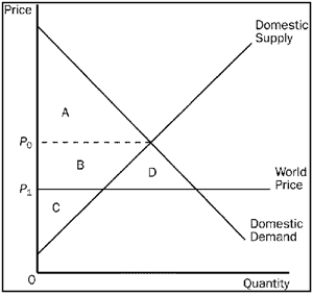 -Refer to Figure 9-11. Producer surplus plus consumer surplus in this market before trade is
 (Multiple Choice)
4.8/5 (75)
(75) Scenario 9-2
• For a small country called Boxland, the equation of the domestic demand curve for
cardboard is  ,
where
 represents the domestic quantity of cardboard demanded, in tons, and
 represents the price of a ton of cardboard.
• For Boxland, the equation of the domestic supply curve for cardboard is
 ,
where
 represents the domestic quantity of cardboard supplied, in tons, and
 again
represents the price of a ton of cardboard.
-Refer to Scenario 9-2. Suppose the world price of cardboard is $45. Then Boxland's gains from international trade in cardboard amount to
,
where represents the domestic quantity of cardboard demanded, in tons, and represents the price of a ton of cardboard.
• For Boxland, the equation of the domestic supply curve for cardboard is ,
where represents the domestic quantity of cardboard supplied, in tons, and again
represents the price of a ton of cardboard.
-Refer to Scenario 9-2. Suppose the world price of cardboard is $45. Then Boxland's gains from international trade in cardboard amount to (Multiple Choice)
4.8/5 (80)
(80) Use the graph to answer the following questions about CDs. 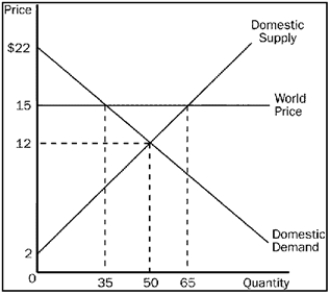 a.What is the equilibrium price of CDs before trade?
b.What is the equilibrium quantity of CDs before trade?
c.What is the price of CDs after trade is allowed?
d.What is the quantity of CDs exported after trade is allowed?
e.What is the amount of consumer surplus before trade?
f. What is the amount of consumer surplus after trade?
g. What is the amount of producer surplus before trade?
h. What is the amount of producer surplus after trade?
i. What is the amount of total surplus before trade?
j. What is the amount of total surplus after trade?
k. What is the change in total surplus because of trade?
a.What is the equilibrium price of CDs before trade?
b.What is the equilibrium quantity of CDs before trade?
c.What is the price of CDs after trade is allowed?
d.What is the quantity of CDs exported after trade is allowed?
e.What is the amount of consumer surplus before trade?
f. What is the amount of consumer surplus after trade?
g. What is the amount of producer surplus before trade?
h. What is the amount of producer surplus after trade?
i. What is the amount of total surplus before trade?
j. What is the amount of total surplus after trade?
k. What is the change in total surplus because of trade? (Essay)
4.8/5 (87)
(87) Without free trade, the domestic price of a good must be equal to the world price of a good.
(True/False)
4.8/5 (84)
(84) If the Korean steel industry subsidizes the steel that it sells to the United States, the
(Multiple Choice)
5.0/5 (70)
(70) Suppose Japan exports televisions to the United States and imports sugar from Argentina. This situation suggests
(Multiple Choice)
4.7/5 (78)
(78) Figure 9-24
The following diagram shows the domestic demand and supply in a market. Assume that the world price in this market is $20 per unit. 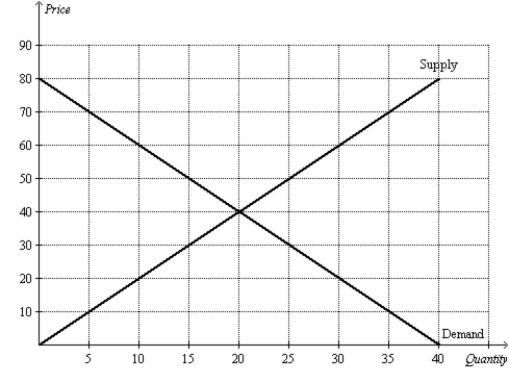 -Refer to Figure 9-24. Suppose the government imposes a tariff of $10 per unit. With trade and a tariff, consumer surplus is
 (Multiple Choice)
4.7/5 (83)
(83) The small country assumption is made in developing models of international trade because it applies to US markets.
(True/False)
4.9/5 (68)
(68) Using the graph below, answer the following questions about hammers. 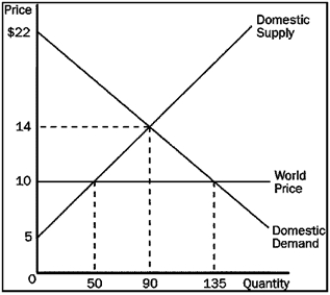 a.What is the equilibrium price of hammers before trade?
b.What is the equilibrium quantity of hammers before trade?
c.What is the price of hammers after trade is allowed?
d.What is the quantity of hammers imported after trade is allowed?
e.What is the amount of consumer surplus before trade?
f. What is the amount of consumer surplus after trade?
g. What is the amount of producer surplus before trade?
h. What is the amount of producer surplus after trade?
i. What is the amount of total surplus before trade?
j. What is the amount of total surplus after trade?
k. What is the change in total surplus because of trade?
a.What is the equilibrium price of hammers before trade?
b.What is the equilibrium quantity of hammers before trade?
c.What is the price of hammers after trade is allowed?
d.What is the quantity of hammers imported after trade is allowed?
e.What is the amount of consumer surplus before trade?
f. What is the amount of consumer surplus after trade?
g. What is the amount of producer surplus before trade?
h. What is the amount of producer surplus after trade?
i. What is the amount of total surplus before trade?
j. What is the amount of total surplus after trade?
k. What is the change in total surplus because of trade? (Essay)
4.9/5 (65)
(65) Figure 9-9 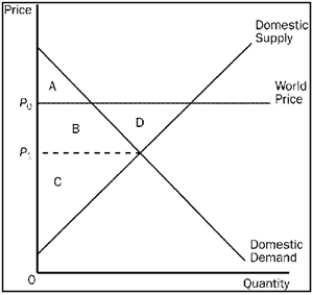 -Refer to Figure 9-9. Total surplus in this market before trade is
 (Multiple Choice)
4.8/5 (89)
(89) Scenario 9-1
The before-trade domestic price of peaches in the United States is $40 per bushel. The world price of peaches is $52 per bushel. The U.S. is a price-taker in the market for peaches.
-Refer to Scenario 9-1. If trade in peaches is allowed, the price of peaches in the United States
(Multiple Choice)
4.9/5 (77)
(77) Figure 9-2
The figure illustrates the market for calculators in a country. 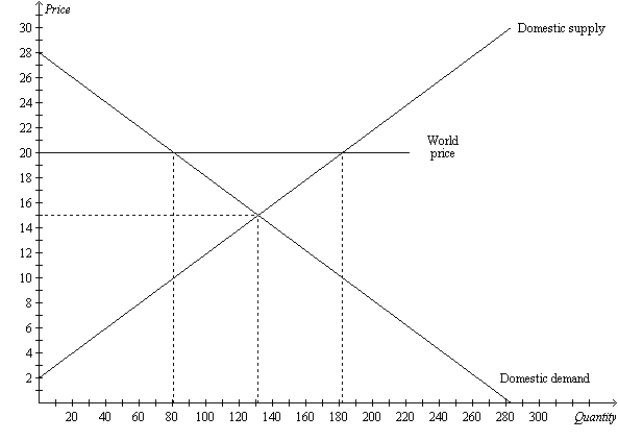 -Refer to Figure 9-2. The world price for calculators represents
 (Multiple Choice)
4.8/5 (87)
(87) Patterns of trade among nations are primarily determined by
(Multiple Choice)
4.9/5 (92)
(92) Scenario 9-2
• For a small country called Boxland, the equation of the domestic demand curve for
cardboard is ,
where represents the domestic quantity of cardboard demanded, in tons, and represents the price of a ton of cardboard.
• For Boxland, the equation of the domestic supply curve for cardboard is ,
where represents the domestic quantity of cardboard supplied, in tons, and again
represents the price of a ton of cardboard.
-Refer to Scenario 9-2. Suppose the world price of cardboard is $60 and international trade is allowed. Then Boxland's consumers demand
,
where represents the domestic quantity of cardboard demanded, in tons, and represents the price of a ton of cardboard.
• For Boxland, the equation of the domestic supply curve for cardboard is ,
where represents the domestic quantity of cardboard supplied, in tons, and again
represents the price of a ton of cardboard.
-Refer to Scenario 9-2. Suppose the world price of cardboard is $60 and international trade is allowed. Then Boxland's consumers demand (Multiple Choice)
4.9/5 (84)
(84) When a country allows trade and becomes an exporter of a good,
(Multiple Choice)
4.9/5 (79)
(79) Figure 9-14. On the diagram below, Q represents the quantity of crude oil and P represents the price of crude oil. 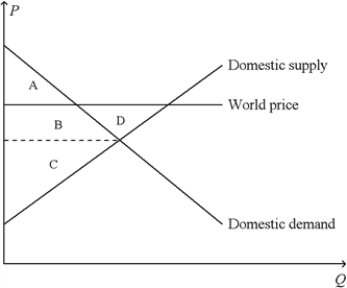 -Refer to Figure 9-14. A result of this country allowing international trade in crude oil is as follows:
 (Multiple Choice)
4.8/5 (88)
(88) 
Filters
- Essay(0)
- Multiple Choice(0)
- Short Answer(0)
- True False(0)
- Matching(0)