



 Chat with AI
Exam 18: International Macroeconomics

Exam 1: First Principles183 Questions
Exam 2: Economic Models: Trade-Offs and Trade341 Questions
Exam 3: Supply and Demand230 Questions
Exam 4: Price Controls and Quotas: Meddling With Markets187 Questions
Exam 5: International Trade224 Questions
Exam 6: Macroeconomics: the Big Picture128 Questions
Exam 7: GDP and the CPI: Tracking the Macroeconomy213 Questions
Exam 8: Unemployment and Inflation300 Questions
Exam 9: Long-Run Economic Growth268 Questions
Exam 10: Savings, Investment Spending, and the Financial Syst355 Questions
Exam 11: Income and Expenditure114 Questions
Exam 12: Aggregate Demand and Aggregate Supply308 Questions
Exam 13: Fiscal Policy120 Questions
Exam 14: Money, Banking, and the Federal Reserve System135 Questions
Exam 15: Monetary Policy316 Questions
Exam 16: Inflation, Disinflation, and Deflation194 Questions
Exam 17: Macroeconomics: Events and Ideas283 Questions
Exam 18: International Macroeconomics411 Questions
Select questions type


The difference between a country's exports and its imports of goods and services is known as the:
(Multiple Choice)
4.7/5  (81)
(81) All countries must have either a fixed or floating exchange rate, since there are no possible compromises between the two policies.
(True/False)
4.8/5 (78)
(78) Use the following to answer questions: 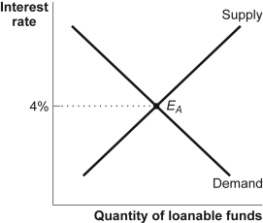 -(Figure: The Loanable Funds Model in the U.S. Market) Refer to Figure: The Loanable Funds Model in the U.S. Market. If the actual interest rate is higher than 4% in the U.S. market, then the quantity supplied of loanable funds will be _____ the quantity of loanable funds demanded.
 (Multiple Choice)
5.0/5 (80)
(80) The United States exports corn to other nations. In the U.S. balance of payments account, this transaction is entered as a payment _____ foreigners in the _____ account.
(Multiple Choice)
4.9/5 (84)
(84) Use the following to answer questions: 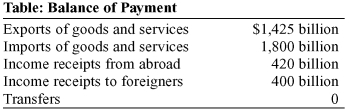 -(Table: Balance of Payments) Refer to Table: Balance of Payments. The country's balance of payments on financial account is:
 (Multiple Choice)
4.9/5 (77)
(77) Governments can use foreign exchange controls to help them fix the value of their currency.
(True/False)
4.8/5 (88)
(88) All other things equal, an expansionary monetary policy in Britain will decrease British interest rates and increase the demand for and decrease the supply of the pound sterling.
(True/False)
4.9/5 (91)
(91) Scenario: Gizmovia The Republic of Gizmovia wants to maintain the exchange rate of its currency, the gizmo, at $0.50, but the current exchange rate for the gizmo is $0.40. If Gizmovia uses foreign exchange controls, it should require licenses to _____ gizmos and _____ dollars.
(Multiple Choice)
4.9/5 (72)
(72) Use the following to answer questions:  -(Figure: Change in the Demand for U.S. Dollars) Refer to Figure: Change in the Demand for U.S. Dollars. A movement from E2 to E1 in this foreign exchange market would cause Americans to purchase _____ goods and services from Europe.
 (Multiple Choice)
4.8/5 (85)
(85) A country has a floating exchange rate if the government lets the exchange rate go wherever the market may take it.
(True/False)
4.8/5 (83)
(83) Scenario: Exchange Rates The value of a euro goes from US$1.25 to US$1.50. The euro has:
(Multiple Choice)
4.8/5 (71)
(71) Which group would demand dollars in the foreign exchange market? I. Americans who want to buy U.S. goods, services, and assets
II) Americans who want to buy European goods, services, and assets
III) Europeans who want to buy U.S. goods, services, and assets
(Multiple Choice)
4.7/5 (90)
(90) If the government wants to increase the value of its currency in foreign exchange markets, it can limit the ability of foreigners to buy its currency.
(True/False)
4.8/5 (83)
(83) A recession in the United States could begin with our trading partners.
(True/False)
4.9/5 (95)
(95) The behavior of the financial accounts is determined in the international _____ market.
(Multiple Choice)
4.8/5 (81)
(81) An increase in the value of a floating currency is called an appreciation.
(True/False)
4.8/5 (80)
(80) Scenario: Purchasing Power Parity A car costs $30,000 in the United States and the exchange rate is $1 = £0.50. The same car costs £12,000 in Britain. What is the purchasing power parity of the pound?
(Multiple Choice)
4.8/5 (97)
(97) 
Filters
- Essay(0)
- Multiple Choice(0)
- Short Answer(0)
- True False(0)
- Matching(0)