



 Chat with AI
Exam 18: International Macroeconomics

Exam 1: First Principles183 Questions
Exam 2: Economic Models: Trade-Offs and Trade341 Questions
Exam 3: Supply and Demand230 Questions
Exam 4: Price Controls and Quotas: Meddling With Markets187 Questions
Exam 5: International Trade224 Questions
Exam 6: Macroeconomics: the Big Picture128 Questions
Exam 7: GDP and the CPI: Tracking the Macroeconomy213 Questions
Exam 8: Unemployment and Inflation300 Questions
Exam 9: Long-Run Economic Growth268 Questions
Exam 10: Savings, Investment Spending, and the Financial Syst355 Questions
Exam 11: Income and Expenditure114 Questions
Exam 12: Aggregate Demand and Aggregate Supply308 Questions
Exam 13: Fiscal Policy120 Questions
Exam 14: Money, Banking, and the Federal Reserve System135 Questions
Exam 15: Monetary Policy316 Questions
Exam 16: Inflation, Disinflation, and Deflation194 Questions
Exam 17: Macroeconomics: Events and Ideas283 Questions
Exam 18: International Macroeconomics411 Questions
Select questions type


Use the following to answer questions: 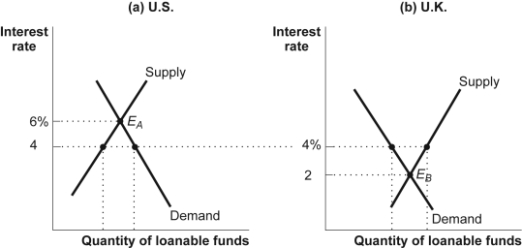 -(Figure: International Capital Flows) Refer to Figure: International Capital Flows. At an interest rate of 4%, the total quantity of loanable funds demanded across the two markets is _____ the total quantity of loanable funds supplied by lenders.
 (Multiple Choice)
4.8/5  (88)
(88) If the exchange rate is ¥200 per U.S. dollar, the U.S. price level is 120, and the Japanese price level is 600, then the real exchange rate is:
(Multiple Choice)
4.8/5 (76)
(76) If the nominal exchange rate and the price level fall, then the real exchange rate will fall as well.
(True/False)
4.9/5 (84)
(84) If the United States is in a recessionary gap, the appropriate policy is to _____ the money supply to _____ interest rates.
(Multiple Choice)
4.8/5 (91)
(91) If the government wants to increase the value of its currency in foreign exchange markets, it can sell its domestic currency in the foreign exchange market.
(True/False)
4.8/5 (86)
(86) If the government wants to decrease the value of its currency in foreign exchange markets, it can use expansionary monetary policy.
(True/False)
4.9/5 (88)
(88) When a currency becomes more valuable in terms of other currencies, it depreciates.
(True/False)
4.9/5 (95)
(95) Use the following to answer questions: 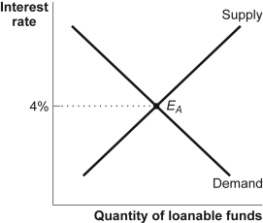 -(Figure: The Loanable Funds Model in the U.S. Market) Refer to Figure: The Loanable Funds Model in the U.S. Market. If the actual interest rate is less than 4% in the U.S. market, then the quantity supplied of loanable funds will be _____ the quantity of loanable funds demanded.
 (Multiple Choice)
4.9/5 (70)
(70) One limitation of maintaining a fixed exchange rate system is that:
(Multiple Choice)
4.8/5 (87)
(87) After a devaluation, all other things equal, exports will likely _____ and imports will likely _____.
(Multiple Choice)
4.8/5 (69)
(69) When interest rates are higher in country A than in other countries:
(Multiple Choice)
4.9/5 (73)
(73) Use the following to answer questions:
-(Figure: The Loanable Funds Model in the U.S. Market) Refer to Figure: The Loanable Funds Model in the U.S. Market. Assume that each country's equilibrium interest rate is 4%. To reconcile the apparent disequilibrium in both markets, assuming that assets and liabilities are viewed as homogeneous, capital _____ will _____ interest rates.
-(Figure: The Loanable Funds Model in the U.S. Market) Refer to Figure: The Loanable Funds Model in the U.S. Market. Assume that each country's equilibrium interest rate is 4%. To reconcile the apparent disequilibrium in both markets, assuming that assets and liabilities are viewed as homogeneous, capital _____ will _____ interest rates. (Multiple Choice)
4.8/5 (78)
(78) The primary economic disadvantage of adopting the euro for Britain is:
(Multiple Choice)
4.9/5 (69)
(69) If a fixed currency is below its target exchange rate, the government will sell its own currency in foreign exchange markets.
(True/False)
4.8/5 (77)
(77) Economists summarize a country's transactions with other countries with a(n) _____ account.
(Multiple Choice)
4.9/5 (71)
(71) When a currency depreciates, the prices of its imports from other countries will:
(Multiple Choice)
4.8/5 (86)
(86) The Venezuelan bolivar trades at a fixed exchange rate. If Venezuela uses monetary policy to change the exchange rate of the bolivar from $0.16 to $0.20, the bolivar has:
(Multiple Choice)
4.7/5 (88)
(88) 
Filters
- Essay(0)
- Multiple Choice(0)
- Short Answer(0)
- True False(0)
- Matching(0)