



 Chat with AI
Exam 18: International Macroeconomics

Exam 1: First Principles183 Questions
Exam 2: Economic Models: Trade-Offs and Trade341 Questions
Exam 3: Supply and Demand230 Questions
Exam 4: Price Controls and Quotas: Meddling With Markets187 Questions
Exam 5: International Trade224 Questions
Exam 6: Macroeconomics: the Big Picture128 Questions
Exam 7: GDP and the CPI: Tracking the Macroeconomy213 Questions
Exam 8: Unemployment and Inflation300 Questions
Exam 9: Long-Run Economic Growth268 Questions
Exam 10: Savings, Investment Spending, and the Financial Syst355 Questions
Exam 11: Income and Expenditure114 Questions
Exam 12: Aggregate Demand and Aggregate Supply308 Questions
Exam 13: Fiscal Policy120 Questions
Exam 14: Money, Banking, and the Federal Reserve System135 Questions
Exam 15: Monetary Policy316 Questions
Exam 16: Inflation, Disinflation, and Deflation194 Questions
Exam 17: Macroeconomics: Events and Ideas283 Questions
Exam 18: International Macroeconomics411 Questions
Select questions type


If a government fixes the exchange rate below the market equilibrium rate, there will be a surplus of its currency.
(True/False)
4.9/5  (84)
(84) As a result of expansionary monetary policy, lower U.S. interest rates will result in a(n) _____ in the demand for dollars and a(n) _____ in the supply of dollars.
(Multiple Choice)
4.8/5 (85)
(85) Foreign exchange controls, unlike tariffs and quotas, do not distort incentives for trade between countries.
(True/False)
4.7/5 (95)
(95) When the United States gives foreign aid to developing nations in Africa, the _____ account is affected.
(Multiple Choice)
4.9/5 (75)
(75) A reduction in the interest rate has _____ impact on aggregate demand with _____ exchange rates than with _____ exchange rates.
(Multiple Choice)
4.7/5 (91)
(91) A country has a capital account deficit if the balance on the:
(Multiple Choice)
4.9/5 (69)
(69) The difference between a fixed and a floating exchange rate regime is that with a _____ rate system, the _____, whereas with a _____ rate system it does not.
(Multiple Choice)
4.9/5 (81)
(81) Scenario: Purchasing Power Parity A car costs $30,000 in the United States and the exchange rate is $1 = £0.50. The same car costs £12,000 in Britain. To have purchasing power parity, the pound must:
(Multiple Choice)
4.8/5 (76)
(76) Use the following to answer questions: 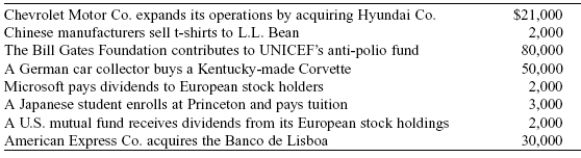 -(Table: International Transactions) Refer to Table: International Transactions. The balance on current account is:
 (Multiple Choice)
4.9/5 (76)
(76) Which method can be used to maintain a fixed exchange rate? I. exchange market intervention
II) monetary policy
III) foreign exchange controls
(Multiple Choice)
5.0/5 (79)
(79) An argument in favor of Britain's adopting the euro was that using the same currency as many other European countries would expand trade and increase productivity.
(True/False)
4.8/5 (86)
(86) A fixed rate system eliminates uncertainty about the future value of a currency.
(True/False)
4.7/5 (75)
(75) If the exchange rate is $1.50 per euro, the U.S. price level is 180, and the eurozone price level is 120, then the real exchange rate per euro is:
(Multiple Choice)
4.8/5 (83)
(83) Which of the following would be included in the U.S. current account?
(Multiple Choice)
4.7/5 (81)
(81) Which statement regarding exchange rate intervention is FALSE?
(Multiple Choice)
4.9/5 (71)
(71) A fixed exchange rate means that supply and demand of the currency determine its exchange rate.
(True/False)
4.9/5 (86)
(86) Scenario: Japan and the United States Suppose that the interest rate in the United States is 4%, in Japan it is 7%, and financial assets in the two countries are equal in risk. As a result:
(Multiple Choice)
4.8/5 (86)
(86) Britain, Sweden, and Switzerland chose not to adopt the euro in 1999.
(True/False)
4.9/5 (68)
(68) Real exchange rates are those that are recognized by the International Monetary Fund.
(True/False)
4.7/5 (80)
(80) 
Filters
- Essay(0)
- Multiple Choice(0)
- Short Answer(0)
- True False(0)
- Matching(0)